
Mastering Innovation Essentials
Accelerating Growth and Performance
Through Enterprise Agility, Innovation, and Technology
How can visual summaries improve innovation?
Innovation happens in bursts. When an idea sparks your imagination, you have to act fast to see whether it will succeed. Visual summaries help you do just that: They let you capture ideas visually without having to write them down first. You don’t have to worry about losing important details because you’re not writing anything down yet. And once you decide to pursue an idea further, you can easily share it with others.
Visual summaries also help you think creatively. If you want to come up with new ways to solve problems, brainstorming alone won’t cut it. You need to get creative while thinking through solutions. Mastering innovation essentials is even more important now than before and it is the key to unlock future growth.
How do visual summaries affect creativity?
It has been shown that the human mind processes visual stimuli quicker than verbal stimuli. It takes longer to read or hear what we already know. Therefore, by presenting our thoughts visually, we allow ourselves to be open-minded enough to consider new perspectives.
Why should I learn how to make visual summaries?
You probably already know this but here goes anyway: The best way to remember things is to visualize them. By making visualizations, you increase the chances of remembering those things later. Moreover, visualization techniques can enhance learning. If you’ve ever tried drawing a diagram or map, then you understand the power of visualization.
When people create visual summaries, they often find themselves coming up with more original ideas. This may seem counterintuitive since creating visuals requires time and effort. However, studies show that the brain is better able to process pictures than words.
As a result, using visuals helps people generate novel insights. For instance, researchers found that students were much more likely to suggest improvements after viewing a picture rather than reading a description of their peers’ suggestions. In addition, participants generated more unique ideas when asked to draw something instead of typing responses into a computer program. You need to get creative while thinking through solutions.
So many methodology and tools – what do they all mean?
Lean Startup methodology focuses on building minimum viable products, often starting with a single customer segment. This allows teams to learn more about their potential markets faster than traditional projects would allow. Once they’ve learned enough, they can pivot to target different segments. The technique includes continuous integration, test automation, and other practices designed to eliminate delays caused by bottlenecks.
Agility refers to iterative development cycles. It emphasizes quick feedback loops and short iterations. The goal is to release software frequently enough to keep users happy but small enough to avoid wasting too many resources.
Kanban is an old Japanese word meaning “signal”. In kanban systems, cards represent items being worked on. They get moved through the process using signals called “stickies”, which indicate progress towards completion. When the item reaches the end of the line, it gets shipped out.
Pull Systems use pull requests instead of stickies. A request goes to whoever wants to complete it first. If multiple people want to finish at once, then everyone pulls together until only one person remains. Then he finishes his part and sends back the rest of the team.
Scrum is a framework that helps you plan work into manageable chunks. Each sprint consists of user stories that describe features to build. At the beginning of each sprint, you estimate how long it’ll take to implement each story. Afterward, you check if any of the stories were completed late, and adjust accordingly.
The Relationship between Lean and Agile
Combining Agile and Lean offers benefits such as:
- Reduced costs through better processes, reduced cycle time and increased productivity.
- Improved quality by reducing defects and increasing reliability.
- Increased flexibility in response to changing requirements.
- Better communication with customers because you are more responsive to their needs.
- A lean approach can be applied to any type of project or business activity but it’s particularly useful when dealing with complex projects where there may be many stakeholders involved.
What are the benefits of continuous improvement?
Your goal should always be to improve things continuously so they get better over time. If something isn’t improving then change it!
Simplicity: Keep everything simple – don’t complicate things unnecessarily. Make sure all decisions have been made based on facts, not opinions.
Transparency: Be open and honest with everyone including yourself. Don’t hide anything from anyone.
Respect: Treat others the way you want them to treat you.
How does visual management improve communication and processes?
Use visuals whenever possible to communicate information clearly and effectively.
- Focus on results: When making changes make sure you know exactly what will happen before starting work.
- Measurement & Feedback: Always measure progress against goals and keep track of performance using metrics.
- People First: Put people at the heart of every decision.
- Ownership: Take responsibility for whatever happens within your team.
In general, “visual” means something visible or tangible – not necessarily pictures. So, when we talk about visual management, we mean having visibility over things like who did what, how much was spent, whether everything went according to schedule, etc.
There are two main approaches to visual management:
1) Use paper-based tracking.
2) Use electronic tracking.
Both have advantages and disadvantages. Paper-based tracking requires people to physically move around stuff while electronic tracking makes it easier to update information without moving anything. Both also require someone to take care of keeping up with them.
So, in summary, both have pros and cons depending on your situation. You should choose one based on its strengths and weaknesses relative to your particular circumstances.

Why Your Product Can Be Invisible Before Sales Gets Involved
Sannah Vinding shares how industrial B2B teams can help customers find clear product answers, assess fit, and know when to bring in a technical expert.

How Leaders Prepare Sales Teams for Growth With AI and Better Training – Episode 153
Brooks Mattice of MFC Group explains how leaders prepare sales teams for growth through training, onboarding, feedback, and AI-supported tools.

Why Leadership Is Built in the Moments Nobody Sees- Episode 152
Colin Strother, Executive Vice President at Rochester Electronics, joins Sannah Vinding to discuss trust, authenticity, customer commitment, and leading global teams across the electronics industry. They talk about why customers need both digital and personal service, how leaders develop confidence and composure, and what small actions reveal about leadership.

How Distribution Leaders Build Trust as AI Speeds Up Work – Episode 151
Riad Nizam of Master Electronics shares how distribution leaders build trust, culture, communication, and judgment as AI speeds up work.

You Want Speed. Your Team Needs Trust.
Why technical teams need trust, curiosity, and better management habits before speed can actually improve the work.

AI Can Speed Up Sales. It Cannot Create Credibility.
AI can help technical sales teams move faster, but credibility still depends on accuracy, context, judgment, and the person who can stand behind the answer.
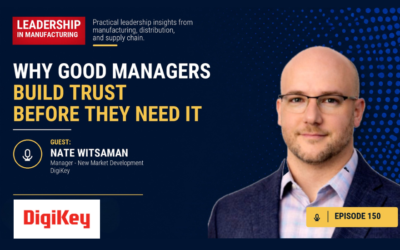
Why Good Managers Build Trust Before They Need It – Episode 150
Nate Witsaman of DigiKey joins Sannah Vinding to discuss curiosity, trust, feedback, remote leadership, and developing managers.
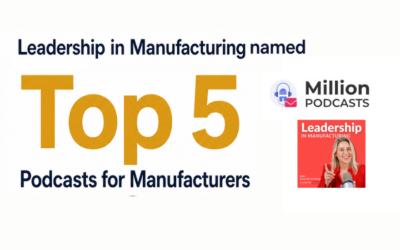
Leadership in Manufacturing Named a Top Five Podcast for Manufacturers
Leadership in Manufacturing was named a top-five podcast for manufacturers by MillionPodcasts. This recognition reflects the growing need for practical leadership conversations inside electronics, manufacturing, distribution, supply chain, and technical teams.

Why Credibility Still Wins in Technical Sales – Episode 149
Mic Cardone of ENOVA USA joins Sannah Vinding to discuss credibility in technical sales, AI, leadership patience, and customer trust.