
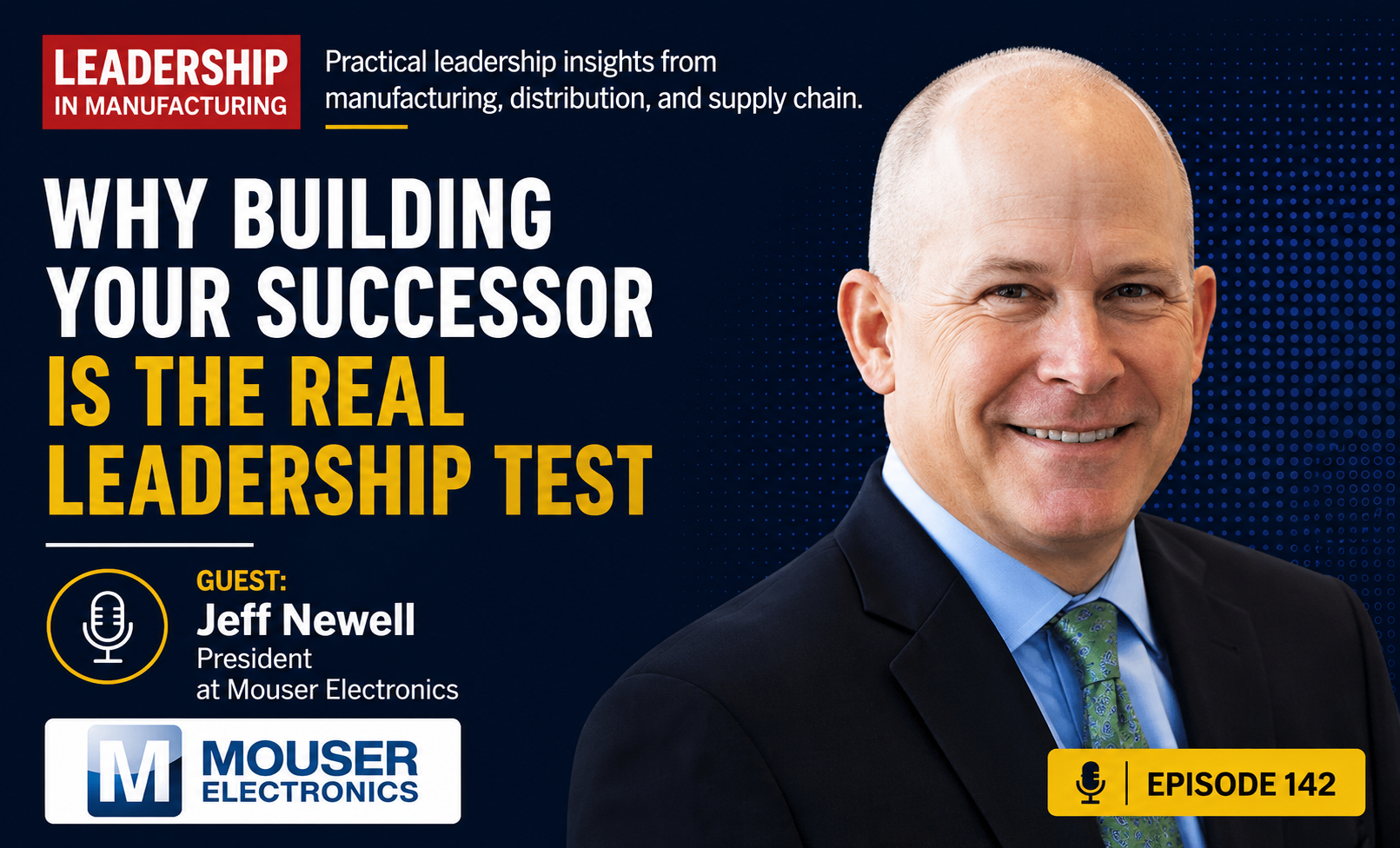
Episode 142
Why Building Your Successor Is the Real Leadership Test
How Jeff Newell, President of Mouser Electronics, leads a global business by building the leaders behind him
Episode summary
Jeff Newell is the President of Mouser Electronics, a global authorized distributor that ships to more than 650,000 customers in 223 countries and territories from its one million square foot distribution facility in the Dallas-Fort Worth area. He leads a business with more than 4,000 employees, over 1,200 manufacturer partners, and more than 1.2 million products in stock. Before becoming President in 2025, Jeff spent more than a decade as Senior Vice President of Products at Mouser. Prior to that, he spent over 20 years at Texas Instruments in distribution and operations leadership roles. He is an engineer by training and a leader by practice.
This episode is about what leadership actually looks like at the top of a global distribution business. Jeff is direct about how he leads. He is a servant leader. He does not ask anyone on his team to do something he would not do himself. He runs Mouser without micromanaging because he trusts the people he has put in place. And he holds himself to a leadership test that most senior leaders avoid until it is too late: if your successor is not ready, you are not ready.
The conversation moves through the moments most senior leaders quietly recognize. How to step into a role someone held for 36 years without changing too much too fast. How to give feedback that does not become personal. How to build trust by being open about your own mistakes. Why younger people working fully remote will struggle to get promoted, and what to do about it. How to read industry cycles before they roll over. And the single piece of career advice Jeff received decades ago that still shapes how he leads today.
This one is for the senior leaders who carry weight, run teams, and are quietly asking themselves whether they are doing the work that actually moves people forward.
You Will Learn
-
- Why the readiness of your successor is the most accurate signal of whether you are ready for your next role
- How to give feedback without making it personal and without waiting too long for it to land
- Why a servant leader at the top of a global business gets more done than a top-down operator
- How to step into a long-tenured leader’s role without rattling a successful company
- Why being open about your own mistakes builds more trust than hiding them
- How to recognize the early signals of an industry cycle turning, and how to position your team for it
- Why staying open to opportunities outside your current comfort zone is the career move most senior leaders stop making
- How leading remote teams shifts what leaders need to watch for, especially with younger employees aiming for promotion
Listen now and subscribe to Leadership in Manufacturing.




Key takeaways
Servant Leadership Scales When Trust Is Built In
Jeff runs a business with over 4,000 employees, but he leads it the same way he led his team of product managers. He does not put himself on a pedestal. He sees himself as part of the team. He removes friction for the people doing the work and gives them the autonomy to act without fear. This is not soft leadership. It is operating discipline.
This style only works if the leader trusts the people they have put in place. Jeff said it directly: he does not have time to be involved with everyone. So he puts leaders in place who can lead without him constantly checking in, and he stays close enough to see issues coming.
“I am very much a servant leader. I don’t want to ask folks on our team to do something that I either haven’t done or wouldn’t do.”
Building Your Successor Is the Real Leadership Test
Most leaders think readiness for promotion is about themselves. Jeff frames it differently. The first thing he asks anyone looking for more responsibility is whether their successor is ready. If the person below cannot pick up the work, then the leader is not free to take on more. The succession question is not a sidebar conversation. It is the operating signal.
Any leader who waits to think about their successor until they want a promotion is already too late.
“If your successor is not ready, then you’re not ready. That’s one of the things that any leader should think about the first day in the job.”
Feedback Lands When It Is Fast, Private, and Specific
Praise in public. Critical feedback in private. Never wait long enough that the person has forgotten the moment or moved on. If you sit on a hard conversation for three months, the situational details are gone, and the message lands as judgment rather than help.
Jeff also flips the script on receiving feedback. He asks for it. He follows up with questions to check what people actually heard versus what he said. He does not get defensive when someone tells him he is wrong. He shares his own mistakes openly so his team feels safe doing the same.
“If you have bad news, let’s bring it quick. The longer you wait, the worse it’s going to be.”
Stay Open and Don’t Pigeonhole Yourself
Jeff never had one specific job in mind. He never said “this is the title I’m aiming for.” He stayed open to what came next. That instinct is how he ended up President of a global distribution business.
He warns about the cost of saying no too often. When a leader builds a pattern of turning ideas down, people stop bringing them. The career narrows. The choices shrink. Staying open is not passive. It is the active discipline of letting the next possibility find you.
“Anytime you say no, they start to draw a line of those dots and say, this person’s not open to something new. So I’m going to stop talking to that person.”
Choose Your Boss Wisely
The single piece of career advice that has stayed with Jeff longest came from a leader at Texas Instruments early in his career. He was interviewing for a promotion. He wanted the title. The advice he got was not about the role. It was about the boss.
A boss is not just the person you report to. A boss shapes the career path you are on. A great boss will help you grow into more than the job description on paper. A bad boss will quietly cap how far you go.
“Choose your boss wisely. That’s going to set you on a different career path than the one you might be on today.”
Why this matters
This conversation lands because the leadership lessons are coming from someone running a business at real scale, not theorizing about leadership from the outside. The senior leaders listening to this show are making the same decisions Jeff is making. How much to change when stepping into a new seat. How to keep a team moving in a cycle that is rolling over. Who to promote, and who is not ready yet. How to stay close to engineers and customers when the business gets large.
What stands out about Jeff is the simplicity of his frame. Lead by example. Build successors. Give feedback fast and in private. Stay open. The rules are not new. The discipline of practicing them at scale is what separates the leaders who grow people from the ones who just manage them.
“How do you know if you’re a good leader? That’s a tough question. Everybody needs to look at that and think about it so they can become a much better one.”
Episode highlights
Stepping Into a Seat Held for 36 Years
-
- Jeff replaced Glenn Smith, who led Mouser for 36 years and was at the company for 52. The advice Jeff received from a supplier who had been through something similar shaped his entire transition: don’t change too much too quickly because everyone will wonder why. Mouser was already a successful company. Jeff’s job was to bring his style without rattling the system. What changed was the communication. Jeff is more open. He shares his mistakes. He asks for feedback. The substance of how Mouser operates was not the thing to overhaul.
Protecting Inventory for the Design Engineer
-
- Jeff is direct about who Mouser exists for. The engineer designing the next product. During the pandemic cycle, on-the-shelf inventory got tight, and Mouser made the call to protect that inventory for engineers building bills of materials, even at the cost of larger orders from contract manufacturers. If an engineer cannot get the part they need for their next design, they will put something else in that socket. That is a lost design-in opportunity for the supplier. Mouser plays the long game.
Get Comfortable With Being Uncomfortable
-
- Last year, Jeff told his staff something he keeps coming back to: we need to get comfortable with being uncomfortable. He was not asking the team to be harsh with each other. He was asking them to push each other with respect, because the business needs forward momentum. The team that avoids friction with each other is the team that stops moving.
Why Younger Remote Employees Struggle to Get Promoted
-
- Jeff is honest about a hard truth for younger people working fully remote. If no one sees you in scenarios at work, no one knows whether they can trust you to lead a team. Leadership decisions at higher levels come down to trust, and trust gets built in the in-person moments. Jeff has had this conversation with young employees who aspire to grow. The look on their face shifts when they realize it.
Reading Cycles Before They Roll Over
-
- Jeff has been in this industry since 1991. He has lived through enough up-cycles and down-cycles to know the rhythm. The first signal he watches is lead times. When lead times extend faster than the team can react, inventory starts to stock out. The harder signal is when the cycle rolls over. False demand from double and triple ordering inflates the picture. The leaders who position their team for the next cycle are the ones who can read the early signs without overreacting.
Practical Tip
Run the Successor Check on Yourself This Week
Most senior leaders carry the weight of their team’s outcomes without ever asking whether they have built someone who could step into their seat. The longer that question is avoided, the harder it gets to take the next role.
-
- Identify the one person on your team who is closest to ready to do your job
- Write down the two skills they would need to build to be ready in 12 months
- Have one direct conversation with them this week about where they are headed
- Put one stretch responsibility on their plate that pushes them past their comfort zone
- Set a 90-day calendar reminder to check the gap again
What shifts when you do this: you stop being the bottleneck for your team’s growth, and you start being the leader who builds people who can carry the work after you.
About the guest

Jeff Newell
President, Mouser Electronics
Jeff Newell is President of Mouser Electronics, one of the world’s leading authorized distributors of semiconductors and electronic components. With more than 30 years of experience in semiconductor sales, distribution, international business development, and management, Jeff brings deep expertise in product strategy, supplier engagement, pricing, technical support, and global business growth.
Before becoming President in 2025, Jeff served as Senior Vice President of Products at Mouser for more than a decade, helping guide the company’s product organization and supplier relationships across its global line card of more than 1,200 manufacturer brands. Prior to joining Mouser, Jeff spent nearly 22 years at Texas Instruments in a range of leadership roles, including Director of Distribution for the Americas.
He holds an MBA from Southern Methodist University’s Cox School of Business and a Bachelor of Science in Electrical Engineering from Kansas State University.
Who this episode is for
This episode is built for:
-
-
- Presidents, CEOs, and Founders running global or regional businesses in electronics, manufacturing, or distribution
- VPs and Directors stepping into bigger leadership roles in technical industries
- Senior leaders responsible for succession planning and building the next bench
- Sales Managers and Operations Leaders who are giving and receiving feedback at scale
- Leaders inheriting a team or business from a long-tenured predecessor
- Engineering and product management leaders moving into general management
-
What you will be able to do after listening
Leaders who listen to this conversation walk away ready to:
-
-
- Apply the successor test to your own readiness for the next leadership role
- Give faster, more specific feedback without making it personal
- Build trust with your team by sharing your own mistakes openly
- Step into a new leadership role without rattling a successful operation
- Identify the early signals of an industry cycle turning before your competitors do
- Coach younger remote employees on what visibility actually requires
- Stay open to career opportunities outside your current comfort zone
-
You can unsubscribe at any time.*
Related Episodes

Why Leadership Is Built in the Moments Nobody Sees- Episode 152
Colin Strother, Executive Vice President at Rochester Electronics, joins Sannah Vinding to discuss trust, authenticity, customer commitment, and leading global teams across the electronics industry. They talk about why customers need both digital and personal service, how leaders develop confidence and composure, and what small actions reveal about leadership.

How Distribution Leaders Build Trust as AI Speeds Up Work – Episode 151
Riad Nizam of Master Electronics shares how distribution leaders build trust, culture, communication, and judgment as AI speeds up work.