
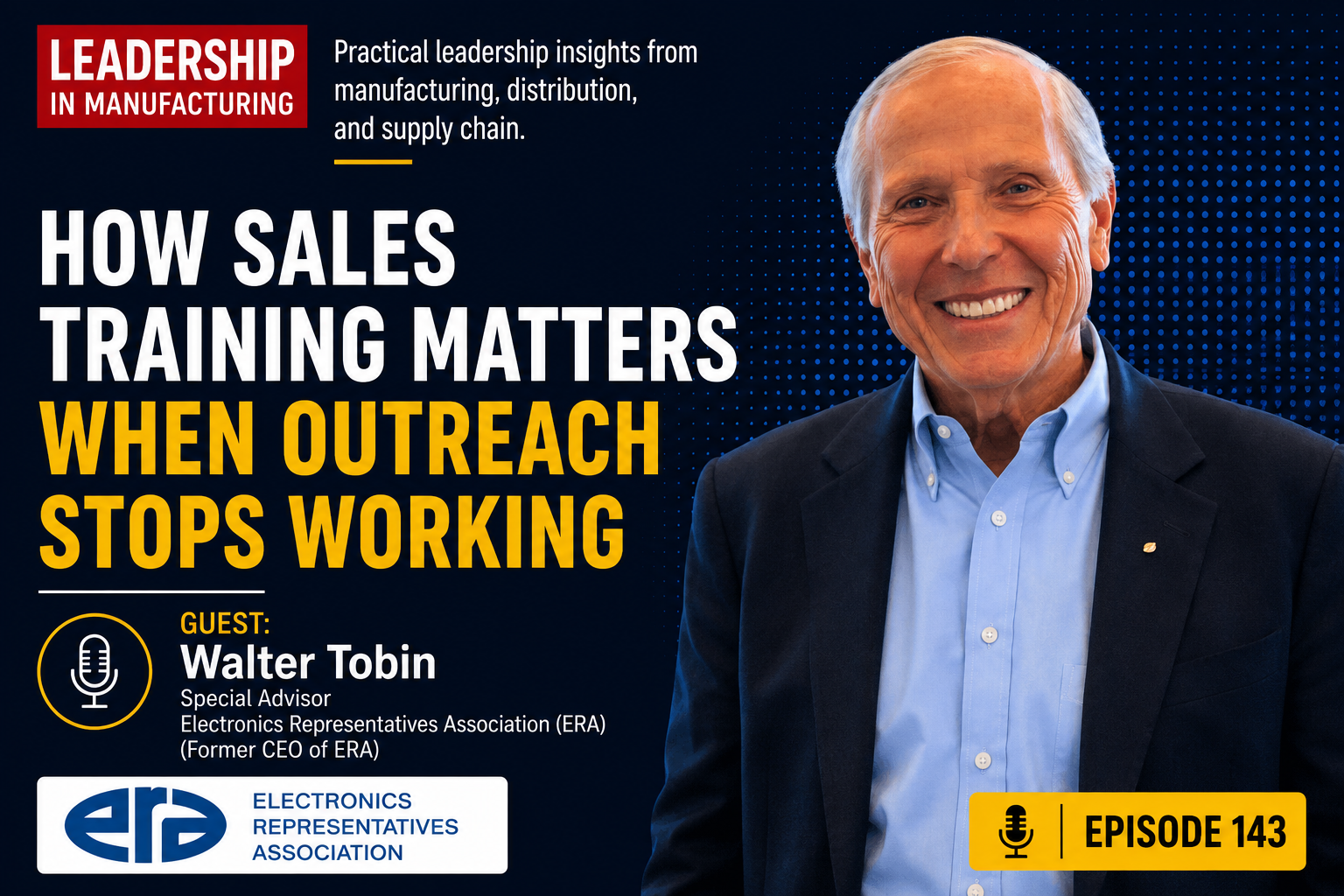
Episode 143
Why Sales Training Matters When Outreach Stops Working
Walter Tobin on sales training, customer attention, and the rep-distributor relationship in the electronics channel
Episode summary
Walter has seen the industry from multiple sides: distribution, manufacturer sales, and the manufacturers rep community. Before leading ERA for close to a decade, he held senior leadership roles at Future Electronics, Pioneer-Standard, and Arrow Electronics. That background gives him a practical view of what breaks down when reps, distributors, and manufacturers compete for credit instead of working together to win and keep the opportunity.
The conversation starts with outreach, but it becomes a bigger discussion about sales discipline. Walter makes the case that AI can help sales teams find the right companies, contacts, and market signals, but it cannot replace the human part: knowing what value means to the customer, following up well, earning trust, and becoming the person a customer calls when they need a straight answer.
This episode is for leaders across electronics manufacturing, distribution, and the rep community who are trying to help their teams reach customers without adding more noise. It is also for anyone responsible for sales training, channel relationships, or the last mile between information and customer trust.
You Will Learn
-
- Why customers have changed faster than many outreach habits have changed.
- Why sending more emails does not solve a relevance problem.
- How LinkedIn outreach breaks trust when the pitch comes too fast.
- Why sales training is still underdeveloped in parts of the electronics industry.
- How reps and distributors can work together to win and keep the socket.
- Why manufacturers risk losing customer coverage when they bypass rep relationships.
- Where AI helps in sales research, and where human judgment still has to take over.
- Why responsiveness and straight answers are part of becoming a trusted advisor.
Listen now and subscribe to Leadership in Manufacturing.




Key takeaways
Customers changed. Outreach did not
Walter is direct about the problem: the customer is not behaving the way they did before. Remote work, inbox overload, and automated selling have made people harder to reach. Yet too many sales teams are still using the same outreach patterns and expecting different results.
The issue is not only volume. It is relevance. A customer who receives 100 emails a day is not looking for another sequence. They are looking for a reason to care, a reason to open, and a reason to trust that the sender understands their problem.
“Acknowledge the fact that the customer has changed and we need to change in our outreach. Because we have not.”
Sales training is not optional anymore
Walter comes back to training throughout the conversation. Many people in the industry learned sales by doing it, not through structured training. That worked when access was easier and relationships were built in person more often. It is not enough when customers are harder to reach and less patient with weak messaging.
Training does not mean scripts for the sake of scripts. It means helping people understand how to create value in the first contact, how to follow up without being a nuisance, how to ask better questions, and how to handle the opportunity after the customer finally gives them time.
“Most of us have never gone through sales training. Here we are in the electronics industry, and we do not go through training. That is crazy.”
Reps and distributors are stronger together
The conversation moves into the tension between reps, distributors, and manufacturers. Walter explains why competition for credit, especially around registrations, can weaken the whole channel. The real value comes when the rep and distributor work together to win the socket and then keep it.
Winning the design is not enough if the supply chain does not support the customer. A distributor can help with availability, logistics, and continuity of supply. A rep brings customer knowledge, manufacturer alignment, and local relationship depth. When those two sides work together, the customer gets a better answer.
“Where there is strength, where there is power, is when the rep and the distributor are working together to win the socket, but also to keep the socket.”
AI helps with the search. It does not earn the meeting
Walter sees real value in AI for sales research. It can identify customers in a vertical, find contacts, pull market context, summarize articles, and help a salesperson prepare. That is useful. But the tool does not solve the hardest part.
The last mile is still human. The salesperson has to decide what matters, write something worth reading, show up prepared, and follow through. AI can help you know more before you reach out. It cannot make the customer trust you.
“AI can help you with the data, but then here I am at my computer sending that email to the unreachable. How do I get them to respond to me?.”
Why this matters
The electronics channel has always depended on relationships, but relationships are being tested by speed, automation, and noise. Customers want faster answers. They expect better information. They do not have time to teach a salesperson how to be useful.
That creates pressure for leaders. If teams rely on more emails, more tools, and more activity without better training, they will create more friction instead of more opportunities. The companies that improve will be the ones that train people to use information with judgment and show up with something useful.
“The reps who are breaking through are not the ones doing more. They are the ones doing something more specific.”
Episode highlights
The inbox problem is really a value problem
-
- Walter walks through the math of a normal inbox: 100 emails, most ignored, a few opened, and only one or two answered. That is the reality sales teams are working against. The lesson is not to send more. It is to make the message worth opening
- The same problem shows up on LinkedIn. When a connection request turns into an immediate pitch, the relationship is over before it starts. The customer learns to protect their attention.
The rep-distributor relationship is part of customer trust
-
-
Walter explains that reps and distributors were built for different roles, but the customer needs both. The rep often brings account knowledge and manufacturer alignment. The distributor supports supply chain, delivery, and continuity.
-
When they work together, the customer gets more than a part number. They get a path to design, source, and sustain the business.
-
Cutting rep commissions can cut customer coverage
-
-
Walter describes what happens when manufacturers see rep commissions as a cost to remove instead of a sales model that creates coverage. A direct sales hire may look cheaper on paper, but the company can lose years of relationships, local knowledge, and access to the long tail of customers.
-
The problem is especially visible when the decision is made from a spreadsheet instead of from customer reality.
-
The quote is the most precious thing a customer can give you
-
-
Walter names the quote as a serious moment in the sales process. A customer request for quote often comes after months of work. If the internal team treats it casually, delays the response, or fails to follow up, the opportunity can be lost.
-
That is where sales training becomes operational, not theoretical. Follow-up is not a task. The goal is to book and keep the order.
-
The trusted advisor gives the straight answer
-
-
Walter gives a clear example of trust: if another supplier has the better solution, say so. A customer remembers when someone gives an honest answer that helps the program, even when it does not create an immediate sale.
-
That kind of trust is not built through automation. It is built in the moments where the salesperson chooses the customer relationship over the short-term pitch.
-
Practical Tip
Audit one outreach sequence for customer value
Before adding another tool or another sequence, review one current outreach flow and ask whether it would make a busy engineer, buyer, or product leader stop and care.
-
- Pick one live email or LinkedIn outreach sequence.
- Remove every line that is only about your company, your product, or your goal.
- Rewrite the first two sentences around the customer’s likely problem or current pressure.
- Add one specific reason the message is relevant to that company or role.
- Make the next step easy, direct, and respectful of time.
- Stop using follow-up language that makes the customer feel guilty for not responding.
The outcome is not a longer message. It is a clearer reason for the customer to open, read, and reply.
About the guest
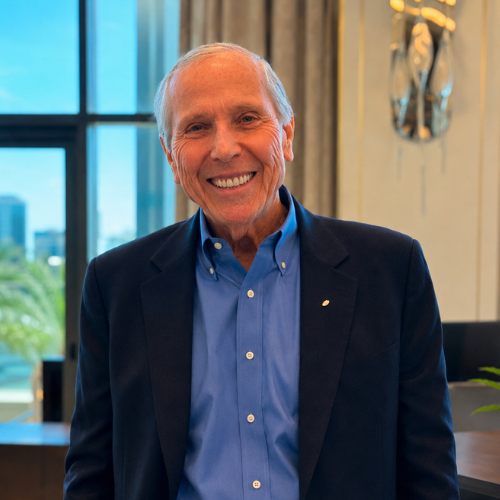
Walter Tobin
Former CEO, Electronics Representatives Association (ERA)
Walter Tobin is the former CEO of the Electronics Representatives Association, where he led ERA for close to a decade and helped expand its membership, conference attendance, distributor engagement, regional chapter activity, and industry programs. ERA represents and advocates for the professional field sales function across manufacturers representatives, manufacturers, and distributors in the electronics industry.
Before joining ERA, Walter built a long career in electronics distribution and executive leadership. He served as Corporate Vice President at Future Electronics and held leadership roles at Pioneer-Standard and Arrow Electronics. He holds both a B.S. and an MBA from Boston College and is a former U.S. Army Captain. Walter is also the namesake of ERA’s Tobin Bridge Award, which recognizes leaders who bring reps, manufacturers, and distributors together across the electronics industry.
Who this episode is for
This episode is built for:
-
-
- Sales leaders in electronics manufacturing, distribution, and the rep channel.
- Manufacturers reps working to reach engineers, buyers, and product teams.
- Distribution leaders responsible for demand creation and customer follow-through.
- Manufacturers reviewing channel strategy, coverage, and rep relationships.
- FAEs, product managers, and technical sales teams supporting customer decisions.
- Senior leaders trying to improve sales discipline without adding more noise.
-
What you will be able to do after listening
Leaders who listen to this conversation walk away ready to:
-
-
- Recognize why current outreach habits may be failing.
- Reframe sales training as a customer-access issue, not a nice-to-have.
- Evaluate whether AI is improving relevance or just increasing volume.
- Explain why reps and distributors need each other to win and keep business.
- Identify where customer trust breaks down after a quote request.
- Coach teams to follow up with more purpose and less noise.
- Use industry research to make outreach more specific and useful.
-
You can unsubscribe at any time.*
Related Episodes

Why Leadership Is Built in the Moments Nobody Sees- Episode 152
Colin Strother, Executive Vice President at Rochester Electronics, joins Sannah Vinding to discuss trust, authenticity, customer commitment, and leading global teams across the electronics industry. They talk about why customers need both digital and personal service, how leaders develop confidence and composure, and what small actions reveal about leadership.
How Distribution Leaders Build Trust as AI Speeds Up Work – Episode 151
Riad Nizam of Master Electronics shares how distribution leaders build trust, culture, communication, and judgment as AI speeds up work.