
Episode 144
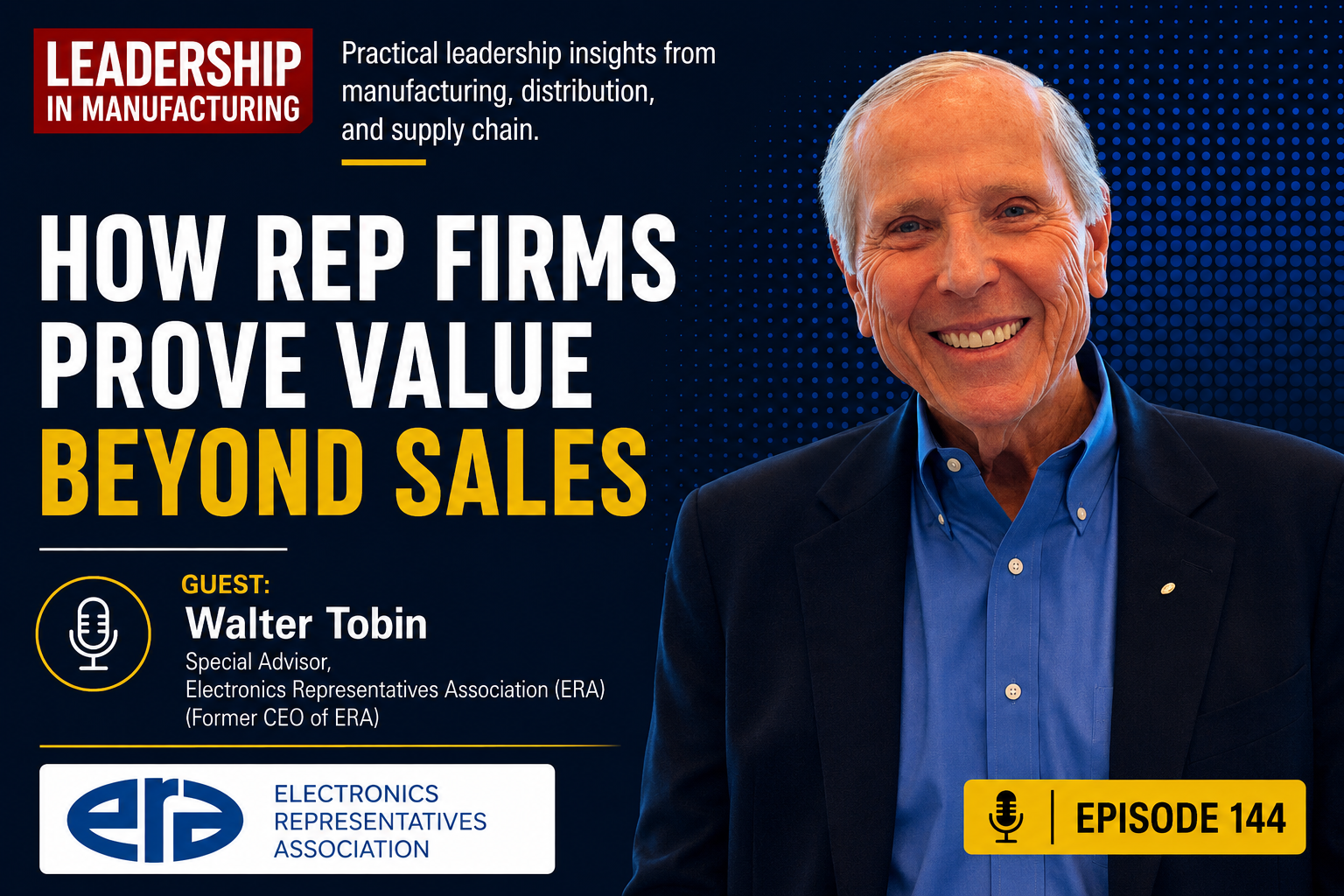
How Rep Firms Prove Value Beyond Sales
Walter Tobin on the consulting mindset, technical value, and the next version of the manufacturers rep role
Episode summary
The manufacturers rep model has always depended on relationships, territory knowledge, and trust. But the role is changing. Manufacturers expect more visibility into opportunities. Engineers are harder to reach. Digital presence matters earlier in the buying process. And a rep firm built only around the identity of being a sales organization may not be positioned for what customers and principals need next.
In this episode of the Leadership in Manufacturing Podcast, Sannah Vinding continues her conversation with Walter Tobin, former CEO of the Electronics Representatives Association. Walter spent much of his career in electronic distribution, including senior leadership at Future Electronics, before leading ERA and working closely with the independent rep community. That gives him a practical view of how the channel is changing from the inside.
This part of the conversation focuses on what rep firms need to do now: build a stronger technical foundation, use AI to find opportunities, improve their digital presence, create succession plans, and explain their value to manufacturers in a way that goes beyond commission. Walter also explains why the best rep firms are not only calling themselves sales organizations. They are positioning themselves as consulting firms that help engineers design in the right technology.
For leaders in electronics, distribution, manufacturing, and the rep community, this episode is about the next level of value. It is not enough to have the line card. The question is whether your organization can prove why it matters.
You Will Learn
-
-
Why rep firms need to keep adding technologies and services that match where the market is going
-
How the lead flow has changed between manufacturers and reps
-
Why digital presence matters more than many rep firms realize
-
How a consulting mindset can help rep firms recruit technical talent
-
Why succession planning should be visible to both employees and principals
-
What manufacturers often misunderstand about the independent rep model
-
Why technical training matters as much as sales training for the next generation
-
How AI can help reps find customers, opportunities, and market signals faster
-
Listen now and subscribe to Leadership in Manufacturing.




Key takeaways
Rep firms have to keep proving their value
Walter makes a practical point early in the conversation: most rep contracts can be terminated in 30 to 90 days. That reality changes the way rep firms need to think about value. The relationship matters, but relationship alone is not enough if the manufacturer cannot see new opportunities, stronger market coverage, and clear activity in the territory.
The strongest firms are not waiting for the manufacturer to send leads. They are finding opportunities, bringing visibility back to the manufacturer, and showing that they understand the territory better than anyone else. That is a different kind of value than simply representing a line.
“You need to continue to show value. You need to invest in systems, CRM systems, and be able to manage the data.”
The lead flow has changed
For years, many reps expected manufacturers to generate leads and send them into the field. Walter says that expectation has changed. Manufacturers now want reps to bring new customers and new opportunities back to them. That means the rep firm has to operate with more market intelligence, better tools, and a stronger process for finding opportunity.
This is a major shift for sales leadership. A rep firm that only waits for the principal to create demand is easier to replace. A rep firm that brings qualified opportunities, customer insight, and territory intelligence becomes harder to lose.
“The leads have to now go from the rep up to the manufacturer. That’s a big change.”
The rep role is moving closer to consulting
One of the strongest points in the episode is how Walter frames the rep role for technical talent. Most engineers do not want to become salespeople. But many are interested in helping other engineers solve problems, evaluate technology, and make design decisions. That is where the consulting mindset matters.
This is not just a recruiting message. It is a positioning message. If a rep firm can show that it helps engineers design in technology, it can speak to customers, manufacturers, and future employees in a more credible way.
“We’re a consulting firm. How would you like to come to us and be a consultant and help engineers design in technology?”
Succession planning is a channel trust issue
Walter also brings up a risk that many rep firms know is real: succession. If the owner or president is the center of the relationship and the future leader is unclear, manufacturers may see risk before the rep firm is ready to talk about it.
Succession planning is not only an internal leadership topic. It is also a principal confidence topic. When manufacturers know who is next, they have more reason to trust continuity. When they do not know, they may start looking for a different option.
“Let your principals know your succession plan. It’s really key.”
AI is already a practical tool for opportunity finding
Walter is direct about AI. He is not positioning it as a replacement for sales work. He is using it to find companies, identify possible customers, support members, and help people build plans. The point is not that AI does the work for you. The point is that it can help you start further ahead.
That is especially relevant for rep firms. If manufacturers want new customers and new opportunities, the ability to use AI for research, targeting, and preparation is no longer a side skill. It is part of how the work gets done.
“If you have a company today that’s not using AI to find customers, to find opportunities, you’re missing the boat.”
Why this matters
The rep model is still essential to the electronics channel, but the expectations around it are changing. Manufacturers want more visibility. Customers expect faster answers. Engineers want technical credibility. Younger talent may not be interested in a traditional sales label. And the firms that keep growing are the ones that can explain the value they bring before someone asks.
That matters for manufacturers too. If a company wants the benefits of an outsourced sales model, it has to understand what it takes to support that model. Training, collateral, product direction, and a real relationship with the rep force all matter. A rep firm is not an extra set of hands. It is part of the sales force.
“The firms that are winning are not only calling themselves sales companies. They are showing customers and manufacturers where they add value.”
Episode highlights
From territory coverage to market intelligence
-
- Walter explains that reps still own territories for the manufacturers they represent, but the job is no longer limited to covering accounts. The next version of the role includes identifying technologies, finding new opportunities, and bringing data back to the manufacturer.
- That changes what leadership inside a rep firm has to manage. Territory coverage still matters, but it has to be supported by CRM discipline, market research, digital presence, and consistent follow-up.
The website is now part of the first impression
-
- Walter is clear that some rep firms still underestimate their digital presence. If a customer or manufacturer visits a rep website and cannot find the line card, the people, or a direct way to reach someone, they may leave before a conversation ever starts.
- This is not about having a flashy website. It is about reducing friction. Customers want to know who you represent, who to contact, and whether the firm looks current enough to trust.
Manufacturers need to understand how reps get paid
-
- Walter describes the gap many smaller manufacturers have when they first work with reps. They may expect a rep to introduce the product, build the market, and create demand without meaningful support. That misunderstands the model.
- A rep can be a variable cost of sales, but that does not mean the work has no cost. Training, market development, and real support are part of building the channel.
The next generation needs technical confidence
-
- When Sannah asks what skills matter beyond sales training, Walter points to technical training. Not only manufacturer product training, but broader technical training that helps salespeople speak more confidently with engineers.
- That matters because customers do not want every conversation to end with, “Let me bring in my engineer.” The more technical confidence the rep team has, the more useful they become in the moment.
AI still needs the last mile
-
- Walter and Sannah both come back to a grounded view of AI. AI can help with research, targeting, job search, planning, and learning new tools. But it does not replace the human work of judgment, follow-up, relationship building, and doing the work.
- The tool can help you start at step four instead of step one. It cannot make the decision or carry the relationship for you.
Practical Tip
Audit whether your rep firm is positioned as sales or value
If your firm only presents itself as a sales organization, you may be underselling the value you actually bring. This week, look at how your firm appears to manufacturers, customers, and future employees.
-
- Review your website and check whether your line card, people, and contact paths are easy to find.
- Look at your last manufacturer update and ask whether it showed real opportunity, or only activity.
- Identify one place where your team helps customers make better technical decisions.
- Turn that example into language you can use in recruiting, customer conversations, and principal reviews.
- Ask one manufacturer what kind of opportunity visibility would make your partnership stronger.
The outcome is a clearer value story. Not only “we sell your line,” but “this is how we help the market adopt your technology.”
About the guest

Walter Tobin
Former CEO, Electronics Representatives Association (ERA)
Walter Tobin is the former CEO of the Electronics Representatives Association, where he led ERA for close to a decade and helped expand its membership, conference attendance, distributor engagement, regional chapter activity, and industry programs. ERA represents and advocates for the professional field sales function across manufacturers representatives, manufacturers, and distributors in the electronics industry.
Before joining ERA, Walter built a long career in electronics distribution and executive leadership. He served as Corporate Vice President at Future Electronics and held leadership roles at Pioneer-Standard and Arrow Electronics. He holds both a B.S. and an MBA from Boston College and is a former U.S. Army Captain. Walter is also the namesake of ERA’s Tobin Bridge Award, which recognizes leaders who bring reps, manufacturers, and distributors together across the electronics industry.
Who this episode is for
This episode is built for:
-
-
-
Manufacturers rep firm owners thinking about growth, succession, or positioning
-
Sales leaders responsible for managing principal relationships and opportunity pipelines
-
Manufacturers trying to understand how to work better with independent reps
-
Distribution leaders working with reps and manufacturers across shared customers
-
Technical sales and FAE leaders who need stronger customer visibility
-
Emerging leaders in electronics who want to build broader skills beyond one role
-
-
What you will be able to do after listening
Leaders who listen to this conversation walk away ready to:
-
-
-
Explain why the rep role is shifting from sales representation to technical value creation
-
Identify where your firm may need stronger visibility, data, or digital presence
-
Reframe the rep role in a way that appeals to technical talent
-
Start a clearer succession conversation with employees and principals
-
Evaluate whether your manufacturer relationships are supported by the right training and tools
-
Use AI more practically for customer and opportunity research
-
Connect technical training to stronger customer conversations
-
-
You can unsubscribe at any time.*
Related Episodes
How Leaders Prepare Sales Teams for Growth With AI and Better Training – Episode 153
Brooks Mattice of MFC Group explains how leaders prepare sales teams for growth through training, onboarding, feedback, and AI-supported tools.
Why Leadership Is Built in the Moments Nobody Sees- Episode 152
Colin Strother, Executive Vice President at Rochester Electronics, joins Sannah Vinding to discuss trust, authenticity, customer commitment, and leading global teams across the electronics industry. They talk about why customers need both digital and personal service, how leaders develop confidence and composure, and what small actions reveal about leadership.