
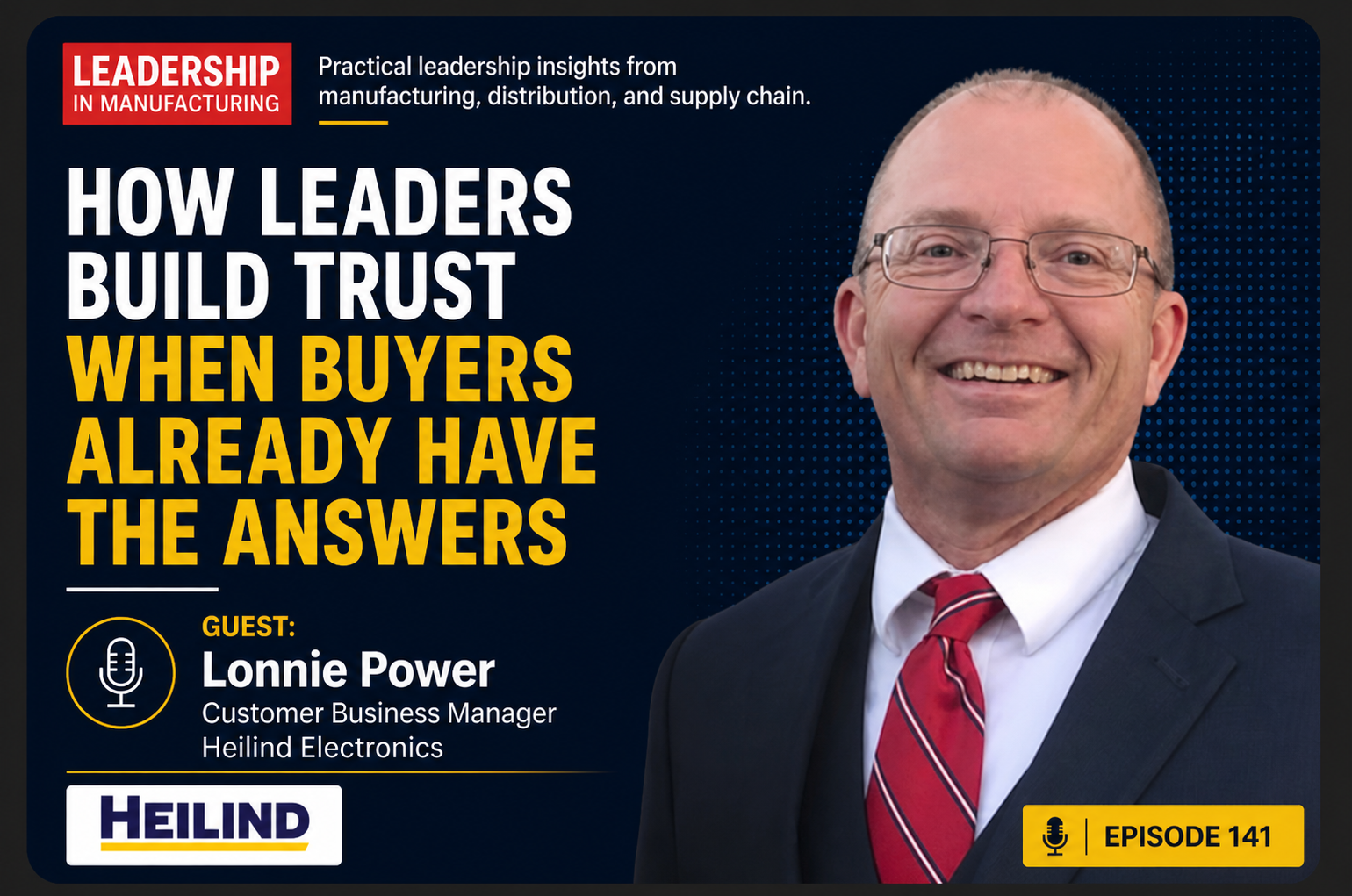
Episode 141
How Leaders Build Trust When Buyers Already Have the Answers
What it takes to lead a technical sales motion when AI has changed how customers prepare, decide, and evaluate.




Episode summary
Lonnie Power has spent close to three decades inside the electronics industry, working both sides of the supplier and distribution relationship. He started in 1998 at NKK Switches, held a regional sales manager role at 3M, spent close to five years at Vishay, and is now a Customer Business Manager at Heilind Electronics. His view of the industry is shaped by sitting on both sides of the table, and that perspective is exactly what this conversation needs.
This episode gets into what actually changes when customers arrive at the conversation already informed. Lonnie talks about why AI is a tool and not a replacement, why it answers confidently whether the answer is correct or not, and how the field sales role has shifted from information delivery to translation, bridging, and problem solving. He names a quiet truth most leaders have noticed but few have addressed: information is everywhere now, but coherence is not, and that is where the human still wins.
The conversation also covers the generational shift inside the industry. Boomer retirements have left holes that mentorship and apprenticeship are still trying to fill. Younger buyers default to Amazon and Alibaba because no one handed them a manual. And the leaders who develop the next generation well are the ones treating knowledge transfer as an operating control, not a side project.
If you lead a technical sales team, a rep firm, or a distribution business, this conversation gives you a frame for the shift you are already living through.
You Will Learn
-
- Why AI speeds up information gathering but does not replace the judgment a buyer needs to act
- How the field sales role is shifting from information delivery to translation and problem solving
- What changes when buyers arrive at the conversation already prepared, and why that raises the bar on the rep
- How to think about the 80/20 rule differently when 20% of your future business depends on technology that did not exist five years ago
- Why the next generation of buyers needs to be shown that there are options beyond Amazon and Alibaba
- How to develop talent through mentorship and apprenticeship when the old hierarchical model no longer fits
- Why managing your personal brand is the one thing you control as the industry shifts around you
- What it looks like to lead your team through disruption without losing momentum
Listen now and subscribe to Leadership in Manufacturing.
Key takeaways
The Real Job Is Translation, Not Information
For decades the field sales role was built on access to information. The rep knew the part, the price, the lead time, and the alternative when the first option went end of life. AI has changed that. A buyer can pull a cross reference in two minutes, and the rep no longer wins on information alone.
What Lonnie names in this episode is the shift to translation. The customer is working across contract design houses, OEMs, contract manufacturers, fulfillment partners, and suppliers. Information is everywhere. Coherence is not. The rep who connects the parties, makes sense of the data, and stays accessible when something breaks is the one who keeps the relationship.
“When you have a problem, being able to be a part of the solution. Online tools are great, but they might not always help with that.”
AI Answers Confidently. That Is Not the Same as Correctly.
Lonnie uses AI in his own work. He plugs in supplier conversations, runs cross references, and accelerates research. He is direct about the value. He is also direct about the risk. AI delivers answers with the same confidence whether they are correct or not, which means the human has to know when to trust the output and when to push back.
This matters more for younger buyers than for senior ones. Senior buyers have been burned and know to check. Newer buyers move fast, take the AI answer at face value, and discover later that the part was discontinued or the cross reference was rough. Speed without judgment creates exposure.
“It answers so confidently, doesn’t it? Whether that answer is right or not is completely something different.”
Reframe the 80/20 Rule for Where the Industry Is Going
The classic read on 80/20 is that 80% of your business comes from 20% of your customers. Lonnie reframes it. Eighty percent of your effort supports the business you have today. Twenty percent has to be pointed at where the industry is going next.
He uses the data center buildout as the example. Five years ago, the demand profile that exists now did not exist. The leaders who saw it early stocked product, listened to their suppliers, paid attention to consuming markets, and positioned themselves to participate when it accelerated. The leaders who only ran today’s book missed the window.
“Eighty percent of the work is supporting the business you have today. The other twenty is preparing for where the market is going next.”
Manage the One Thing That Does Not Change
The simplest line in the conversation is also the most direct. Markets change. Generations change. Tools change. The one thing that does not change is you, and you are responsible for the brand you build inside the industry.
Lonnie’s point is not about personal marketing. It is about reliability. Show up. Do what you said you would do. Follow through quickly. Do that consistently and word travels. Do not do that and word travels faster. In a small industry where careers move across companies and customers follow people, your brand is the asset that compounds.
“The one thing that doesn’t change is you. You are responsible for you. Manage the brand very carefully.”
Why this matters
The industry is shifting on two fronts at once. Senior talent is walking out the door faster than the next generation is being developed, and AI has changed what customers expect when they engage. Most leaders are managing both shifts at the same time without a manual.
This conversation matters because it stays grounded in what actually works. Not theory. Not tool reviews. Practical leadership in a sales motion where the rules are getting rewritten week by week. If you are responsible for a team that sells, supports, or designs into electronics customers, this episode names the shift and gives you language for how to coach through it.
“Information used to be the differentiator. Judgment is what wins now. That is the work of leading a sales team in this market.”
Episode highlights
Why the Field Rep Still Wins in an E-Commerce World
-
- Lonnie walks through what the rep actually delivers in a market where Octopart, Trusted Parts,
and the major aggregators have made information a commodity. The answer is not that the rep
has better information. The answer is that the rep is in the room when something breaks, when
the part needs a cross, when the supply chain hits a hold, and when the customer needs an
authorized source they can trust.
- Lonnie walks through what the rep actually delivers in a market where Octopart, Trusted Parts,
The New Communication Etiquette
-
- Phone, email, text, social. Lonnie names a small but important truth about communicating with
the next generation of buyers. Voicemail is dead. Texting before you call is the new etiquette.
And sometimes a two minute phone call still solves what twenty texts cannot.
- Phone, email, text, social. Lonnie names a small but important truth about communicating with
Knowledge Transfer as an Operating Risk
-
- The boomer retirement wave has left gaps that companies are still trying to fill. Lonnie talks
about how mentorship and apprenticeship have to do the work that hierarchy and tenure used to
do. The leaders who handle this well treat knowledge transfer as an operating control, not a
project.
- The boomer retirement wave has left gaps that companies are still trying to fill. Lonnie talks
Sitting on Both Sides of the Table
-
- Lonnie spent years on the supplier side at 3M and Vishay before crossing into distribution. He
talks about how that perspective changes the work, why he can read a supplier’s pain in real
time, and how that translates into a more useful conversation for the customer.
- Lonnie spent years on the supplier side at 3M and Vishay before crossing into distribution. He
Pivot Is Not a Buzzword
-
- COVID is the easy example, but the principle runs deeper. Lonnie talks about the pivots that happen quietly inside a career when the market shifts, an employer downsizes, or a new technology takes over a category. The leaders who keep the radar up keep moving forward.
Practical Tip
This Week: Build Two Coaching Conversations Into Your Team’s Cadence
Most sales leaders are still running coaching cadences that were designed for an informationled sales motion. The shift Lonnie names in this episode requires two new conversations on a regular cadence. Build both into your week.
Conversation 1: The AI Gap Debrief (15 minutes)
Customers are arriving at the call with AI-assisted research. Some of it is sharp. Some of it is wrong. Most reps are not yet trained to read the difference in real time.
-
- Ask each rep to bring one customer conversation where AI-assisted information shaped the buyer’s question or assumption
- Identify whether the AI output was correct, partially correct, or wrong, and what the rep did with it
- Reward the rep who catches a wrong answer first
- Make this a 15 minute weekly cadence, not a one-off training
Conversation 2: The Authorized Sourcing Talk Track (15 minutes)
A growing number of newer buyers default to Amazon, Alibaba, and unverified marketplaces because no one has taught them what authorized distribution protects them from. Your reps need a clean, non-defensive way to have that conversation without sounding like they are protecting margin.
-
- Have each rep practice a 60 second answer to “why not just buy this from a marketplace”
- Pressure test it for tone. It should sound like education, not a sales pitch
- Build a one-page reference your team can send after the call: traceability, recall path, EOL management, counterfeit risk
- Track which key accounts have had the conversation and which have not
The outcome is a team that holds its ground on judgment and on sourcing integrity. Two of the places the human still wins in this market.
About the guest

Lonnie Power
Customer Business Manager, Heilind Electronics
Lonnie has spent more than two decades selling component solutions inside the electronics industry. He started in 1998 at NKK Switches, then held a regional sales manager role at 3M, and spent close to five years at Vishay before joining Heilind Electronics seven years ago. He has worked both the supplier side and the distribution side of the table, which gives him a working view of where information breaks down and where the human in the loop still matters. His specialties include technical sales, electronic components, distributor relations, new business development, cost negotiation, sales forecasting, and supply chain partnerships.
Lonnie holds an MBA in Marketing and is a Phoenix Alumni Chapter member of Thunderbird School of Global Management. He speaks Spanish proficiently and brings a strong cross-cultural lens to working with global accounts. Outside of his role at Heilind, he is an active member of the Arizona Technology Council and holds a leadership position in his local chapter of Toastmasters.
Who this episode is for
This episode is built for:
-
-
- Sales leaders who manage field reps in electronics, semiconductor, or industrial distribution
- Manufacturer rep firm owners and principals rethinking how their teams add value
- Distribution executives building strategy in a market where buyers research with AI before they engage
- Operations and supply chain leaders working across contract design, OEM, and contract manufacturing relationships
- Senior professionals leading the knowledge transfer from retiring tenured talent to the next generation
- Marketing and product leaders who want to understand how the buyer experience is actually shifting
-
What you will be able to do after listening
After listening to Episode 141, you will be able to:
-
-
- Spot the difference between speed and judgment in your team’s customer conversations
- Coach reps to translate, not just deliver information
Build a coaching cadence that develops the next generation without relying on hierarchy - Reframe the 80/20 rule so your team is positioned for the future, not just the present
- Recognize when an AI-assisted answer is wrong before it reaches the customer
- Develop the personal brand habits that compound across a career
- Lead your team through the next industry pivot with clarity instead of panic
-
You can unsubscribe at any time.*
Related Episodes

Why Leadership Is Built in the Moments Nobody Sees- Episode 152
Colin Strother, Executive Vice President at Rochester Electronics, joins Sannah Vinding to discuss trust, authenticity, customer commitment, and leading global teams across the electronics industry. They talk about why customers need both digital and personal service, how leaders develop confidence and composure, and what small actions reveal about leadership.
How Distribution Leaders Build Trust as AI Speeds Up Work – Episode 151
Riad Nizam of Master Electronics shares how distribution leaders build trust, culture, communication, and judgment as AI speeds up work.