
AI Gets You Close. The Last Mile Is Still Human
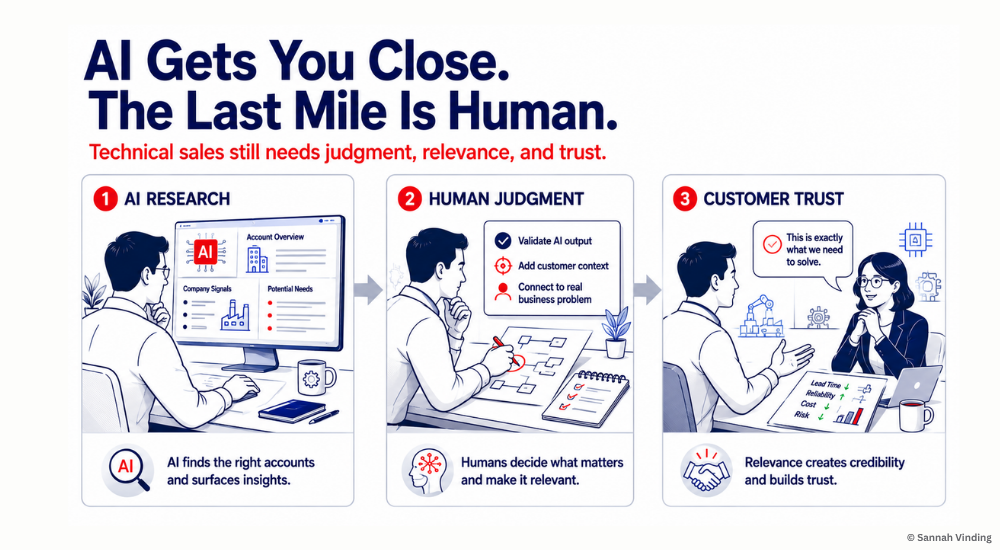
69% of B2B buyers turn to sales reps to validate AI-generated insights.
That is the part of the AI conversation technical sales leaders should not miss. Buyers are using AI. Sellers are using AI. Research is faster, account discovery is easier, and the first layer of preparation can happen in minutes instead of hours. But when the decision is complex, the buyer still needs someone who can validate what the tools surfaced, apply context, and help them understand what matters.
That is the last mile. Not the data. Not the contact record. Not the automated message. The human judgment that turns information into trust.
AI can help sales teams in electronics, manufacturing, distribution, and the rep channel get closer to the right customer faster. It can surface accounts, identify possible applications, summarize company activity, and help a salesperson prepare. But it does not earn the conversation. The last mile is still human: relevance, timing, credibility, and the ability to show why the customer should care.
Buyers Are Not Waiting for Sales to Educate Them
The buying process has already shifted. According to the 2026 B2B Buyer Behavior Report from Consensus, B2B buyers spend only about 17% of their total purchase journey in direct contact with potential suppliers. That means most of the decision shaping happens before a seller is invited into the conversation.
The same report found that 61% of B2B buyers prefer a rep-free buying experience. That does not mean buyers do not need expertise. It means they do not want low-value interruption.
That distinction matters in technical markets.
Engineers, buyers, and cross-functional decision teams are already doing their own research. They are comparing options, reading technical content, checking availability, looking at suppliers, and using AI tools to move faster. By the time a salesperson or rep gets a moment with them, the question is rarely, “Can you tell me what you sell?”
The better question is, “Can you help me make sense of this?”
That is where the sales role changes. The value is no longer access to information. The value is interpretation, context, and judgment.
More Activity Does Not Fix Weak Relevance
In my conversation with Walter Tobin, former CEO of the Electronics Representatives Association, we talked about what it takes to reach people who are already overwhelmed by messages. His answer was direct.
“We try to focus on how to reach the unreachable.”
That line matters because many teams are still solving the wrong problem. When response rates drop, they send more. More emails. More LinkedIn messages. More follow-ups. More automation.
But if the message is not relevant, speed only creates more noise.
Forrester’s 2026 B2B marketing, sales, and product predictions add another layer to this. In 2025, Forrester found that 30% of buyers saw generative AI tools as a meaningful interaction during the final commit stage of a purchase, compared with 17% who said the same about product experts. But Forrester’s prediction is that human expertise will rival generative AI in appeal as buyers look for deeper validation.
That is the opening for a stronger human role, not a weaker one.
AI gives buyers more information. Human experts help buyers know what to trust.
The salesperson, FAE, distributor contact, or manufacturer rep who can validate the buyer’s thinking becomes more valuable. Not because they have more information, but because they can help the customer understand what is true, what is relevant, and what trade-off matters in the actual application.
“AI can help you with opportunities. It can analyze data. But I call it the last mile because you still need to go and talk to the customer, get that foot in the door, and make the conversation matter.”
That is the real leadership question. Are teams using AI to send more, or are they using it to prepare better?
The Last Mile Is Where Trust Gets Built
The Consensus report also found that 77% of B2B buyers describe their most recent purchase as highly complex or difficult. That is especially recognizable in electronics and manufacturing, where decisions often involve technical fit, supply risk, qualification cycles, pricing pressure, and multiple people who all care about different parts of the outcome.
AI can support that work. It can help identify the right accounts. It can help a rep understand a vertical faster. It can summarize what a company manufactures and where a product might fit. That is useful.
But the customer still needs to know whether the person reaching out understands the real problem.
Walter made that point in practical terms. AI can help a salesperson find robotics customers in a region. It can help identify names, companies, and possible opportunities. But then the salesperson has to do something with that information.
“There’s all sorts of ways you can use AI to help demonstrate the value.”
That is the last mile in practice. Not using AI to produce a better-looking generic email. Using AI to prepare well enough that the human interaction is more specific, more useful, and more respectful of the customer’s time.
Listen to the full conversation with Walter Tobin on the Leadership in Manufacturing Podcast.
The teams that win will not be the ones that simply add AI to old outreach habits. They will be the ones that use AI to improve preparation, then bring the human part with more discipline.
The tool can get you closer. The last mile is still yours.
You can unsubscribe at any time.*
Sannah Vinding
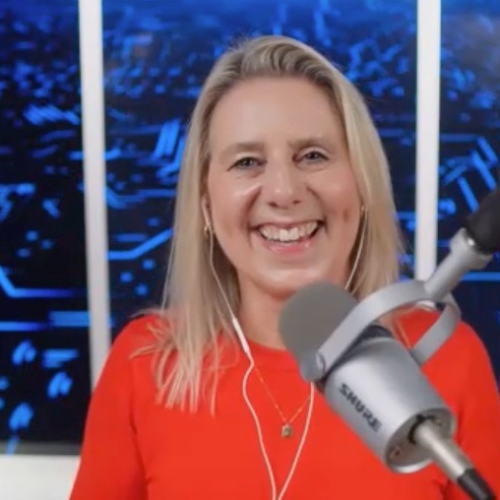
Sannah Vinding
Engineer | GTM, Growth & Product Marketing Leader, Podcast Host
Sannah Vinding is an engineer and go-to-market leader known for bridging technical depth with business clarity across electronics and manufacturing.
Her work sits at the intersection of engineering, product, and commercial teams, translating complex technology, data, and customer insight into clear positioning, strong go-to-market execution, and measurable business impact.
She created Leadership in Manufacturing as an applied leadership platform to explore how leaders actually think, communicate, and make decisions when complexity is high and expectations are rising.
Through candid conversations with executives across manufacturing, distribution, and supply chain, Sannah brings together voices from across the electronics value chain to share lessons that help leaders grow with clarity and confidence.
Available on Your Favorite Podcast Platforms!




Related Episodes
AI Can Speed Up Sales. It Cannot Create Credibility.
AI can help technical sales teams move faster, but credibility still depends on accuracy, context, judgment, and the person who can stand behind the answer.
Leadership in Manufacturing Named a Top Five Podcast for Manufacturers
Leadership in Manufacturing was named a top-five podcast for manufacturers by MillionPodcasts. This recognition reflects the growing need for practical leadership conversations inside electronics, manufacturing, distribution, supply chain, and technical teams.