
Episode 152
Why Leadership Is Built in the Moments Nobody Sees
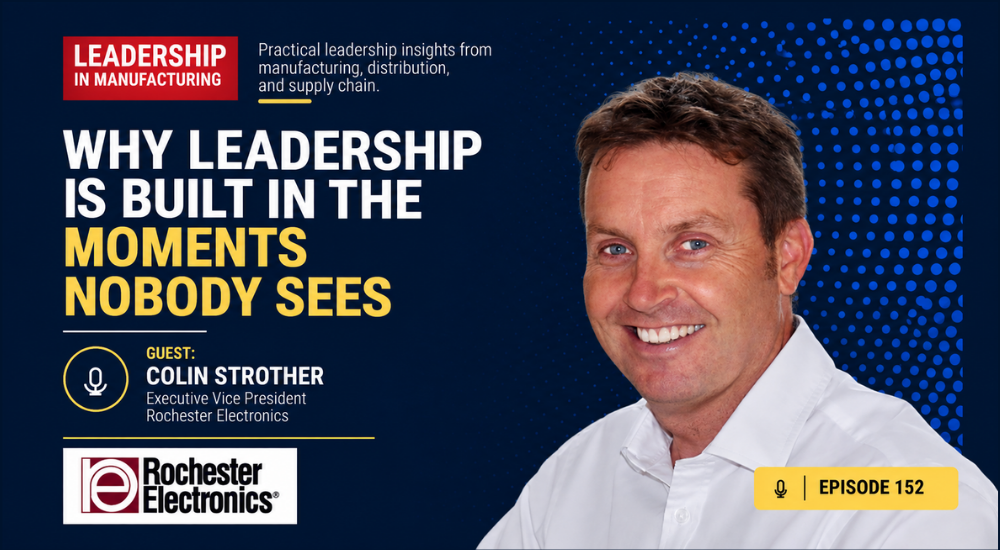
Colin Strother of Rochester Electronics on trust, global teams, customer commitment, and the work leaders do when nobody is asking them to do it
Episode summary
The short version: Leadership is not only what happens in the boardroom or during the difficult conversation. It is also what people see you do when nobody is asking you to do it. In this episode, Colin Strother of Rochester Electronics explains how trust, authenticity, customer commitment, and self-awareness shape leadership across a global electronics business.
Colin Strother started in the electronics industry through an apprenticeship in Scotland, where his education and employment were tied together from the beginning. Since then, he has built a career across electronics, semiconductor distribution, customer experience, and global team leadership. At Rochester Electronics, he has helped build local teams and expand the company’s presence across regions while keeping the customer relationship at the center of the work.
The conversation moves from Rochester’s role in supporting mature and end-of-life semiconductor components to the changing expectations of customers. Colin explains why customers do not want one service channel. They want to meet face to face when trust needs to be built, pick up the phone when they need an answer, and use digital tools when that is the most efficient option.
Colin also shares how his leadership style has developed, why leaders need to remain authentic while learning to pause, and how confidence can change what a new leader is able to contribute. The final example is simple: picking up a piece of trash from the floor because it is there. Small actions can show people what leadership really looks like.
What You’ll Learn
- Why trust is the starting point for influence and customer relationships
- How Colin connects authenticity with getting work done through other people
- Why electronic-component customers expect a combination of personal, phone, and digital service
- What global leaders learn by spending time in local markets and building teams in person
- How mistakes and difficult conversations develop leadership judgment
- Why self-awareness and composure become more important as information moves faster
- How confidence and support helped a new leader step into a larger role
- Why leaders need to model commitment instead of expecting other people to carry it



The Leadership Question
The real tension in this conversation is that digital tools can make information and transactions faster, but they do not remove the need for trust, context, judgment, or personal commitment.
For leaders in electronics manufacturing, distribution, supply chain, sales, and technical teams, that creates a practical question. How do you build systems that give customers speed without losing the human connection that helps them make difficult decisions?
The leadership question is:
How do you make the people, processes, and technology around your customer reinforce trust instead of competing with it?
If leaders miss this, they can build efficient channels that still feel difficult to use. If they get it right, digital tools support the relationship rather than trying to replace it.
Key Moments From the Conversation
Trust comes before influence
Colin starts with a simple leadership principle: people cannot be influenced without trust. That trust depends on people knowing who they are dealing with, which means authenticity is not a personal preference. It is part of the work.
He connects that idea to execution. A leader may have the vision, but the work only moves when other people understand it, buy into it, and help turn it into plans, objectives, tactics, and results.
“You cannot influence people without trust. And for people to trust you, they have to know who you are. To enable that, you have to be your authentic self.”
Customers want choice, not one perfect channel
The conversation turns to customer expectations in electronics distribution. Colin describes a customer who wants face-to-face contact at certain moments, a phone call when a question needs a fast answer, and the ability to complete the same work digitally when that is more convenient.
The practical lesson is that customer experience is not one channel. It is the ability to meet a person where they are without making them start over every time they change channels.
“It wasn’t just one thing. It was many different things. All of the above, at different times.”
Global leadership requires local presence
Colin describes building offices and teams by going to the country, spending time in the local environment, hiring people, and learning how the culture works. He is not treating a global organization as a single template that can be copied without adjustment.
For leaders working across regions, the useful part is the combination of a shared foundation and local understanding. The digital platform can be replicated. Trust still has to be built in each relationship.
“You cannot see the world. You cannot meet people from behind your desk. You’ve got to get up and do it.”
The pause is a leadership skill
Colin and Sannah both talk about reacting too quickly, especially when information moves fast and people expect immediate responses. Colin says learning to maintain composure is a lifelong process, not a skill that gets completed once.
The issue is not whether a leader responds quickly. It is whether the response is deliberate enough to protect the relationship and improve the decision. Sometimes the next move is to take a walk, ask a question, or wait long enough to understand what is actually happening.
“I think it’s a journey. I think it’s a lifelong journey for me to not react, to maintain that composure, that pause.”
“You don’t have to respond in that exact second or within 30 seconds. It is okay to take a moment, think it through, and come back with the right response.”
Confidence changes what people are able to contribute
Colin shares the story of two colleagues in Asia who were nervous in one-on-one conversations, then later grew into people who could command a room while still being direct and respectful. He identifies confidence, experience, and the right support as the difference.
That is a useful reminder for leaders developing new talent. The goal is not to make everyone communicate in the same style. It is to create enough support and opportunity for people to develop a style they can own.
“What changed? Confidence. And that probably came from experience and the right level of support.”
Leadership is visible in the small choices
Near the end of the episode, Colin tells a story about Rochester founder Kurt Gerrish picking up something from the floor. The act was ordinary, but the example stayed with him because it showed that no one is above doing the work that needs to be done.
The point is not that leaders should perform small tasks for attention. It is that people notice whether a leader walks past a problem, waits for someone else to own it, or takes responsibility in the moment.
.
“It’s about doing the right thing when no one’s looking.”
Practical Takeaway
Look for the leadership signal in the small moment.
This week, pay attention to one situation where a problem is visible but ownership is unclear.
- What does your team see you do first?
- Do you ask who owns the problem, or do you help clarify the next step?
- Is there a conversation people only have with you in person?
- What would make that conversation safer and easier to raise earlier?
- Where are you asking technology to carry a relationship that still needs human attention?
The point is not to personally take over every problem. It is to make your response clear enough that people learn what good ownership looks like.
About the guest

Colin Strother
Executive Vice President, Rochester Electronics
Colin Strother is Executive Vice President at Rochester Electronics, where he helps lead global strategy across sales, marketing, business development, product strategy, supply chain, compliance, operations, and business applications.
With more than 20 years of experience in the semiconductor industry, Colin has held leadership roles in worldwide sales, EMEA management, and global commercial operations. His previous experience includes positions at Rochester Electronics, Arrow Electronics, Pattonair, Bi-Link, and Alpha Assembly Solutions.
At Rochester Electronics, Colin supports teams and customers across the Americas, EMEA, APAC, and Japan. His work focuses on long-term semiconductor supply, lifecycle management, and helping customers address component obsolescence through authorized distribution and manufacturing solutions.
Colin began his career as an apprentice electronics engineer in Scotland. He brings a practical technical foundation, global commercial experience, and a people-focused approach to building cross-functional teams and customer relationships.
Episode Chapters
- – 00:00 Trust, authenticity, and turning vision into results
- – 00:39 The creative and task-driven parts of Colin’s leadership style
- – 01:16 Learning from mistakes and developing leadership judgment
- – 01:51 How Colin continues to learn and improve
- – 02:27 Customer service is a human endeavor supported by digital tools
- – 03:47 Episode introduction: Colin Strother and Rochester Electronics
- – 05:59 Colin’s path into the electronics industry
- – 09:18 What makes Rochester Electronics different from a broker or traditional distributor
- – 12:35 Customers are people, not objects
- – 14:01 Meeting customers where they are
- – 16:02 Combining face-to-face, phone, and digital service
- – 18:07 Why global leaders need to get their feet on the street
- – 20:57 Authenticity, trust, and getting work done through others
- – 23:12 Why some people will only raise difficult issues face to face
- – 24:46 Learning from mistakes, scars, and hard conversations
- – 27:23 How do you know if you are a good leader?
- – 30:05 Showing up when customers need you
- – 31:46 Building strategy on hotel stationery
- – 33:10 Bringing the next generation into electronics
- – 33:52 How Colin absorbs information and turns it into ideas
- – 35:53 Balancing creativity with execution
- – 39:31 Self-awareness and learning from difficult interactions
- – 40:35 Building composure when information moves fast
- – 41:20 Confidence, support, and developing new leaders
- – 45:03 Using AI to help sellers practice an important pitch
- – 49:42 The advice Colin would give his younger self
- – 51:58 Doing the right thing when nobody is looking
- – 53:04 Walking the talk during customer pressure
- – 54:53 Closing thought: leadership in the moments nobody sees
Who this episode is for
-
- Leaders building customer experience across sales, service, and digital channels
- Electronics distribution and manufacturer-rep leaders balancing speed with trust
- Managers leading teams across countries and cultural contexts
- Technical sales leaders helping customers make complex decision
- Leaders developing confidence and judgment in the next generation of talent
- Executives thinking about how AI can support training without replacing human judgment
What you will be able to do after listening
-
- Identify where trust is required before influence is possible
- Review whether your customer experience supports channel choice or forces a single path
- Separate a shared global operating foundation from local relationship-building work
- Create more room for new leaders to build confidence through supported practice
- Notice where a pause could improve your response
- Use small visible actions to reinforce the behavior you expect from your team
- Think about AI training tools as practice environments, not replacements for leadership
You can unsubscribe at any time.*
Related Episodes
How Distribution Leaders Build Trust as AI Speeds Up Work – Episode 151
Riad Nizam of Master Electronics shares how distribution leaders build trust, culture, communication, and judgment as AI speeds up work.
Why Good Managers Build Trust Before They Need It – Episode 150
Nate Witsaman of DigiKey joins Sannah Vinding to discuss curiosity, trust, feedback, remote leadership, and developing managers.