
Episode 154
Why Your Product Can Be Invisible Before Sales Gets Involved
Sannah Vinding on helping industrial customers understand product fit, find consistent answers, and know when to bring in a technical expert
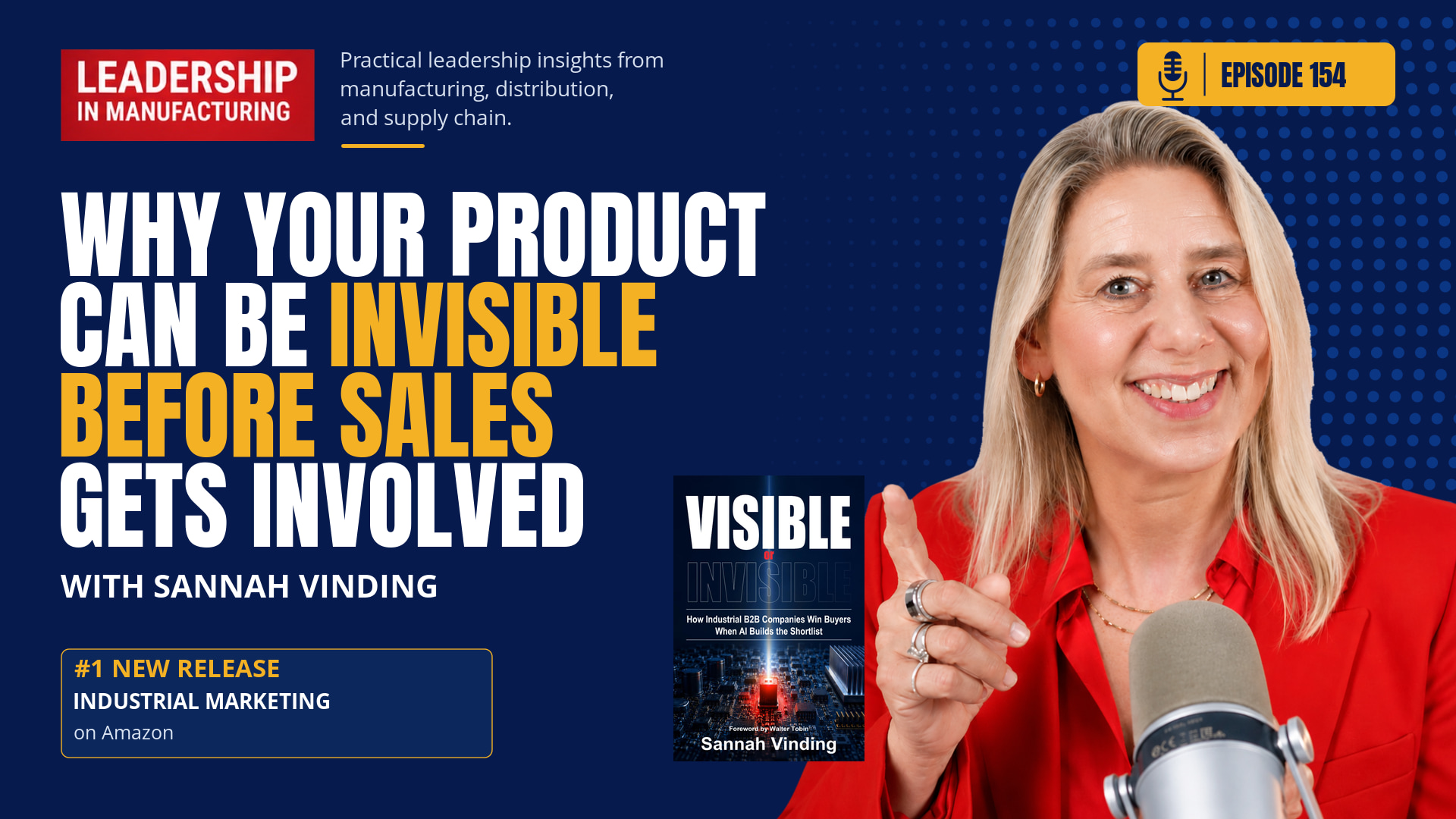

The book behind this episode
Visible or Invisible
How Industrial B2B Companies Win Buyers When AI Builds the Shortlist
Help customers find your expertise, trust your products, and choose your company. A practical guide for industrial B2B teams connecting product knowledge, marketing, sales, and human judgment.
Available in paperback and Kindle. Includes access to the companion toolkit with interactive templates, worksheets, and scorecards.
Get your copyEpisode summary
The short version: Your company can have the right product for a customer’s application and still be overlooked if the customer cannot find the information they need. In this solo episode, Sannah Vinding shares why she wrote Visible or Invisible and how industrial B2B teams can make their expertise easier for customers to find, trust, and use.
Customers may move between AI tools, company websites, technical documents, and distributor pages before speaking with anyone. They need to understand where a product fits, what could change a recommendation, and which details need an expert’s review. When information is incomplete or inconsistent, the customer has more work to do before they can make a decision.
Sannah introduces three buying jobs from the book: Discover, Prove Fit, and De-risk. She also explains the five foundations of the Visible GTM System: Product Truth, Governed Knowledge, Signal Quality, Workflow Readiness, and Human Trust.
The practical starting point is small. Choose one product family or application, bring together the people who support it, and work through one recurring customer question. Agree who prepares the answer, who checks the technical details, who approves it, and who keeps it current. Then check whether the answer helps customers and the people who work with them.
What You’ll Learn
- Why useful product knowledge can remain difficult for customers to find
- How customers move between Discover, Prove Fit, and De-risk
- Where inconsistent website, data sheet, and distributor information creates uncertainty
- How engineering, product management, product marketing, sales, customer service, reps, and distribution contribute to a usable answer
- What the five foundations of the Visible GTM System mean in practic
- How to choose one customer question and improve the answer together
- Why technical judgment, application knowledge, and human relationships remain part of the buying decision



The Leadership Question
Your team knows who to call when a product question gets complicated. A customer researching your company may have no idea where to turn.
For leaders, the work involves connecting the people who know the answers with the places customers look. It also means deciding who is responsible for technical review, approval, updates, and the handoff to someone who can help with an application.
The leadership question is:
Can a customer find and use your team’s knowledge before they speak with you, and is it clear when they need a person to help?
Start by tracing one recurring question across your website, technical documents, and distributor pages. Look for the gaps a customer would encounter without your internal knowledge.
Key Moments From the Conversation
The missed opportunity may happen before a conversation
Sannah opens with a customer who finds a product but cannot tell whether it will work in their design. Someone inside the company could answer the question quickly, yet that explanation is missing when the customer needs it.
This is the question behind the book: how much of the knowledge across your teams can a customer actually find and use?
Customers move between three jobs
Discover, Prove Fit, and De-risk describe work a customer needs to do. A customer may begin with an AI answer, check a company website, compare a distributor page, and look for technical proof. A new question or a request from procurement can send them back to research.
The useful question for your team is whether the available information helps the customer move through those jobs, including knowing when to speak with an engineer or salesperson.
A reliable answer needs shared ownership
Sales, customer service, reps, and distributors hear where customers get stuck. Application engineers help check whether an answer holds up in the customer’s application. Product management brings requirements, capabilities, and limitations. Product marketing helps make the explanation clear, and marketing helps put it where customers look.
Job titles may vary, and one person may cover several roles. The team still needs to agree who prepares the answer, checks it, approves it, and maintains it.
The five foundations give the team a place to start
- Product Truth: Explain what the product does, where it fits, and where it does not.
- Governed Knowledge: Make ownership, review, and updates clear.
- Signal Quality: Consider whether observed activity shows meaningful customer interest. A click or download alone does not establish purchase intent.
- Workflow Readiness: Clarify who owns each step, who reviews the work, and when another person needs to help.
- Human Trust: Make it possible for customers to reach people who understand the application, check assumptions, and explain trade-offs.
Use these foundations to examine one product family and one recurring question. Choose a gap your team can work on together.
Human expertise helps customers decide
Customers can arrive with research and still need help checking what it means for their application. Are they comparing the same product and information? Which assumptions need attention? What else needs to be understood before a recommendation is made?
“AI helps prepare, people help customers decide.”
AI can help organize and prepare information. People remain responsible for the advice, decisions, and commitments that follow. Sannah also explains that no formula guarantees inclusion in an AI answer
Practical Takeaway
Work through one recurring customer question
- Choose one product family or application and bring together the people who support it.
- Ask which customer question comes up repeatedly. Discuss the answer before writing anything.
- Identify the conditions, limitations, and trade-offs. Agree when the customer needs an application engineer.
- Look for the answer on your website, in the data sheet, and on the distributor page. Read it as someone unfamiliar with the product.
- Assign an owner to write the explanation and an appropriate technical expert to review it.
- Agree who approves the answer, maintains it, and shares changes with the people and channels using it.
- Check whether customers can understand the options and whether sales can use the explanation. Learn from the remaining questions before expanding the work.
About the host and author

Sannah Vinding
Author of Visible or Invisible | Product Marketing & GTM Leader | Engineer
Sannah Vinding is the host of Leadership in Manufacturing and the author of Visible or Invisible: How Industrial B2B Companies Win Buyers When AI Builds the Shortlist. Her career spans work across engineering, product management, product marketing, sales, and distribution.
In this episode, she brings those perspectives together around a practical question: how can companies make their internal expertise useful to customers while keeping people responsible for technical judgment and advice?
About Visible or Invisible
Visible or Invisible: How Industrial B2B Companies Win Buyers When AI Builds the Shortlist explores how industrial B2B companies can help customers find, trust, and use their knowledge as AI becomes part of the research process.
The book is relevant to teams across manufacturing, semiconductors, components, materials, distribution, and manufacturers’ representation. It includes access to a companion toolkit with interactive templates, worksheets, and scorecards. Access instructions are inside the book. Walter Tobin wrote the foreword.
#1 New Release in Industrial Marketing on Amazon.
Learn about the book: https://visibleorinvisible.com
Paperback on Amazon: https://www.amazon.com/dp/B0HMFQGWJW
Kindle on Amazon: https://www.amazon.com/dp/B0HMFCJJKJ
Episode Chapters
-
00:00 The product question a customer could not answer
-
00:44 Why I wrote Visible or Invisible
-
02:04 Start small and look beyond internal knowledge
-
02:45 Researching options before a conversation
-
03:28 Discover, Prove Fit, and De-risk
-
04:00 Consistent answers and technical judgment
-
04:55 Shared ownership and one recurring customer question
-
06:05 Review, approve, maintain, and test the answer
-
07:02 The five foundations of the Visible GTM System
-
08:09 Human Trust and helping customers decide
-
08:49 The companion toolkit, foreword, and book details
-
09:24 Closing thoughts
Who this episode is for
-
- Manufacturing and industrial B2B leaders responsible for connecting technical expertise with customer needs
- Product management and product marketing teams improving product explanations
- Sales and customer service teams answering recurring application questions
- Application engineers reviewing product claims, conditions, and limitations
- Distributors and manufacturers’ reps working with product information across channels
- Teams exploring how AI-supported research affects the information customers need
What you will be able to do after listening
-
- Choose a recurring customer question to work on with your team
- Look for gaps and inconsistencies across the places customers research products
- Clarify ownership for preparing, checking, approving, and maintaining answers
- Identify when a customer needs technical help to assess an application
- Use the five Visible GTM foundations to organize a small improvement before expanding it
You can unsubscribe at any time.*
Related Episodes
Why Leadership Is Built in the Moments Nobody Sees- Episode 152
Colin Strother, Executive Vice President at Rochester Electronics, joins Sannah Vinding to discuss trust, authenticity, customer commitment, and leading global teams across the electronics industry. They talk about why customers need both digital and personal service, how leaders develop confidence and composure, and what small actions reveal about leadership.
How Distribution Leaders Build Trust as AI Speeds Up Work – Episode 151
Riad Nizam of Master Electronics shares how distribution leaders build trust, culture, communication, and judgment as AI speeds up work.