
Episode 153
How Leaders Prepare Sales Teams for Growth With AI and Better Training
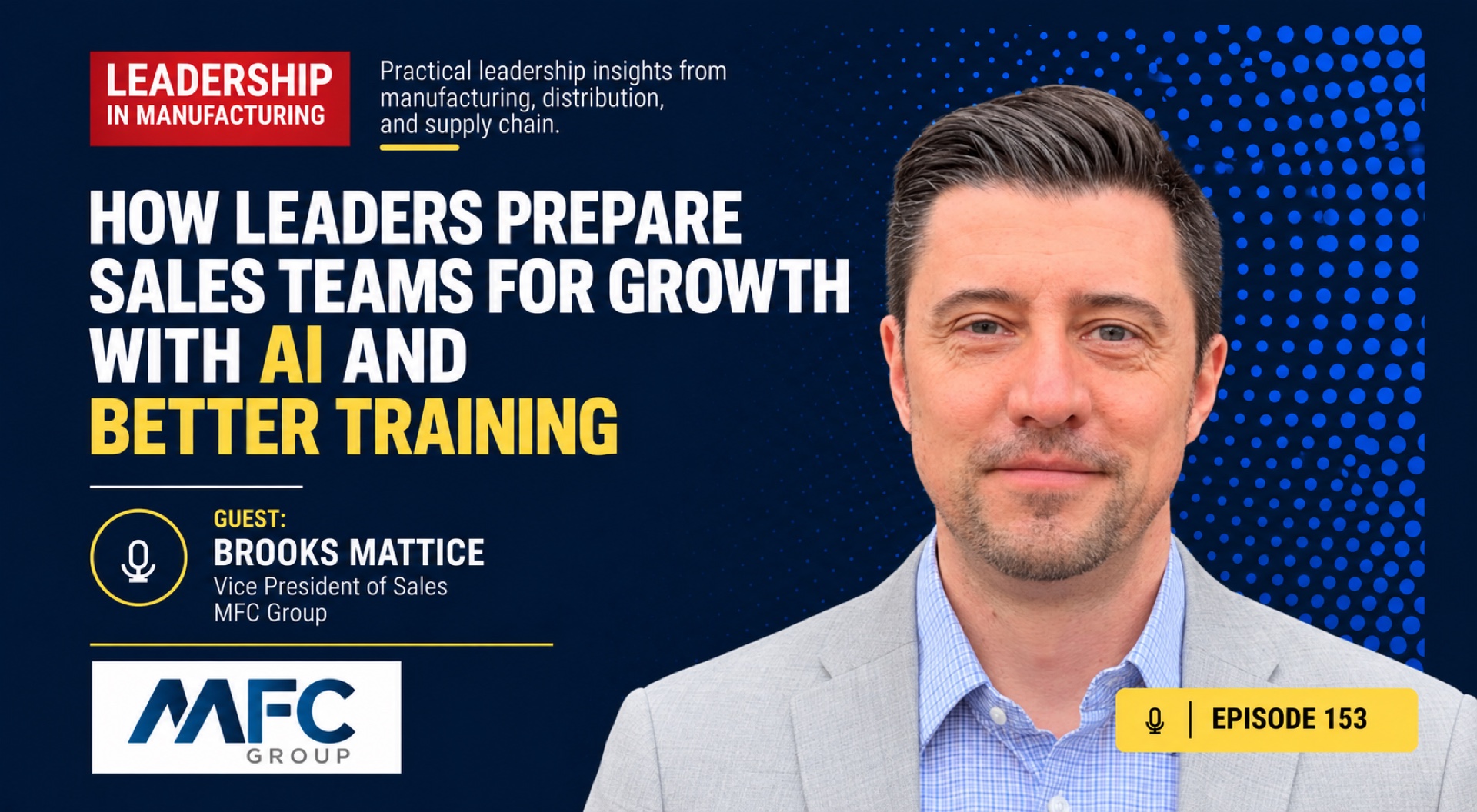
Brooks Mattice of MFC Group on sales training, AI-supported preparation, and the judgment behind customer trust
Episode summary
The short version: Sales teams do not become stronger simply because they have access to more tools. Brooks Mattice explains how MFC Group combines structured training, practical onboarding, manager feedback, and AI-supported research to help salespeople prepare better and spend more time in front of customers.
Brooks Mattice, Vice President of Sales and Partner at MFC Group, has spent more than 25 years across semiconductor, electronic systems, EMS, passive, electromechanical, and wireless markets. He moved from field sales into leadership and now helps lead an employee-owned manufacturers’ representative firm across 20 states.
As MFC Group grew from roughly seven states and 28 people to 20 states and more than 80 people, the company saw the need for a shared minimum standard for sales skills and processes. Its training combines skills training, process training, outside trainers, homework, quizzes, and reinforcement through weekly and biweekly manager conversations.
The conversation also looks at how AI is helping new salespeople research accounts, identify contacts, estimate market opportunity, understand product fit, create training modules, and prepare for customer conversations. The point is not to replace sales judgment. It is to reduce preparation friction so salespeople can stay in front of customers more often.
What You’ll Learn
- Why product training alone is not enough for a growing sales organization
- How to establish a shared minimum standard for sales skills and processes
- How structured onboarding can help new salespeople become productive faster
- How AI can support account research, contact hunting, TAM and SAM analysis, fit analysis, and training
- Why AI should help salespeople prepare, not replace their judgment
- How managers can reinforce training through regular conversations
- Why feedback should happen before a problem becomes harder to address
- How leaders can use early adopters and testing groups before rolling out new tools



The Leadership Question
The real tension in this conversation is that sales teams are being asked to use more tools while customers, suppliers, and markets are becoming harder to navigate. More information does not automatically create better decisions or better customer conversations.
For sales leaders, manufacturers’ representatives, and managers of technical teams, the question is how to build enough shared process and capability that people can use new tools without losing judgment, curiosity, or trust.
The leadership question is:
How do you prepare people to use AI well before you ask AI to accelerate the work?
If leaders skip the training, operating rhythm, and review loops, the organization may produce more activity without creating better customer value.
Key Moments From the Conversation
Growth requires people to move beyond the comfort zone
Brooks describes growth as something that happens when people push themselves into unfamiliar situations and learn from the experience. In sales, that can mean calling someone who does not know you, learning to speak in front of a group, or taking on a leadership role after being a peer.
The practical lesson is not to remove every uncomfortable moment. It is to help people move through it with enough support and reflection to improve.
“Growth doesn’t occur in the comfort zone.”
Sales training needs a shared operating standard
MFC Group already received plenty of product training from suppliers, but that did not cover the sales skills and processes the organization needed as it expanded. The company created a shared minimum standard through skills training, process training, homework, quizzes, and manager reinforcement.
That structure gave experienced salespeople useful reminders and gave newer employees a clearer way to build capability. It also became a differentiator with principal partners because the training was part of how MFC Group operated, not a one-time event.
“We need to standardize on a set of skills and processes that are kind of like our minimum standard of entry.”
AI can reduce preparation friction
Brooks explains how MFC Group is using AI with new college graduates to research accounts, identify contacts, estimate TAM and SAM, assess fit, and connect a line card to likely applications and engineering teams.
Compared with the old model of handing a new salesperson large data books and asking them to make 25 calls a week, the new approach gives people a more focused plan of attack. AI prepares the work. The salesperson still has to validate the information, ask good questions, and build the relationship.
“Everything we do with AI is to keep our salespeople in front of customers more often.”
Leaders need honest feedback, not only encouragement
Brooks reflects on the transition from being a peer to becoming a manager. Earlier in his management career, he gave too much praise and was not direct enough about areas for improvement. Over time, he learned that delaying a difficult conversation usually makes the problem harder to address.
For managers, the useful move is to make feedback timely, honest, and constructive while still recognizing strong work.
“If you delay that conversation, it becomes worse.”
AI prepares the work. People make the judgment
Sannah brings the conversation back to the human role in AI-supported sales work. AI can help research accounts, organize information, and reduce preparation friction, but it cannot replace the expertise of the person leading the customer conversation.
For technical sales teams, the last mile still depends on judgment. Someone has to understand the customer’s situation, test whether the information is relevant, ask the next useful question, and connect the right product or solution to the real need.
“AI can really prepare the work and help you, but it’s the people who need to do the judgment.”
Early adopters help organizations test before scaling
MFC Group uses an innovation committee and a group of early adopters to evaluate new tools. The team tests whether a calculator, analysis workflow, or AI application is robust enough before considering broader adoption.
This creates a practical bridge between experimentation and operating discipline. New tools have to prove that they improve the work, support the sales team, and produce information that can be trusted.
“We vet these things pretty well and we’ll test for beta certain tools to make sure that they’re robust enough for use.”
Practical Takeaway
Build the training and review loop before scaling the tool
Before introducing another AI tool to a sales team, define what good preparation looks like and how managers will reinforce it.
- Choose the minimum sales skills and processes everyone needs to understand.
- Give people a repeatable way to research an account and prepare for a customer conversation.
- Test the AI workflow with a small group of early adopters.
- Require people to check the output against product, customer, and market knowledge.
- Use weekly or biweekly manager conversations to reinforce the process
- Track whether the tool is helping salespeople spend more time in useful customer conversations.
The tool becomes more useful when the team knows what good work looks like before the tool enters the workflow.
About the guest

Brooks Mattice
Vice President of Sales, MFC Group
Brooks Mattice is Vice President of Sales and Partner at MFC Group, where he helps electronics suppliers and customers build durable business across a 20-state territory. With more than 30 years at TMC and MFC Group, he brings deep experience in semiconductor, electronic systems, EMS, design services, passive components, and electromechanical solutions.
Brooks works with manufacturers, distribution partners, and OEM customers to align component technologies with real application requirements. His background spans automotive, industrial, HVAC, appliances, medical, lighting, military and aerospace, communications, computing, data center, and EMS markets.
He is focused on building accountable customer relationships, developing high-performing sales teams, and supporting design-to-production opportunities. His approach reflects MFC Group’s employee-owned culture and its core values: service, performance, integrity, relationships, innovation, and teamwork.
Episode Chapters
- [00:00] Growth, discomfort, and keeping salespeople in front of customer
- [03:05] Why the manufacturers’ rep role is becoming more valuabl
- [05:34] Brooks’ path from electrical engineering to sales leadershi
- [11:17] Moving from field sales into organizational leadershi
- [17:00] Building a shared sales training and onboarding proces
- [22:21] Using AI to research accounts and prepare new salespeopl
- [27:37] Data quality, early adopters, and testing AI tool
- [29:58] Learning from peers instead of reinventing everythin
- [32:25] Feedback, recognition, and leading former peer
- [35:06] Authenticity, transparency, and patienc
- [37:03] Leading through shortage, excess, and market swing
- [42:01] How leaders know whether they are leading wel
- [44:00] Culture, listening, and using talented people wel
- [47:51] Closing thought
- [48:11] Host reflection and closing
Who this episode is for
-
- Sales leaders building capability across a growing organization
- Manufacturers’ representative leaders working across regions and product lines
- Managers onboarding early-career salespeople
- Technical sales teams using AI for customer and market research
- Leaders balancing supplier expectations with customer relationships
- Managers learning how to give clearer and more timely feedback
What you will be able to do after listening
-
- Build a shared minimum standard for sales skills and processes as your organization grows
- Design onboarding that combines skills training, process training, practice, quizzes, and manager reinforcement
- Use AI to research accounts, identify contacts, estimate TAM and SAM, and assess product fit
- Keep human judgment and customer understanding at the center of AI-supported sales preparation
- Test new AI tools with early adopters before rolling them out across the organization
- Give feedback early, clearly, and constructively before a problem becomes harder to address
- Help salespeople move through uncomfortable situations with the support and practice they need to improve
You can unsubscribe at any time.*
Related Episodes
How Distribution Leaders Build Trust as AI Speeds Up Work – Episode 151
Riad Nizam of Master Electronics shares how distribution leaders build trust, culture, communication, and judgment as AI speeds up work.
Why Good Managers Build Trust Before They Need It – Episode 150
Nate Witsaman of DigiKey joins Sannah Vinding to discuss curiosity, trust, feedback, remote leadership, and developing managers.