
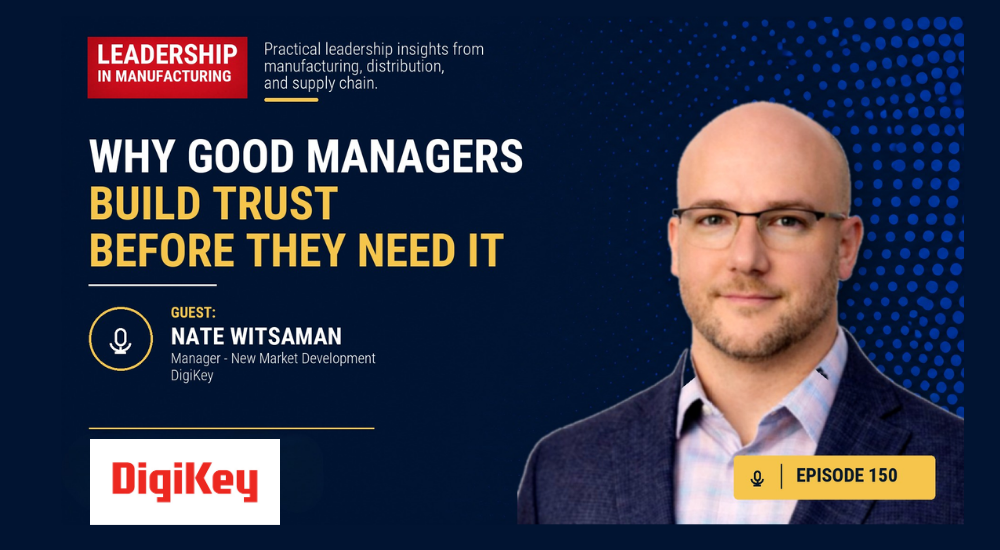
Episode 150
Why Good Managers Build Trust Before They Need It
Nate Witsaman of DigiKey on curiosity, communication, and developing people
Episode summary
The short version: Good managers do not wait until something goes wrong to build trust with their people. In this episode, Nate Witsaman, Manager of New Market Development at DigiKey, talks about curiosity, communication, feedback, and the everyday habits that help leaders develop people instead of only manage tasks.
Nate Witsaman, Manager of New Market Development at DigiKey, joined Sannah Vinding on the Leadership in Manufacturing Podcast to talk about management, trust, curiosity, remote leadership, and developing people in technical teams.
Nate works with emerging technologies, supplier relationships, product onboarding, and market development across DigiKey’s global electronics distribution platform. His role connects market strategy, supplier needs, customer value, and the practical work of helping teams see what is coming next.
The conversation moves through the shift from being a strong individual contributor to becoming a manager, and why that shift is not only about getting work done. Nate talks about why good managers stay curious, how leaders can build trust with each person on the team, and why communication needs to change depending on the person receiving it.
The strongest thread in the episode is trust. Nate shares the idea of building a bank account with each person who works for you. The small deposits matter: the check-in, the honest question, the direct feedback, the pause in a meeting, and the time spent understanding how each person works best. If leaders wait until the hard moment to build the relationship, they are already late.
What You’ll Learn
- Why curiosity is one of the strongest management skills
- How to build trust before a difficult conversation happens
- Why recognition and feedback need to be personal, not generic
- How remote leaders can avoid becoming only transactional
- Why quieter team members may need room and a direct invitation to speak
- How slowing down can help teams improve before things break
- Why safe practice matters when developing future leaders
- How feedback improves when leaders separate the message from the emotion



The Leadership Question
The real tension in this conversation is that many people get promoted because they were strong individual contributors. Then they become managers and realize the work is different. The job is no longer only about doing the task well. It is about understanding people, communication, timing, trust, and how each person grows.
For managers, directors, product leaders, supplier leaders, sales leaders, and technical team leads, that shift matters. If leaders only manage work, they may miss what is actually happening with the people doing the work.
The leadership question is:
Are you building trust with your team before you need to ask for honesty, change, or extra effort?
If leaders wait until the hard moment to build the relationship, they are already late. Trust is built in the smaller moments: the check-in, the pause, the question, the honest feedback, and the time spent understanding how each person works best.
Key Moments From the Conversation
Why good managers stay curious
Nate connects good management with curiosity. When someone is struggling, quiet, or not performing in the way a leader expected, the first answer is not always the real answer.
For managers in technical teams, performance issues are not always skill issues. Sometimes the person is missing context, confidence, trust, or the right kind of communication from their leader.
Curiosity helps a manager slow down long enough to understand what is actually happening before deciding how to respond.
“I think good managers are very curious. We should never believe that we have all the answers.”
Trust is built before the hard conversation
Nate describes trust as something leaders build over time with each person on the team. It is not created in one big moment. It comes from small, consistent interactions before pressure shows up.
That trust becomes important when a leader needs to give feedback, ask for honesty, support someone through a hard moment, or ask the team to stretch. If the relationship is too thin, the hard conversation becomes harder than it needs to be.
For managers, the practical lesson is clear: build the relationship before you need to rely on it.
“You’ve got to build your bank account with each individual that works for you.”
Remote leadership has to be intentional
Remote work changed how leaders build relationships with their teams. The casual moments that used to happen in the hallway, over coffee, or after a meeting do not happen the same way when people are spread across locations.
Without intention, communication can become only transactional: task updates, deadlines, meetings, and Teams messages. Leaders need to create room for connection, notice who has been quiet, and check in before something is wrong.
For distributed teams in electronics, manufacturing, and distribution, relationship-building is not extra work. It is part of how trust and communication stay strong.
“You have to be very intentional as a leader to not just have it be like a transactional communication in Teams.”
Slow down before you speed up
Sannah brings up the pressure leaders feel when everything is moving faster and faster, and the need to slow down before trying to speed up again. Nate connects that idea to one of his favorite leadership reminders.
Middle managers often feel pressure from both directions: executive expectations on one side and individual contributors on the other. Moving quickly can feel productive, but it can also push a team down an inefficient path.
The practical move is to pause long enough to ask what should stop, what should start, what can be automated, and what can be delegated. Slowing down gives the team a better chance to move in the right direction.
“We also need to make sure that we slow down and then you can speed up.”
Develop people before the pressure is high
Nate describes a monthly leadership-development habit where supervisors and leaders take turns bringing a topic and leading a discussion. It gives people a place to practice presentation skills, talk through leadership ideas, and learn from each other.
This kind of practice gives future leaders room to build confidence before the stakes are high. They can try, miss, adjust, and learn before they are carrying a bigger leadership responsibility.
For leaders, development is not only about identifying who is ready today. It is about creating the conditions that help people become ready before the opportunity arrives
.
“Develop them in a space where they can try, possibly fail, but build those skills.”
Practical Takeaway
Build the trust account before you need to use it.
This week, look at your team and ask whether you are only connecting when there is a task, a deadline, or a problem. If the answer is yes, the relationship may be too thin for the moment when you need honesty, speed, or change.
Try this:
- Pick two people you have not checked in with recently.
- Ask one question that is not tied to a task.
- Notice who is quiet in your next team call and invite their view.
- Ask one person how they prefer to receive recognition or feedback.
- Before giving feedback, separate the facts from your own frustration.
- Set aside time with your team to ask: what should we stop doing, start doing, automate, or delegate?
Trust does not come from one big leadership moment. It comes from small deposits made before the pressure shows up.
About the guest

Nate Witsaman, MBA
Manager, New Market Development, DigiKey
Nate Witsaman is Manager of New Market Development at DigiKey, where he works on identifying and scaling emerging technologies and supplier relationships that bring long-term value to engineers, system integrators, and OEMs worldwide. His work connects market strategy, supplier relationships, product onboarding, and customer value across DigiKey’s global distribution platform.
In this episode, Nate brings a practical management perspective shaped by business development, Lean Six Sigma, marketplace work, and leadership inside the electronics distribution industry. He talks about curiosity, communication, feedback, and the daily habits that help managers develop people instead of only manage work.
Guest LinkedIn: https://www.linkedin.com/in/natewitsaman
Episode Chapters
- [~00:00] Opening clip: curiosity, slowing down, and developing people
- [~01:46] Book message: Visible or Invisible
- [~02:26] Episode introduction
- [~04:07] Sannah welcomes Nate Witsaman
- [~04:54] Why Nate loves the electronics industry
- [~06:20] What separates managers from people developers
- [~06:37] Why good managers stay curious
- [~09:12] Building trust with each person on the team
- [~11:20] Asking how people want to communicate
- [~14:12] How remote work changed relationship building
- [~16:41] Bringing remote teams together with intention
- [~19:23] Making space for quieter voices in Teams calls
- [~21:21] Slowing down before speeding up
- [~22:43] Asking what should stop, start, automate, or delegate
- [~24:44] Translating internal product language for customers
- [~26:27] Challenging the process while things are going well
- [~29:01] How Nate keeps learning
- [~32:23] Monthly leadership learning inside the team
- [~36:03] Learning from leaders who create room to grow
- [~39:28] Asking for feedback as a leader
- [~40:33] Leading across generations
- [~42:26] Giving feedback in a way people can receive
- [~46:58] Nate’s advice to his younger self
- [~48:16] Closing thought and share ask
Who this episode is for
-
- Managers who are moving from strong individual contributor to people leader
- Distribution leaders managing remote or cross-functional teams
- Product and supplier leaders working across internal and external teams
- Sales and business development leaders who need trust before the hard conversation
- Technical leaders who want to develop people, not only manage tasks
- Rising leaders preparing for future management roles
What you will be able to do after listening
-
- Reframe curiosity as a management skill
- Ask better questions before assuming the reason behind a performance issue
- Identify where your remote communication has become too transactional
- Build trust through small, consistent check-ins
- Recognize how each person prefers to receive feedback and recognition
- Create safer ways for developing leaders to practice and learn
- Use slower reflection time to improve team processes before pressure rises
You can unsubscribe at any time.*
Related Episodes

How Leaders Prepare Sales Teams for Growth With AI and Better Training – Episode 153
Brooks Mattice of MFC Group explains how leaders prepare sales teams for growth through training, onboarding, feedback, and AI-supported tools.

Why Leadership Is Built in the Moments Nobody Sees- Episode 152
Colin Strother, Executive Vice President at Rochester Electronics, joins Sannah Vinding to discuss trust, authenticity, customer commitment, and leading global teams across the electronics industry. They talk about why customers need both digital and personal service, how leaders develop confidence and composure, and what small actions reveal about leadership.