
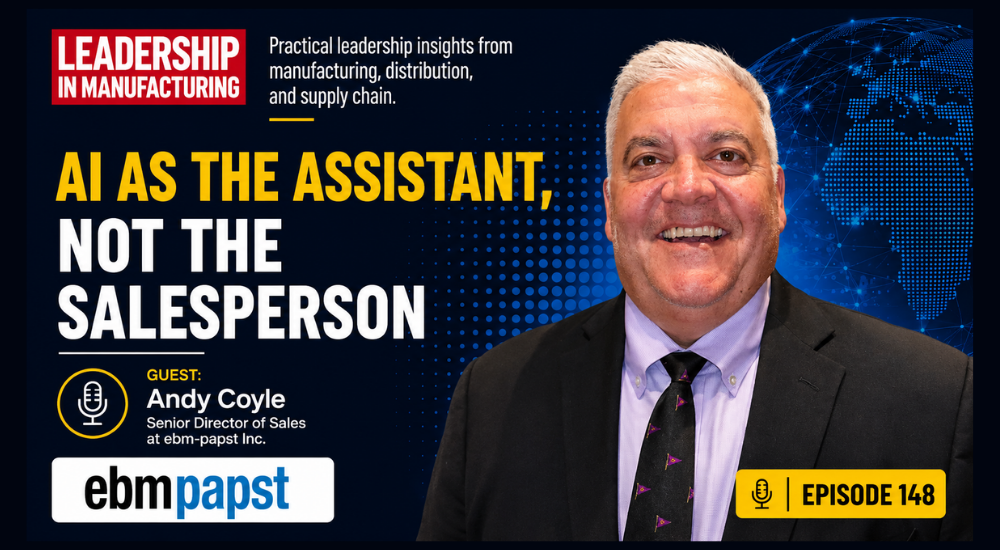
Episode 148
AI as the Assistant, Not the Salesperson
Andy Coyle on AI, sales workflows, CRM, and the human work that still matters
Episode summary
The short version: AI can help sales teams research faster, document better, and reduce repetitive work. In this short follow-up episode, Andy Coyle explains how manufacturers can use AI as an assistant while protecting the human work that still matters: judgment, trust, and customer relationships.
Andy Coyle is Senior Director of Sales at ebm-papst Inc. He has spent more than thirty years in electronics, distribution, and manufacturing sales, with experience at Hallmark Electronics, Sager Electronics, Laird Technologies, and ebm-papst.
This short episode follows Sannah’s two-part conversation with Andy in Episode 146 and Episode 147. After the main recording, Sannah asked Andy one more question: how should manufacturers use AI better?
Andy talks about using AI for research, sales preparation, CRM updates, documentation, follow-up, quoting, and parts analysis. He also explains why AI can prompt better thinking when it challenges the way we ask questions, search for information, and look at a market.
The practical lesson is simple: AI can take friction out of the work, but it should not replace the salesperson. It can support the process. It can help teams move faster. But the customer conversation still needs trust, context, judgment, and a person who understands the relationship.
What You’ll Learn
- How Andy uses AI instead of traditional search for some research tasks
- Why AI can prompt better questions and deeper thinking
- Where AI can help sales teams with CRM, follow-up, and documentation
- How manufacturers can use AI to reduce repetitive administrative work
- Why distributors may move faster than manufacturers on systems and tools
- Why AI should be treated as an assistant, not the salesperson
- How leaders can help teams use AI without losing judgment
- Why the human work that still matters cannot be handed off to a tool




The Leadership Question
The real tension in this conversation is that AI can make parts of the sales process faster, but speed is not the same as trust.
For sales leaders, channel leaders, manufacturer reps, distribution leaders, and technical teams, that creates a practical question. Where should AI support the work, and where does the human still need to lead?
The leadership question is: Are you using AI to support better customer work, or are you just adding another tool to the process?
If leaders miss this, they risk treating AI as a shortcut instead of a support system. If they get it right, they can reduce administrative drag, improve preparation, and give sales teams more room for the human work that still matters.
“AI can help with the repetitive work. The real work still needs people who can think, listen, and close the loop with the customer.”
Key Moments From the Conversation
AI can be more than a search tool
Andy explains that he does not use search engines the same way he used to. He now uses tools like ChatGPT and Copilot for research, market questions, and exploring information in a more interactive way.
The useful part is not only the answer. It is the way AI can prompt another question, push the user to go deeper, and make someone think differently about what they are trying to understand.
“It actually prompts my own thinking.”
AI can reduce the administrative drag on sales teams
Andy talks about using AI to help salespeople do their jobs more efficiently. That includes CRM updates, follow-up, documentation, and the repetitive work that takes time away from customers.
For sales leaders in manufacturing and distribution, this is a practical starting point. Before making AI a broad strategy, look at the tasks your team repeats every week. Those are often the places where AI can help first.
“AI is an assistant, as a tool, to help them spend less time on the administrative part of their job.”
Manufacturers and distributors may not move at the same systems speed
Andy gives a practical explanation for why distributors often have more advanced systems and technology than manufacturers. His view is that manufacturers have to invest heavily in R&D, product development, production, and engineering resources.
That matters because AI adoption is not only about interest. It is also about where capital, systems, data, and process maturity already exist inside the business.
“Manufacturers are usually behind the distributors. We spend all of our money on R&D.”
AI should support the work, not remove the thinking
Sannah connects Andy’s comments back to a practical leadership point. AI can speed up research and reduce repeated process work, but people still need to do the thinking.
That is especially true in technical sales, where customers are not only buying information. They are making decisions about risk, timing, trust, fit, and confidence.
“It can speed up some processes that are just repetition. Then you can go in and do the real work.”
The customer conversation still belongs to people
The strongest part of the episode is the distinction between preparation and the customer conversation. AI can help before and after the meeting. It can organize, summarize, draft, compare, and speed things up.
But the human part of sales still matters. Someone has to read the room, understand the customer’s concern, validate the risk, and help close the loop.
“The last mile is when you’re talking to that customer.”
Practical Takeaway
Start with one workflow, not a broad AI rollout.
If you lead a sales, channel, or customer-facing team, do not start by asking where AI can be used everywhere. Start with one workflow your team already repeats every week.
Look for the work that is important, but repetitive. CRM updates. Meeting notes. Customer research. Quote preparation. Follow-up drafts. Internal documentation.
Ask your team:
- Where are we spending time on repeat work?
- Where do we need better consistency?
- Where do people avoid the process because it takes too long?
- Where could AI help prepare the work without owning the final answer?
- Where does human review need to stay in place?
The goal is not to make AI the salesperson. The goal is to remove friction so people have more time and capacity for the customer work that still needs trust, judgment, and context.
About the guest

Andy Coyle
Senior Director of Sales, ebm-papst Inc.
Andy Coyle is Senior Director of Sales at ebm-papst Inc., where he leads sales and channel development across technical markets that include air movement, cooling, HVACR, data centers, refrigeration, industrial equipment, and related applications.
Andy has spent more than thirty years in electronics, distribution, and manufacturing sales. His career includes time at Hallmark Electronics, Sager Electronics, Laird Technologies, and ebm-papst. He describes himself as a high-touch leader in a high-tech world, and his leadership approach centers on people, trust, sales fundamentals, and long-term customer and distributor relationships.
Episode Chapters
- – [00:00] Opening clip: AI, CRM, and the last mile
- – [01:21] Introduction to the short follow-up episode
- – [02:29] How Andy uses AI for research
- – [03:27] Using AI to support salespeople and reduce admin work
- – [04:19] CRM, documentation, quoting, and parts analysis
- – [04:40] Why manufacturers and distributors invest differently in systems
- – [05:52] AI as a tool, not the problem or the solution by itself
- – [07:34] How AI can speed up repetitive work
- – [08:11] The human work that still matters
- – [08:45] Closing remarks
- – [09:00] Outro and link to the full Andy Coyle conversation
Who this episode is for
This episode is useful for:
- Sales leaders thinking about where AI fits into the sales process
- Manufacturer reps and channel leaders balancing tools with relationships
- Distribution leaders looking at AI, CRM, quoting, and workflow support
- Technical sales teams trying to reduce administrative work
- Manufacturing leaders evaluating how to introduce AI without creating more noise
- Executives who want better data, better process, and stronger customer follow-through.
What you will be able to do after listening
After listening, you will be able to:
- Identify where AI can support repetitive sales work
- Reframe AI as an assistant instead of a replacement
- Evaluate where CRM, documentation, and follow-up processes create friction
- Ask better questions about AI adoption inside sales teams
- Recognize why better tools still need better workflows
- Protect the human work that still matters in customer relationships
- Start a practical AI conversation with your team without turning it into hype
Listen to the full Andy Coyle conversation
This short episode follows Sannah’s two-part conversation with Andy Coyle:
- Episode 146: Why the Last Mile of Sales Still Happens Face to Face
- Episode 147: Why Strong Leaders Get Comfortable Saying “I Don’t Know”
You can unsubscribe at any time.*
Related Episodes
How Distribution Leaders Build Trust as AI Speeds Up Work – Episode 151
Riad Nizam of Master Electronics shares how distribution leaders build trust, culture, communication, and judgment as AI speeds up work.
Why Good Managers Build Trust Before They Need It – Episode 150
Nate Witsaman of DigiKey joins Sannah Vinding to discuss curiosity, trust, feedback, remote leadership, and developing managers.