
Episode 146
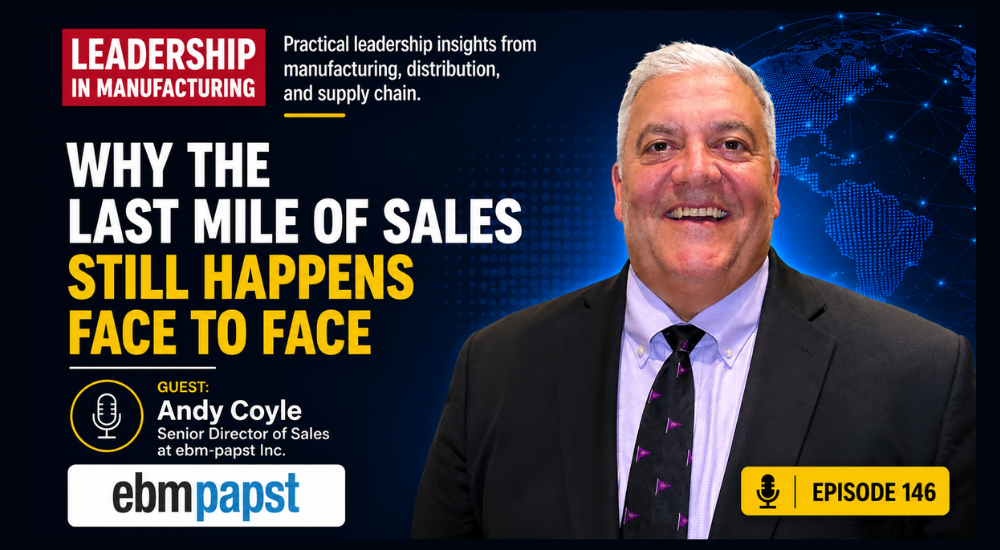
Why the Last Mile of Sales Still Happens Face to Face
Andy Coyle on sales training, trust, AI, and the basics teams still need
Episode summary
The short version: Sales teams have more tools than ever, but the last mile of sales still depends on trust, judgment, and the ability to read the room. In this episode, Andy Coyle explains why sales training, face-to-face communication, and people-first leadership still matter for leaders in electronics, manufacturing, distribution, and channel sales.
Andy Coyle is Senior Director of Sales at ebm-papst Inc. He has spent more than thirty years in electronics, distribution, and manufacturing sales. His perspective is useful because he has worked both sides of the table. He understands the speed and pressure of distribution, and he also understands the longer design cycles, engineering resources, and decision-making patterns inside manufacturing.
This conversation goes into what changed after COVID, what got lost when teams moved away from face-to-face selling, and why product training and CRM training cannot replace the basics of sales training. Andy talks about running a post-COVID sales boot camp with his team, going back to networking, prospecting, pre-call planning, sales calls, follow-up, and role play.
We also talk about AI. Andy is clear that AI has helped him research faster, compare information, and learn things he would not have tried before. But his point is practical: when the opportunity is big or the relationship is under pressure, people still get on a plane. That is where Sannah’s last-mile framing fits. AI can support the work, but people still have to carry the trust.
What You’ll Learn
- Why sales training has been crowded out by product, CRM, and tool training
- What salespeople lose when they stop practicing face-to-face conversations
- Why vulnerability is a strength in technical and commercial teams
- How Andy used a post-COVID boot camp to bring his team back to the basics
- What younger and more experienced salespeople can learn from each other
- How AI can support sales work without replacing judgment
- Why trust still decides what happens when deals get difficult
- How leaders can help remote sales teams stay connected to the company and each other




Key Moments From the Conversation
Sales training got smaller while everything else expanded
Andy talks about how product training, technology training, CRM training, and now AI training have all grown. The basics of selling have not always received the same attention. The result is a gap between knowing the product and knowing how to work with a buyer across the desk.
“We forget the sales training and the basics of sitting across the desk from a buyer. What is she thinking? What does she need from me and my company?”
Vulnerability changes the room
Andy says it took him years to realize vulnerability is a sign of strength. He connects that to asking for help, admitting when something is not clear, and giving other people permission to ask the question they were afraid to ask.
“It took me a lot of years to realize vulnerability is actually a sign of strength.”
Distribution and manufacturing move at different speeds
Because Andy has worked in distribution and manufacturing, he gives language to a tension many leaders recognize. Distribution moves fast. Manufacturing can move more deliberately because of design cycles, engineering work, global resources, and customer-specific requirements. Leaders need to explain that difference before frustration builds.
“The distribution pace and the distribution work ethic, which I have the utmost respect for, is very different. Manufacturing is a different pace.”
The boot camp brought sales back to basics
After COVID, Andy told his boss that his team had forgotten how to sell. The response was a sales boot camp focused on networking, prospecting, pre-call planning, the actual sales call, post-call follow-up, travel, entertainment, and role play. The part people dreaded became one of the most useful parts of the meeting.
“Everyone hates role playing. But when it was all over, it was the most fun and the best part of the meeting.”
AI helps, but trust still has to be built
Andy uses AI and believes in it as a tool. He uses it for research, comparison, and learning. But when a relationship is strained or an opportunity is big, people still meet face to face. That is the last mile Sannah points to in the episode.
“I’m a believer in AI as a tool. But when things go really bad or the opportunity is really big, people are getting on a plane and they’re going face to face.”
The Leadership Question
The real tension in this conversation is that sales teams are getting more technical support, more systems, and more AI help, while the human parts of selling are getting less practice.
For sales leaders, channel leaders, manufacturer reps, distribution leaders, and technical teams, that creates a practical risk. A rep can know the product, update the CRM, and use AI for research, but still struggle when the buyer pushes back, the room feels tense, or the customer needs a real conversation.
The leadership question is: Are you training your team to use the tools, or are you training them to do the job?
If leaders miss this, they risk building teams that can prepare the meeting but cannot carry it. The last mile still belongs to people who can listen, ask, negotiate, explain, and build trust when the answer is not obvious.
“AI can help with the research, the preparation, and the structure. The last mile is still where trust, judgment, and human conversation decide what happens next.”
Practical Takeaway
Run a basics check before adding another tool.
Before adding another platform, dashboard, or AI workflow, look at the sales moments where your team still needs practice. The basics are not old. They are the parts that get tested when the customer pushes back, the deal gets complex, or the room needs someone to explain what is really happening.
Ask your team:
- Can we explain what the buyer needs, not only what the product does?
- Do we practice negotiation before the difficult customer call?
- Do we know when to introduce a distribution partner instead of forcing the wrong model?
- Do newer team members know how to read the room, not only present the slides?
- Are we using AI to prepare better, or are we using it to avoid thinking?
- When a customer conversation gets tense, do our people know what to say next?
The useful work is not choosing between tools and people. It is making sure the tools support the people who still have to carry the trust.
About the guest

Andy Coyle
Senior Director of Sales, ebm-papst Inc.
Andy Coyle is Senior Director of Sales at ebm-papst Inc., where he leads sales and channel development across technical markets that include air movement, cooling, HVACR, data centers, refrigeration, industrial equipment, and related applications.
Andy has spent more than thirty years in electronics, distribution, and manufacturing sales. His career includes time at Hallmark Electronics, Sager Electronics, Laird Technologies, and ebm-papst. He describes himself as a high-touch leader in a high-tech world, and his leadership approach centers on people, trust, sales fundamentals, and long-term customer and distributor relationships.
Episode Chapters
- 00:00 Opening quote on vulnerability
- 02:15 Episode introduction
- 04:35 Why people shaped Andy’s career
- 05:39 What younger and experienced salespeople learn from each other
- 10:26 Why inside sales deserves more respect
- 11:15 Distribution pace versus manufacturing pace
- 15:09 Vulnerability as a leadership strength
- 17:06 Communication, disconnects, and leading between field and corporate
- 20:26 Why sales training needs more attention
- 21:43 What salespeople need to understand about the buyer
- 23:37 Knowing when to stand up for your company
- 26:07 The post-COVID sales boot camp
- 27:03 Going back to networking, prospecting, pre-call planning, and role play
- 29:03 AI as a tool in sales work
- 31:19 Why face-to-face still matters when the stakes are high
- 32:29 Sannah’s last-mile framing
- 33:01 The freedom and responsibility of sales roles
- 36:08 Why remote sales teams need connection
- 39:06 What AI has changed for Andy
- 42:54 Why trust remains the foundation
- 44:38 Closing takeaway: tools change, the basics do not
Who this episode is for
-
- Sales leaders in electronics, manufacturing, and technical markets
- Distribution leaders working with manufacturers and supplier partners
- Manufacturer reps and channel teams thinking about trust and value
- Product and engineering-adjacent teams that support technical sales
- Leaders developing younger salespeople in a more digital sales environment
- Teams trying to use AI without losing the human parts of customer relationships
What you will be able to do after listening
-
- Reframe sales training as a leadership and operating issue
- Identify where your team may be overtrained on tools and undertrained on conversations
- Ask better questions about customer trust, buyer expectations, and sales confidence
- Evaluate where AI helps and where human judgment still has to lead
- Build more useful training around negotiation, role play, and customer meetings
- Recognize the different pace between distribution and manufacturing sales
- Support salespeople who work remotely and need stronger team connection
You can unsubscribe at any time.*
Related Episodes
How Leaders Prepare Sales Teams for Growth With AI and Better Training – Episode 153
Brooks Mattice of MFC Group explains how leaders prepare sales teams for growth through training, onboarding, feedback, and AI-supported tools.

Why Leadership Is Built in the Moments Nobody Sees- Episode 152
Colin Strother, Executive Vice President at Rochester Electronics, joins Sannah Vinding to discuss trust, authenticity, customer commitment, and leading global teams across the electronics industry. They talk about why customers need both digital and personal service, how leaders develop confidence and composure, and what small actions reveal about leadership.