
The Line Card Is Not Enough. Rep Firms Need Proof.
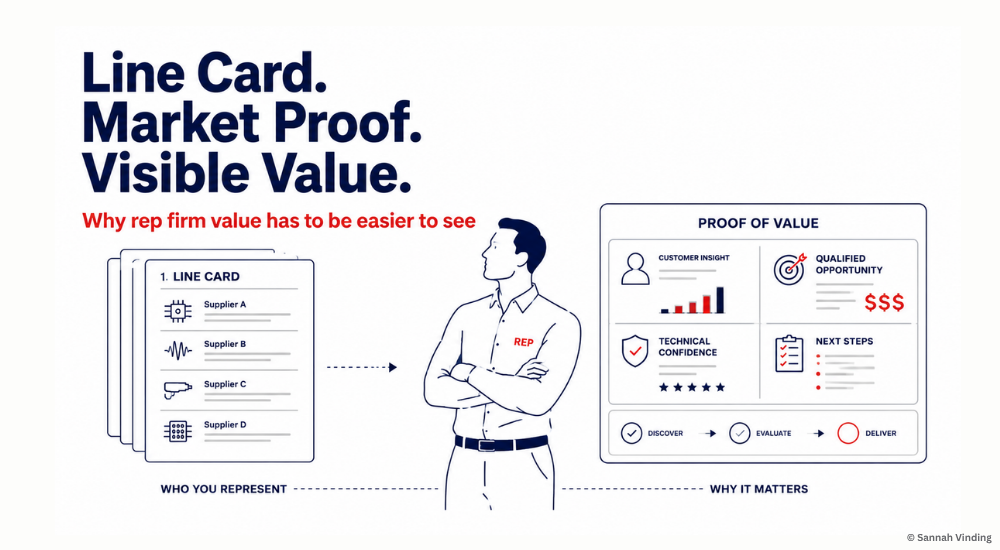
B2B buyers now spend only about 17% of their total purchase journey in direct contact with potential suppliers. That means most of the decision is already being shaped before a salesperson, rep firm, distributor, or manufacturer gets a real conversation.
For manufacturers’ reps, that changes the value story.
A line card still matters. Territory coverage still matters. Relationships still matter. But none of those things prove enough on their own when buyers are researching earlier, manufacturers want more visibility, and technical decisions require more confidence before anyone commits.
Rep firms prove value beyond sales when they bring market intelligence, customer insight, technical confidence, qualified opportunities, and clear follow-through back to both customers and manufacturers. The work is no longer only about representing a line. It is about making the value of that representation visible.
The Old Value Story Is Getting Too Thin
For a long time, the rep value story was easier to explain.
A manufacturer needed coverage in a territory. A rep firm had relationships in that territory. The rep knew the customers, understood the local market, and could create opportunities the manufacturer could not reach directly.
That still has value. But it is no longer enough to simply say, “we know the territory” or “we have the relationships.”
Buyers are doing more work on their own. Gartner found that 61% of B2B buyers prefer an overall rep-free buying experience, which does not mean they never need people. It means they have less patience for conversations that do not add value.
In technical markets, that is an important distinction. Buyers are not rejecting expertise. They are rejecting interruption that does not help them make a better decision.
For rep firms, the practical question is simple: when a customer or manufacturer looks at your firm, can they see what you know, what you are learning, and how you help the market move?
If the answer is no, the line card is doing too much of the work.
Proof Has to Move Back Up the Channel
Walter Tobin named one of the biggest shifts clearly in Episode 144 of the Leadership in Manufacturing Podcast.
“The leads have to now go from the rep up to the manufacturer. That’s a big change.”
That one line captures a larger change in channel expectations.
The manufacturer is not only asking, “Can you cover this territory?” They are asking, “What are you seeing? Which customers are active? Which opportunities are real? Where is the market moving? What information are you bringing back that we would not have without you?”
That requires more than activity. It requires proof.
In many B2B decisions, the short list is forming before anyone gets a live conversation. 6sense found that 94% of buyers ranked their shortlist before engaging with sellers. That makes visibility, clarity, and proof more important long before the first meeting.
Proof can look like stronger CRM discipline, account intelligence, opportunity notes, customer feedback, application insight, or a clearer explanation of where a product is gaining traction. It can also look like using AI and digital tools to find possible customers faster, then applying human judgment to decide what deserves follow-up.
The important part is not the tool. The important part is whether the rep firm can make its value visible before the manufacturer has to ask for it.
“The firms that are winning are not only calling themselves sales companies. They are showing customers and manufacturers where they add value.”
Technical Confidence Is Part of the Value Story
The strongest rep firms are not only proving that they can sell. They are proving that they can help customers make better technical decisions.
That matters because buyers may have more information than ever, but not always more confidence. Forrester reports that 19% of buyers using AI applications feel less confident in purchase decisions because of inaccurate or unreliable information. In electronics, manufacturing, distribution, and supply chain, confidence is not an abstract idea. It shows up in design requirements, product tradeoffs, availability concerns, supplier risk, application fit, and internal stakeholder alignment.
This is where the consulting mindset becomes useful.
Walter talked about rep firms positioning the work differently, especially when they are trying to attract technical talent. Most engineers do not want to be told they are becoming salespeople. But many do understand the value of helping other engineers evaluate technology, solve problems, and design in the right solution.
That framing is not only better for recruiting. It is better for the customer.
A rep firm that can bring technical context into the conversation becomes more than a path to a purchase order. It becomes part of how the customer builds confidence and how the manufacturer understands the market.
The Website, the Data, and the Follow-Up All Count
Proof does not only happen in a principal review meeting.
It starts earlier.
If a manufacturer or customer visits a rep firm’s website and cannot quickly find the line card, the people, the territory, or a clear way to contact someone, that sends a signal. Not because the website has to be flashy, but because digital presence is now part of trust.
If the CRM is thin, the opportunity notes are vague, or the customer feedback never makes it back to the manufacturer, that sends a signal too.
And if the firm is active but cannot explain what that activity is producing, the value story becomes harder to defend.
Forrester puts it plainly: B2B buyers are increasingly looking for proof, transparency, validation, and measurable outcomes. That is why the line card cannot carry the whole value story anymore.
This is not about turning rep firms into reporting machines. It is about making the work visible enough that customers, manufacturers, and future employees can understand why the firm matters.
Listen to the full conversation with Walter Tobin on the Leadership in Manufacturing Podcast.
The line card still matters. But it is not the whole story.
The next version of rep firm value will be easier to see. It will show up in customer insight, technical confidence, opportunity creation, market intelligence, digital presence, and better communication back to manufacturers.
That is the leadership work now.
Not just being in the territory.
Proving why your presence in the territory creates value.
For more practical leadership insights from across electronics, manufacturing, and distribution, join 4,800+ leaders on the Leadership in Manufacturing newsletter.
You can unsubscribe at any time.*
Sannah Vinding
Sannah Vinding
Engineer | GTM, Growth & Product Marketing Leader, Podcast Host
Sannah Vinding is an engineer and go-to-market leader known for bridging technical depth with business clarity across electronics and manufacturing.
Her work sits at the intersection of engineering, product, and commercial teams, translating complex technology, data, and customer insight into clear positioning, strong go-to-market execution, and measurable business impact.
She created Leadership in Manufacturing as an applied leadership platform to explore how leaders actually think, communicate, and make decisions when complexity is high and expectations are rising.
Through candid conversations with executives across manufacturing, distribution, and supply chain, Sannah brings together voices from across the electronics value chain to share lessons that help leaders grow with clarity and confidence.
Available on Your Favorite Podcast Platforms!




Related Episodes

AI Can Speed Up Sales. It Cannot Create Credibility.
AI can help technical sales teams move faster, but credibility still depends on accuracy, context, judgment, and the person who can stand behind the answer.
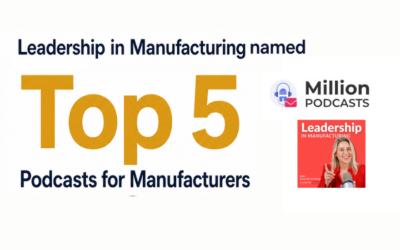
Leadership in Manufacturing Named a Top Five Podcast for Manufacturers
Leadership in Manufacturing was named a top-five podcast for manufacturers by MillionPodcasts. This recognition reflects the growing need for practical leadership conversations inside electronics, manufacturing, distribution, supply chain, and technical teams.