
Successor Readiness Is the Real Leadership Test
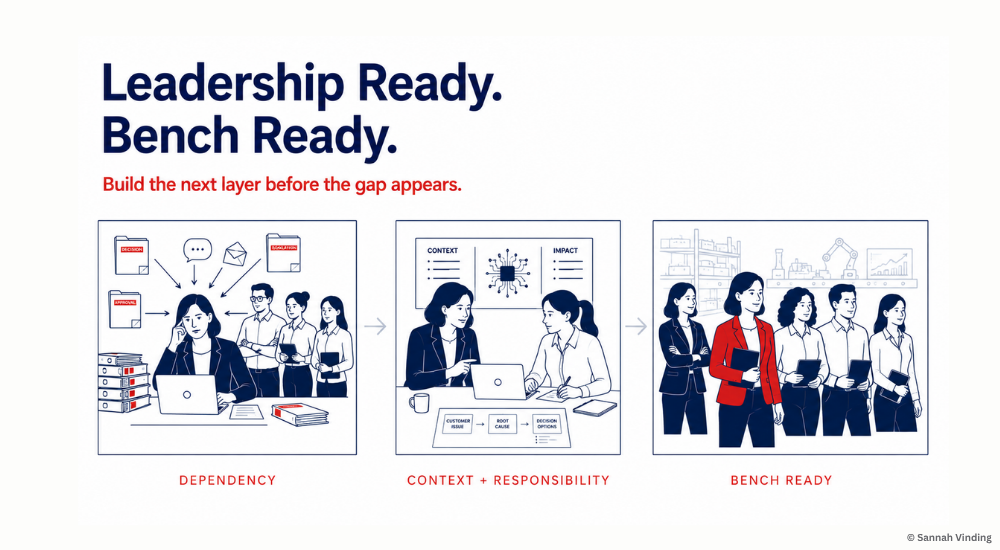
80% of organizations lack confidence in their leadership pipelines. Companies with a high-quality succession planning strategy are also 2.9 times more likely to achieve high internal promotion success rates.
That is not just an HR problem. It is an operating risk.
In electronics, manufacturing, distribution, and supply chain, leadership gaps do not stay abstract for long. They show up in delayed decisions, stalled customer conversations, missed context, and teams that keep waiting for one experienced person to tell them what to do. The leader may be ready for more scope. The system behind them may not be.
Promotion readiness is not only about whether a leader can carry more responsibility. It is about whether the team behind that leader has been developed enough to carry more without them. If everything depends on one person staying in the seat, the organization does not have readiness. It has dependency.
The Promotion Test Most Leaders Miss
Most leaders think about promotion as an individual question.
Can I handle the next level? Can I manage more complexity? Can I lead a larger team, a bigger region, a more strategic customer base, or a more visible role?
Those questions matter. But they are incomplete.
The better question is whether the work becomes fragile when that leader moves. If every hard decision still comes back to one person, if the customer relationships are held by one person, if the context sits in one person’s head, then the leader has not built capacity. They have built a bottleneck.
That bottleneck can hide inside strong performance. The team hits the number. The customer gets the answer. The supplier relationship stays steady. The leader looks effective because the work keeps moving.
But the system is not stronger if it only works while that leader is present.
That is why succession planning cannot be treated as a form, a chart, or a once-a-year talent review. It has to show up in how responsibility is handed over before the role is open. It has to show up in who gets context, who gets visibility, who gets feedback, and who is trusted with decisions before everyone agrees they are fully ready.
The Bench Does Not Build Itself
Succession planning often fails because organizations treat readiness as something to identify instead of something to build.
A name gets placed in a box. Someone is labeled high potential. A leader says, “We have someone in mind.” But being close to the work is not the same as being ready to carry the work.
DDI’s succession planning research is direct about the business impact: companies with a high-quality succession planning strategy are 2.9 times more likely to achieve high internal promotion success rates and 2.8 times more likely to outperform industry peers financially.
That makes sense. Internal promotion only works when people have been given the judgment, context, and exposure before the title changes.
In technical organizations, this matters even more. A successor does not only need tasks. They need to understand trade-offs, customer history, supplier dynamics, product constraints, regional differences, and how decisions are made when the data is incomplete. They need to know when to move fast and when to slow down. They need to understand which problems are urgent and which ones are just loud.
That is not built by adding more work to someone’s plate. It is built by teaching the thinking behind the work.
“I have seen this happen when a strong leader becomes the person everything has to run through. The real work is not just getting yourself ready for the next role, it is building the people behind you so the team can keep moving.”
Readiness Starts Before the Role Opens
The strongest succession work happens long before the organization needs a replacement.
It happens when a manager invites someone into the decision, not just the task. It happens when a team member is asked to lead a customer conversation with support nearby. It happens when a leader explains why a decision was made, what trade-off mattered most, and what risk would have changed the answer.
It also happens through feedback. Not delayed feedback. Not vague feedback. Fast, specific, respectful feedback while the moment is still fresh enough to learn from.
That is where Jeff Newell’s point lands. Succession is not separate from day-to-day leadership. It is the result of day-to-day leadership.
“If your successor is not ready, then you’re not ready. That’s one of the things that any leader should think about the first day in the job.”
A leader who wants to move up has to build the person behind them. That does not mean abandoning the work or pushing people too fast. It means creating enough stretch that the next layer starts learning how to carry real responsibility before the business depends on them doing it alone.
Listen to the full conversation with Jeff Newell on the Leadership in Manufacturing Podcast.
The practical leadership move is simple: choose one responsibility you currently own and identify who needs to start learning it now.
Do not just delegate the task. Teach the context. Explain the judgment. Stay close enough to coach, then let the person carry a real piece of the work. That is how the next layer gets stronger before the gap appears.
You can unsubscribe at any time.*
Sannah Vinding
Sannah Vinding
Engineer | GTM, Growth & Product Marketing Leader, Podcast Host
Sannah Vinding is an engineer and go-to-market leader known for bridging technical depth with business clarity across electronics and manufacturing.
Her work sits at the intersection of engineering, product, and commercial teams, translating complex technology, data, and customer insight into clear positioning, strong go-to-market execution, and measurable business impact.
She created Leadership in Manufacturing as an applied leadership platform to explore how leaders actually think, communicate, and make decisions when complexity is high and expectations are rising.
Through candid conversations with executives across manufacturing, distribution, and supply chain, Sannah brings together voices from across the electronics value chain to share lessons that help leaders grow with clarity and confidence.
Available on Your Favorite Podcast Platforms!




Related Episodes

AI Can Speed Up Sales. It Cannot Create Credibility.
AI can help technical sales teams move faster, but credibility still depends on accuracy, context, judgment, and the person who can stand behind the answer.
Leadership in Manufacturing Named a Top Five Podcast for Manufacturers
Leadership in Manufacturing was named a top-five podcast for manufacturers by MillionPodcasts. This recognition reflects the growing need for practical leadership conversations inside electronics, manufacturing, distribution, supply chain, and technical teams.