
The Tools Are Faster. The Last Mile Is Still Human.
That number is important, but it is not the whole story.
The same Gartner research points to the leadership work underneath the technology. AI can support research, recommendations, workflow execution, and seller preparation. But the strongest sales organizations are not simply asking sellers to do the same work faster. They are redesigning the work so sellers can spend more time where judgment, customer value, and human understanding matter most.
That is the real shift for leaders in electronics, manufacturing, distribution, and technical sales.
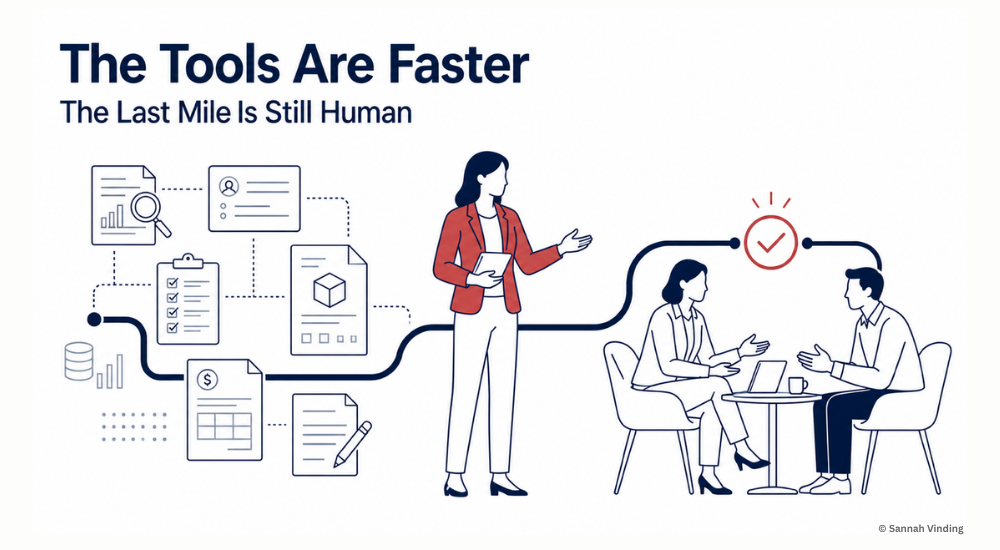
AI can help sales teams prepare. It can summarize, compare, document, organize, and reduce repetitive work. But it does not replace the part of sales that depends on trust, context, timing, risk, and the customer conversation.
That is what I think of as the Last Mile Principle: tools can prepare, organize, and speed up the work, but people still carry the final part that depends on judgment, trust, context, and responsibility.
The useful question is not whether AI belongs in sales. The useful question is where AI should support the work, and where people still need to lead.
More Tools Do Not Automatically Create Better Sales Conversations
Sales teams have been asked to absorb a lot.
Product training keeps expanding. CRM training keeps expanding. Digital tools keep expanding. AI training is now entering the same list.
At the same time, the basics of selling can get smaller. Not because leaders do not care about them, but because they are harder to scale. It is easier to train someone on a product line, a dashboard, or a workflow than it is to teach them how to read the room, ask a better question, understand a buyer’s hesitation, or know when the conversation needs to move face to face.
That tension came through clearly in my three-part conversation with Andy Coyle, Senior Director of Sales at ebm-papst Inc.
In Episode 146, Andy talked about the basics of sales training and why the last mile of sales still happens face to face. In Episode 147, we talked about leadership, trust, and the confidence to say, “I don’t know.” In Episode 148, we added the AI layer: how AI can help sales teams with research, CRM updates, documentation, follow-up, quoting, and repetitive work.
Together, the three conversations point to the same leadership issue.
The work is getting more technical. The tools are getting faster. The customer still needs someone they trust.
Sales organizations that provide sellers with AI-enabled next-best actions are 2.6x more likely to achieve commercial growth.
AI Helps Most When the Work Around It Is Clear
This is where a lot of AI conversations get too broad.
Leaders ask, “How should we use AI?” That question matters, but it is usually too big to answer in a useful way.
A better starting point is: what work is repeated every week, and what part of that work should not require a salesperson’s best thinking?
That might be CRM notes. It might be follow-up drafts. It might be organizing customer information before a call. It might be parts analysis, quoting support, market research, or comparing distributor opportunities. Those are real use cases because they remove friction from work the team already does.
Salesforce reports that sales reps spend 60% of their time on non-selling tasks. That is why AI is getting attention from sales leaders. There is real time trapped in manual work, documentation, tool switching, and preparation.
But time savings only matter if leaders are clear about what the saved time is for.
If AI gives a salesperson more time, does that time go back into better customer preparation? Better questions? Better follow-up? Better handoffs with engineering, distribution, or product teams? Or does it simply become more activity without more value?
This is where the leadership work starts.
“It can speed up some processes that are just repetition. Then you can go in and do the real work.”
The point is not to protect every old way of working. Some work should get easier. Some administrative drag should go away. But leaders need to decide what kind of work AI is being invited into.
Buyers May Want Less Friction, But They Still Need Confidence
There is another reason this matters now.
Buyers are changing too.
Gartner found that 67% of B2B buyers prefer a rep-free experience, and 45% used AI during a recent purchase. Buyers are researching, comparing, and shaping their thinking before they talk to sales.
That does not make the salesperson less important. It changes when and how the salesperson becomes important.
By the time a technical buyer, engineering team, distribution partner, or customer account asks for help, they may already have information. What they may not have is confidence.
They may need help deciding what applies to their situation. They may need someone to explain the tradeoff. They may need a person who can connect the product reality to the business risk. They may need someone who understands the customer relationship, not only the data in the system.
That is why AI-supported sales is not only a technology question. It is a clarity question. It is a training question. It is a leadership question.
Andy said it directly in Episode 148:
“AI is an assistant, as a tool, to help them spend less time on the administrative part of their job.”
That is the right starting point. AI as support. AI as preparation. AI as a way to reduce repetitive work.
Not AI as the relationship.
The Last Mile Is Human
The Last-Mile Principle is simple:
AI helps prepare. People help customers decide.
Tools, systems, and automation can move the work forward. They can search, summarize, compare, draft, organize, and surface options.
But in complex B2B environments, the final mile is still human.
People still bring the judgment, expertise, empathy, context, accountability, and follow-through that turn information into trust.
That is the thread running through these three conversations.
In Episode 146, the last mile showed up in the sales fundamentals: prospecting, pre-call planning, role play, follow-up, and face-to-face trust
In Episode 147, it showed up in leadership: authenticity, having your team’s back, making decisions without perfect information, and being willing to say, “I don’t know.”
In Episode 148, it showed up in the AI conversation: using AI to support the sales process without pretending the process is the whole job.
For sales leaders in electronics, manufacturing, distribution, and technical markets, the practical move is not to slow down AI adoption. It is to connect AI adoption to better sales discipline.
Start with one workflow. Make the owner clear. Decide what good output looks like. Build the review loop. Train the team on how to use the saved time. Then ask whether the customer conversation is getting better.
That is where the last mile shows up.
The tools may help us get there faster.
But the last mile is still human.
67% of B2B buyers prefer a rep-free buying experience.
For sales leaders in electronics, manufacturing, distribution, and technical markets, the practical move is not to slow down AI adoption. It is to connect AI adoption to better sales discipline.
Start with one workflow. Make the owner clear. Decide what good output looks like. Build the review loop. Train the team on how to use the saved time. Then ask whether the customer conversation is getting better.
That is where the last mile shows up.
The tools may help us get there faster.
But the last mile is still human.
Listen to the full Andy Coyle series on the Leadership in Manufacturing Podcast: Episode 146, Episode 147, and Episode 148.
The point is not to use AI as a shortcut around sales fundamentals.
It is to use the tools where they help, so people have more room for the work that still needs judgment, context, and trust.
Faster research is useful. Cleaner notes are useful. Better preparation is useful.
But the customer still has to trust the person in the conversation.
You can unsubscribe at any time.*
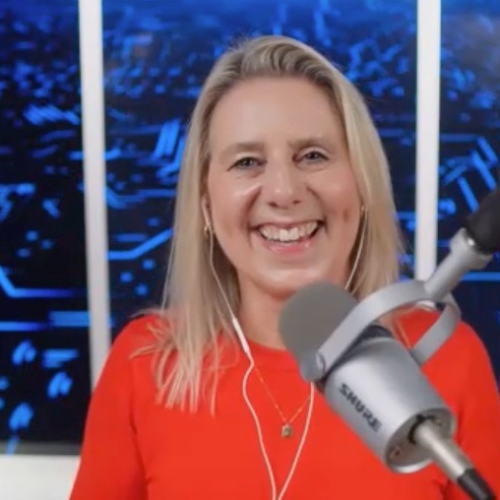
Sannah Vinding
Sannah Vinding
Engineer · Product Marketing & GTM Leader · Author · Podcast Host
Sannah Vinding is an engineer, go-to-market leader, and host of Leadership in Manufacturing, a top 5% global podcast featuring executives from Mouser Electronics, DigiKey, Schneider Electric, and TE Connectivity. She helps technical B2B companies turn complex technology into clear positioning and growth, and her work has been featured in EE Times and Electronics Weekly. Her book, Visible or Invisible, launches September 2026.
Available on Your Favorite Podcast Platforms!




Related Episodes
AI Can Speed Up Sales. It Cannot Create Credibility.
AI can help technical sales teams move faster, but credibility still depends on accuracy, context, judgment, and the person who can stand behind the answer.
Leadership in Manufacturing Named a Top Five Podcast for Manufacturers
Leadership in Manufacturing was named a top-five podcast for manufacturers by MillionPodcasts. This recognition reflects the growing need for practical leadership conversations inside electronics, manufacturing, distribution, supply chain, and technical teams.