
AI Can Speed Up Sales. It Cannot Create Credibility.
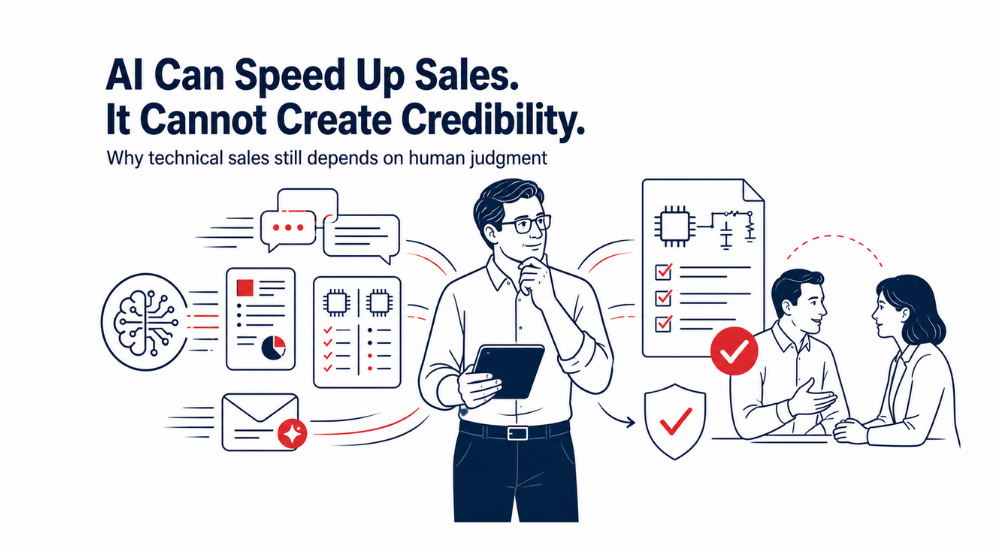
That is the tension technical sales leaders have to pay attention to.
AI can help buyers research faster. It can help sellers prepare faster. It can summarize information, compare options, suggest messaging, and reduce friction across the sales process.
But faster information does not automatically create trust. In electronics, manufacturing, distribution, supply chain, and technical sales, credibility comes from the person who can validate the answer, understand the customer’s context, and stand behind what is being recommended.
AI can speed up sales research, targeting, preparation, and follow-up. It cannot create credibility on its own. In technical markets, credibility is still built through accuracy, context, judgment, follow-through, and the human ability to help customers decide what they can trust.
Speed Is Useful. Thin Messaging Is Not.
Sales teams are under pressure to do more with less time.
AI can help with some of that work, and leaders should not ignore that. A sales team can use AI to prepare for a customer call, summarize account history, compare product information, draft outreach, identify buying signals, or shape a first version of a proposal.
The problem starts when speed is treated as the same thing as substance.
Technical buyers can usually feel the difference between a message that was prepared well and a message that was only polished. They may not know exactly which tool created it, but they know when the answer does not match their real question. They know when the proof is missing. They know when the person on the other side cannot explain the trade-off, the fit, the limitation, or the next step.
Gartner also found that 45% of B2B buyers used GenAI during a recent purchase. That means buyers are not waiting for sales to bring them the first version of the answer. They may already have a summary, a comparison, a shortlist, or a set of assumptions before the first conversation begins.
That changes what sales has to earn.
69% of B2B buyers say they validate vendor claims through independent sources before contacting sales.
The New Sales Problem Is Validation
The useful question is not whether AI belongs in sales.
It does.
The better question is where AI should assist, and where a person still needs to review, challenge, clarify, and own the answer.
This is especially true in technical markets. A customer may be comparing products, applications, specifications, availability, integration risk, service support, or long-term supplier fit. A fast answer helps only if it is accurate enough to use.
Gartner found that 67% of B2B buyers prefer a sales rep-free experience, while the same research on AI-generated insights shows buyers still turn to sales reps when they need validation, reassurance, context, and decision support.
That is not a contradiction.
Buyers are not saying people do not matter. They are saying low-value interruption does not matter. They want to move independently when the work is simple or the information is clear. But when the decision carries risk, they still need someone who can help them know whether the answer is good enough to trust.
For sales leaders, this means the role of the seller is changing. The seller is not always the first source of information anymore. The seller becomes the person who helps the buyer make sense of information that already exists.
“It frees up some time. But you need to use critical thinking when you get it back.”
Credibility Is the Part AI Cannot Fake
This is where my conversation with Michael “Mic” Cardone, President of ENOVA USA, is a useful proof point.
Mic shared a line from earlier in his career that stayed with him. A VP of operations told him that salespeople were “all foam and no beer.” It was blunt. It also named a real credibility problem.
A message can look good and still have no substance behind it.
That is the risk AI can make easier to miss. A team can generate better-looking outreach, cleaner campaign copy, faster summaries, and more polished responses. But if the customer asks one more question and the substance is not there, the trust problem shows up quickly.
For leaders, the work is not to slow everything down. The work is to build a better review layer around the places where credibility is earned or lost.
Before an AI-assisted message reaches a customer, someone should be asking:
- Is the product information accurate?
- Does this match the customer’s real context?
- Are we making a claim we can prove?
- Does this sound like our company or like a generic tool wrote it?
- Who owns the final answer if the customer acts on it?
That last question is the credibility test.
AI can support the first draft, the first search, the first comparison, and the first summary. The last mile still belongs to the person who understands the customer, checks the answer, and can stand behind the recommendation.
“You have to be careful with how much you engage with AI without losing your personal feel.”
More than 70% of B2B buyers say they prefer remote human interactions or digital self-service during the buying process.
Listen to the full conversation with Mic Cardone.
AI will keep changing how sales teams prepare and how buyers research. That is not the part to resist. The risk is using better tools to create more output without building the discipline to check what the output means.
Technical sales still runs on trust. AI can help your team move faster, but credibility is still earned by the people who know the product, understand the customer, and take responsibility for the answer.
You can unsubscribe at any time.*
Sannah Vinding
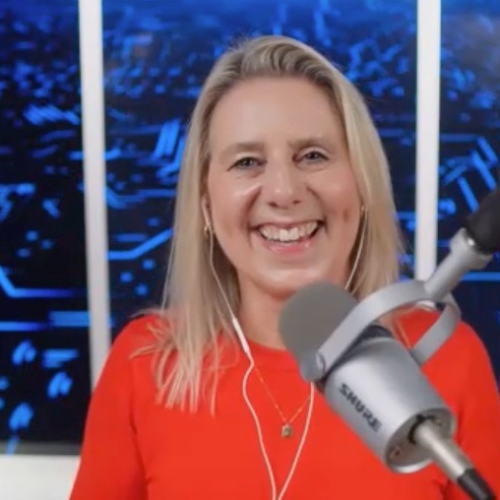
Sannah Vinding
Engineer | Product Marketing & GTM Leader | Author | Host & Producer
Sannah Vinding is an engineer and product marketing and go-to-market leader with experience across electronics, semiconductors, and manufacturing. She builds teams and systems that connect technical expertise with commercial growth.
She is the author of the forthcoming book Visible or Invisible and the host and producer of Leadership in Manufacturing, an independent podcast she created alongside her full-time leadership roles. Her articles draw on industry conversations and firsthand experience to explore leadership, customer needs, and commercial execution, extending the thinking she applies in her professional work.
Available on Your Favorite Podcast Platforms!



Related Episodes
Leadership in Manufacturing Named a Top Five Podcast for Manufacturers
Leadership in Manufacturing was named a top-five podcast for manufacturers by MillionPodcasts. This recognition reflects the growing need for practical leadership conversations inside electronics, manufacturing, distribution, supply chain, and technical teams.
The Tools Are Faster. The Last Mile Is Still Human.
AI can help sales teams research, document, and prepare faster. But in electronics and manufacturing, the last mile of sales still depends on trust, judgment, and human customer conversations.