
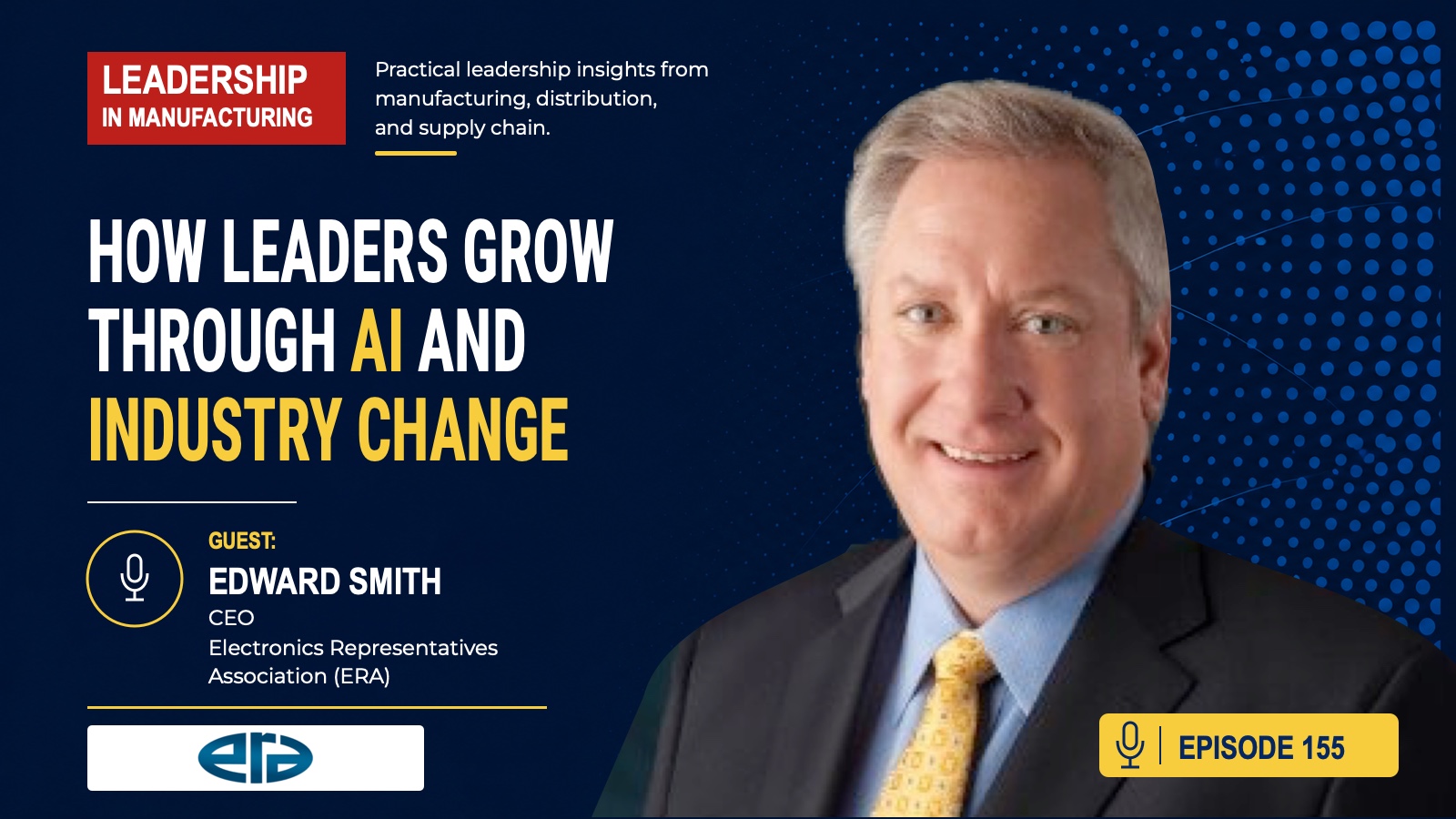
Episode 155
How Leaders Grow Through AI and Industry Change
Edward Smith, CEO of ERA on AI, manufacturers’ reps, trust, mentoring, and leadership in the electronics industry
Episode summary
The short version: AI is changing how electronics companies search, sell, measure markets, and prepare people for the future. Edward Smith explains how leaders can grow with new tools while still relying on trust, mentoring, judgment, communication, and personal responsibility.
Edward Smith is CEO of the ERA (Electronics Representatives Association), with leadership experience across electronic manufacturing services, component distribution, manufacturer representation, and technology. In this conversation, he explains how market cycles, consolidation, AI, and changing customer expectations are reshaping the electronics industry.
Edward talks about why rep firms are consolidating, how succession planning and scale affect the manufacturers’ representative model, and how ERA is using AI and data to help suppliers and rep firms make better decisions about market coverage and territory value.
The conversation then becomes more personal. Edward shares how he gives people ownership, how the Mentor Up program developed, and why leaders need to be present when something goes wrong. He also talks about helping young salespeople become trusted advisors, building culture through communication, giving feedback, hiring for values, and learning to control his own impulses.
What You’ll Learn
- Why industry cycles continue to create familiar inventory and supply-chain problems
- How consolidation, succession planning, and scale are changing rep firms
- How ERA is using AI and data to evaluate market coverage and rep-firm value
- Why people learn new tools faster when they can practice with guidance
- How leaders can give people ownership without disappearing from the work
- Why trust grows through presence, listening, and follow-through
- How young salespeople can become trusted advisors instead of simply making sales calls
- Why leaders need to take responsibility for culture and results



The Leadership Question
AI is changing how electronics companies search, sell, measure markets, and prepare people for the future. Leaders are being asked to adopt new tools while also developing people, building trust, and making sound decisions during industry change.
For electronics manufacturers, distributors, rep firms, and sales leaders, the challenge is not simply choosing which AI tools to use. It is helping people learn, experiment, communicate, and take ownership without losing the judgment and relationships that keep the business moving.
The leadership question is:
How do you help your organization grow with new technology without losing the trust and judgment that make the organization work?
If leaders miss that balance, AI can become another disconnected initiative. When they get it right, new tools can help people learn faster, make better decisions, and create more value for customers and partners.
Key Moments From the Conversation
AI can help make the value of reps visible
Edward explains how ERA is using AI and market data to help suppliers evaluate the value of manufacturers’ representatives market by market. The model can consider the number of accounts, market dollars, people, and other information to help suppliers decide whether a direct, hybrid, or rep-led approach makes the most sense.
Instead of relying only on a presentation about why suppliers should work with reps, leaders can look at the actual market and use data to make a better decision about the resources and relationships they need.
“We now actually have numbers where we might say in a particular market, it should be direct or it should be hybrid or it should be completely rep.”
People Need a Place to Practice With AI
Edward describes ERA’s plans to make AI education hands-on. Participants will build an AI market plan, work through it during a breakout session, and present it to the group.
The approach gives people room to ask questions, make mistakes, and see how the tools fit into their actual work. It turns AI from something people hear about into something they can practice with and apply.
“Having the hands-on work gives you a chance to go much deeper.”
Becoming a Trusted Advisor
Edward explains that young salespeople need to make calls with a purpose and bring something useful to the person on the other end. The goal is not simply to sell the products a company represents. It is to help customers solve problems.
That may include connecting a customer with another manufacturer or resource when it is a better fit. When customers begin calling the salesperson instead of waiting for the next sales call, the relationship has changed.
“When your customers start calling you instead of waiting for you to call, change the dynamic to being a trusted advisor from just being a salesperson.”
Trust Is Built Through Presence and Follow-Through
Edward says he does not want to run people’s day-to-day work, but he does want to show up when they have a problem. After helping someone a few times without taking control, trust begins to develop.
He connects that idea to walking through factories, asking simple questions, and communicating with people at every level. People are more likely to share useful information when they know a leader is willing to listen and act.
“As soon as you had that problem, that’s an invitation for me to help you fix it.”
Leaders Are Responsible for Culture
Edward says leaders need to look at themselves when results and culture are not improving. A leader cannot simply push one approach across the organization and expect it to work for everyone.
Leaders need to listen to people at every level, act on what they hear, and stay close enough to the work to understand what is really happening.
“The number one thing you’re responsible for is culture.”
Practical Takeaway
Build trust before the difficult conversation
Edward’s examples show that feedback works better when people already know the leader is present, listens, and wants them to succeed. Trust grows through ordinary actions: spending time with people, asking questions, following through, and helping when something goes wrong without taking over.
He also explains that accountability is stronger when people have ownership. Instead of simply telling someone what to do, agree on the goal, define what success looks like, and give them room to make decisions.
This week:
- Choose one person on your team.
- Ask what is working and what is getting in the way.
- Agree on one clear goal.
- Define how you will know whether it worked.
- Give the person room to choose the approach.
- Schedule a follow-up conversation.
- Use that conversation to discuss both the result and what they learned.
The practical lesson is simple: feedback is easier to hear when trust comes first and accountability is shared.
About the guest

Edward Smith
CEO, ERA (Electronics Representatives Association)
Edward Smith is CEO of the Electronics Representatives Association and an experienced electronics industry executive with more than 35 years across electronic manufacturing services, component distribution, technology, and industry associations.
He previously served as Executive Chairman of SMTC Corporation and held senior executive positions at Avnet, including President of Avnet Electronics Marketing. Earlier in his career, he served as CEO of Smtek International.
Edward currently serves as Chairman of the Board at Dye & Durham Corporation and Chairman of Data I/O. His work reflects a long-standing focus on building strong organizations, supporting electronics supply-chain partners, developing people, and advancing the role of independent manufacturers’ representatives.
Episode Chapters
- – 00:00 Edward’s passion for change in the electronics industry
- – 01:21 Why industry cycles keep repeating
- – 03:31 Why rep firms are consolidating
- – 05:19 Using AI to measure rep-firm value
- – 08:50 AI, market data, and ERA’s next tools
- – 11:45 Edward’s hands-off leadership style
- – 12:10 Building the Mentor Up program
- – 15:44 How AI speeds up work while people keep judgment
- – 18:24 What strong leadership looks like for the next generation
- – 21:47 Becoming a trusted advisor
- – 25:14 How Edward learns new AI skills
- – 28:43 Advice from a former boss and the need for impulse control
- – 30:46 Listening, communication, and leading from the factory floor
- – 33:41 How leaders know whether they are doing a good job
- – 37:54 Feedback, accountability, and learning from failure
- – 41:33 Hiring for values and building team trust
- – 46:52 The advice Edward would give his younger self
Who this episode is for
-
- Electronics manufacturers evaluating direct, hybrid, and rep-led market coverage
- Rep firm owners thinking about scale, succession, and AI adoption
- Distribution and sales leaders managing market cycles and changing customer expectations
- Managers developing younger leaders in technical and commercial teams
- Salespeople working to become trusted advisors
- Executives introducing AI without losing human judgment and accountability
What you will be able to do after listening
-
- Identify where AI could support a real sales or market-planning workflow
- Ask better questions about the value of a rep firm in a specific market
- Recognize where succession planning needs more attention
- Create a practical learning experience for people adopting AI
- Build trust before you need to give difficult feedback
- Help young salespeople become trusted advisors
- Review whether your leadership approach is improving culture and results
- Think about where slowing down could improve your next leadership decision
You can unsubscribe at any time.*
Related Episodes
How Leaders Prepare Sales Teams for Growth With AI and Better Training – Episode 153
Brooks Mattice of MFC Group explains how leaders prepare sales teams for growth through training, onboarding, feedback, and AI-supported tools.
Why Leadership Is Built in the Moments Nobody Sees- Episode 152
Colin Strother, Executive Vice President at Rochester Electronics, joins Sannah Vinding to discuss trust, authenticity, customer commitment, and leading global teams across the electronics industry. They talk about why customers need both digital and personal service, how leaders develop confidence and composure, and what small actions reveal about leadership.