
You Want Speed. Your Team Needs Trust.
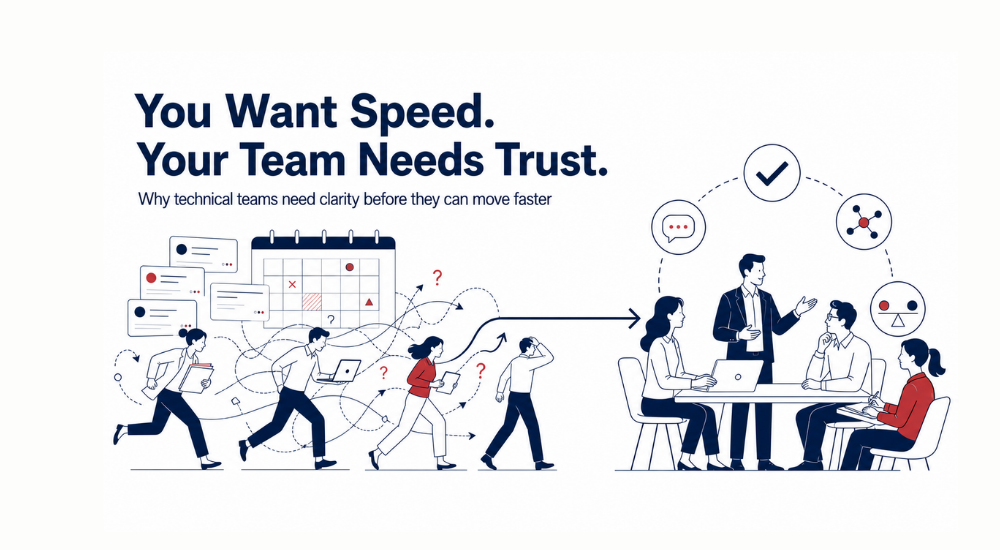
Managers account for at least 70% of the variance in employee engagement scores across business units according to Gallup.
That is not a small management detail. It is an operating issue.
In electronics, manufacturing, distribution, and technical organizations, teams are often under pressure to respond faster, communicate faster, decide faster, and move work through the system faster. But speed only helps when the team has enough trust, clarity, and context to move in the right direction. Without that, speed can hide the real problem. People stay busy, but the work gets heavier.
Good managers do not build trust only when the hard conversation arrives. They build it before the pressure shows up, through curiosity, communication, feedback, and small moments of attention that make people willing to speak honestly when it matters.
Speed does not fix a team that is guessing
A technical team can look productive from the outside and still be working around the same problem every week.
The meetings are happening. The messages are flowing. Customer questions are being answered. Supplier work is moving. Product details are being translated. The calendar is full.
But full is not the same as clear.
A team can spend a lot of energy moving work through a process no one has stopped to question. Asana’s Anatomy of Work Index found that knowledge workers spend 60% of their day on “work about work,” not the skilled work they were hired to do. That should get every manager’s attention.
For technical and commercial teams, that “work about work” can show up as repeated internal explanations, unclear handoffs, customer meetings that do not change, supplier information that has to be reworked, or people waiting because no one is sure who owns the next step.
The useful question is not, “How do we make everyone move faster?”
The useful question is, “What are we asking people to keep carrying that should be stopped, clarified, automated, delegated, or redesigned?”
That question takes time. It also saves time.
Managers account for at least 70% of the variance in employee engagement scores across business units.
Trust is built before the hard moment
This is where many managers get trapped.
They are promoted because they are strong individual contributors. They know the product, the customer, the supplier, the system, or the process. Then the job changes. Suddenly, success depends less on having the answer and more on creating the conditions where other people can tell the truth, learn, improve, and make decisions with confidence.
That shift is easy to underestimate.
Gallup reported that U.S. employee engagement fell to a 10-year low in 2024, with only 31% of employees engaged and 17% actively disengaged. The manager layer is not the only reason for that, but it is one of the places where the daily experience of work becomes real.
People notice how their manager responds when they make a mistake. They notice whether feedback is clear or loaded with frustration. They notice whether quiet voices are invited in, whether remote communication becomes purely transactional, and whether the leader only reaches out when there is a task or problem.
Trust is not built by one big leadership moment. It is built in smaller deposits.
“You cannot wait until the hard moment to build trust. The relationship has to be there before the team needs it.”
That is the part leaders have to solve before pressure hits.
If the first real conversation happens during conflict, feedback, missed performance, or urgent change, the relationship may be too thin to carry the weight.
Good managers slow down enough to see people
In Episode 150 of the Leadership in Manufacturing Podcast, Nate Witsaman, Manager of New Market Development at DigiKey, talked about curiosity as one of the practical habits of good managers.
Curiosity slows the leader down before they jump to the easiest explanation.
If someone is quiet in a meeting, the answer may not be that they have nothing to say. If someone is struggling, the answer may not be that they cannot do the work. If feedback lands badly, the issue may not be that the person is defensive. There may be missing context, unclear expectations, low confidence, a communication mismatch, or a relationship that has not been built yet.
Good managers ask before they assume.
“I think good managers are very curious. We should never believe that we have all the answers.”
That kind of curiosity is not soft. It is operational.
It helps leaders find the real constraint instead of pushing harder on the wrong one. It helps teams improve while things are still going well, not only after something breaks. It also makes feedback easier to receive because the person knows the manager is paying attention to more than the task.
Knowledge workers spend 60% of their day on “work about work,” not the skilled work they were hired to do.
Listen to the full conversation with Nate Witsaman on the Leadership in Manufacturing Podcast
The pressure to move faster is not going away. Technical teams will keep dealing with more information, more tools, more customer expectations, and more cross-functional handoffs.
That makes trust more important, not less.
If you want a team that can move quickly when it matters, build the relationship before the urgent moment. Ask better questions. Make room for quieter voices. Look at the work before adding speed to it. The team that trusts the manager is more likely to tell the truth early enough to do something useful with it.
You can unsubscribe at any time.*
Sannah Vinding

Sannah Vinding
Engineer · Product Marketing & GTM Leader · Author · Podcast Host
Sannah Vinding is an engineer, go-to-market leader, and host of Leadership in Manufacturing, a top 5% global podcast featuring executives from Mouser Electronics, DigiKey, Schneider Electric, and TE Connectivity. She helps technical B2B companies turn complex technology into clear positioning and growth, and her work has been featured in EE Times and Electronics Weekly. Her book, Visible or Invisible, launches September 2026.
Available on Your Favorite Podcast Platforms!



Related Episodes
Leadership in Manufacturing Named a Top Five Podcast for Manufacturers
Leadership in Manufacturing was named a top-five podcast for manufacturers by MillionPodcasts. This recognition reflects the growing need for practical leadership conversations inside electronics, manufacturing, distribution, supply chain, and technical teams.
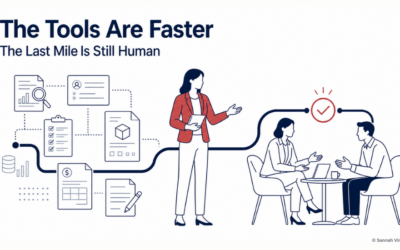
The Tools Are Faster. The Last Mile Is Still Human.
AI can help sales teams research, document, and prepare faster. But in electronics and manufacturing, the last mile of sales still depends on trust, judgment, and human customer conversations.