
Episode 147
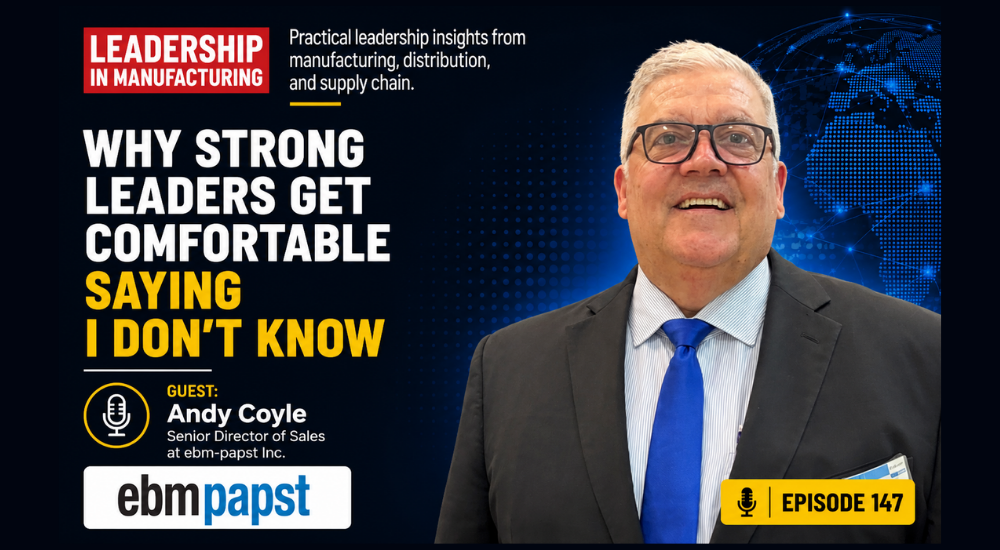
Why Strong Leaders Get Comfortable Saying I Don’t Know
Andy Coyle on authenticity, team trust, decision-making, and the leadership lessons that take time to learn
Episode summary
The short version: Strong leaders do not have every answer. In this episode, Andy Coyle talks about the leadership skills that matter in electronics, manufacturing, distribution, and technical sales: authenticity, having your team’s back, making decisions with incomplete information, and being willing to say, “I don’t know.”
Andy Coyle is Senior Director of Sales at ebm-papst Inc. He has spent more than thirty years in electronics, distribution, and manufacturing sales.
In part one of this conversation, he talked about sales training, AI as a practical tool, and why trust still matters when teams are using more technology. In part two, the conversation moves into leadership.
Andy names three things that have shaped the way he leads: authenticity, protecting and supporting the team, and being willing to make decisions when the information is not perfect. He also talks about the mentors who shaped him, the opportunities that came because he was willing to relocate and travel, and the leadership lessons he wishes he had understood earlier.
The useful part of this episode is how honest Andy is about what leadership looks like over time. Good leaders are not the people who always know. They are the people who build teams strong enough to challenge them, tell them what they need, and help solve the problem together.
What You’ll Learn
- Why authenticity matters more than polish when people decide whether to trust a leader
- What it means to have your team’s back in the hard moments and the good ones
- Why decision-making is a leadership responsibility, especially when the information is incomplete
- How mobility, travel, and different cultures can shape a leader’s understanding of people
- Why mentors matter, but why they do not always hand you a step-by-step plan
- How leaders can give people room to earn their own scars
- Why your team decides what kind of leader you are
- How to respond when someone you lead tells you they need more direction




The Leadership Question
The real tension in this conversation is that many leaders are promoted because they had the answers, but the next stage of leadership requires something different. You still have to make decisions. You still have to carry responsibility. But you also have to create enough trust that people can challenge you, ask for what they need, and help solve the problem.
For sales leaders, technical leaders, distribution leaders, manufacturer reps, and executives in electronics and manufacturing, that tension shows up every day. The market moves, customers need answers, teams need direction, and the information is rarely complete.
The leadership question is: Are you building a team that waits for your answer, or a team that can help you find the answer?
If leaders miss this, they risk training people to depend on certainty that does not exist. If they get it right, they build teams that can move through complexity with more honesty, more trust, and better judgment.
“Strong leadership is not knowing everything. It is building a team strong enough to help you find the answer.”
Key Moments From the Conversation
Why authenticity matters in leadership
Andy names authenticity as one of the leadership skills that has mattered most in his career. His point is not that leaders need to be polished or perfect. It is that people need to know who they are dealing with.
For leaders in electronics, manufacturing, distribution, and technical sales, authenticity matters because the work already has enough complexity. Teams need clear signals from the people leading them, especially when the pressure is high or the answer is not obvious.
“I am not always perfect. I am not always refined. But I am authentic.”
What it means to have your team’s back
Andy talks about the importance of supporting people in their worst moments and celebrating them in their best moments. That is where trust gets built. Not in a leadership statement, but in what the team experiences when things are difficult.
For technical and commercial teams, this matters because mistakes, customer pressure, and internal friction are part of the work. A team that knows its leader will not disappear when things get hard can move with more honesty and confidence.
“You have to have your team’s back, and they have to know that.”
How leaders make decisions without perfect information
One of Andy’s strongest leadership points is that decision-making is part of the role. Leaders often have to decide before every detail is known. That shows up in hiring, customer deals, team direction, and business risk.
The lesson is not to be reckless. It is to understand that waiting for perfect certainty can slow the team down. Strong leaders respect the complexity, gather what they can, and still help the organization move forward.
“Sometimes we do not have all the information, but a decision still has to be made.”
Why leaders need teams that challenge them
Andy reflects on how important it is to be surrounded by people who are not only smart, but willing to challenge him. That is an important distinction. A strong team is not just a group of capable people. It is a group of people who can speak up, push back, and fill in the gaps the leader cannot see alone.
That is especially important in technical industries, where no one person has the full picture. Engineering, sales, product, operations, distribution, and customer-facing teams all see different parts of the problem.
“Surround yourself with people who are smart in different ways and willing to challenge you.”
What mentors teach by not giving every answer
Andy names Bill Gold, Ray Norton, and Sean Harrigan as three people who shaped his career. One of the lessons he took from those experiences was the value of giving people a clear vision without giving them every step.
That kind of leadership gives people room to learn. It creates space for judgment, ownership, and growth. People still need direction, but they also need enough room to earn their own experience.
“Help people understand the vision, where you are going and why, then give them room to get there.”
Why your team decides what kind of leader you are
When Sannah asks Andy how someone knows if they are a good leader, his answer is simple: he does not get to decide. The people he has led, challenged, promoted, supported, and worked beside will decide that over time.
That is a practical reminder for any leader. Your intent matters, but your team’s experience is what becomes your leadership reputation.
“I do not really get to decide if I was a good leader. The people I helped, challenged, and supported will decide that.”
Practical Takeaway
Ask your team where they need more from you
One of the strongest moments in this conversation is when Andy talks about a direct report telling him, “I need more direction on this than you are giving me.” That kind of feedback only happens when people believe it is safe enough to say it.
Use that as a leadership check this week:
- Ask one person on your team, “Where do you need more direction from me?
- Ask another, “Where do you need more room to figure it out?
- Notice whether you give the same kind of leadership to everyon
- Look for the people who are waiting because the direction is unclea
- Look for the people who are capable but need permission to challenge the pla
- Follow up with one specific adjustment, not a broad promise
Strong leadership is not one fixed style. It is knowing when your team needs support, space, challenge, or clarity.
About the guest

Andy Coyle
Senior Director of Sales, ebm-papst Inc.
Andy Coyle is Senior Director of Sales at ebm-papst Inc., where he leads sales and channel development across technical markets that include air movement, cooling, HVACR, data centers, refrigeration, industrial equipment, and related applications.
Andy has spent more than thirty years in electronics, distribution, and manufacturing sales. His career includes time at Hallmark Electronics, Sager Electronics, Laird Technologies, and ebm-papst. He describes himself as a high-touch leader in a high-tech world, and his leadership approach centers on people, trust, sales fundamentals, and long-term customer and distributor relationships.
Episode Chapters
- [~00:00] Opening clips: team trust, vulnerability, and direct feedbac
- [~01:52] Sannah introduces part two of the conversation with Andy Coy
- [~03:09] The leadership skills that matter mo
- [~03:26] Authenticity, having your team’s back, and making decision
- [~06:25] Career growth, timing, relocation, and trave
- [~09:37] How travel changes the way leaders understand peopl
- [~12:26] Mentors, advice, and learning through experienc
- [~14:08] Giving people a vision without giving every ste
- [~15:33] Being comfortable not having all the answer
- [~17:27] How do you know if you are a good leader?
- [~19:51] When your leadership style does not match what someone needs
- [~21:03] What Andy wishes he had learned earlier
- [~24:12] Closing reflection and final thanks
Who this episode is for
-
- Sales leaders in electronics, manufacturing, distribution, and technical market
- Leaders who have been promoted because they were strong individual contributor
- Executives and managers making decisions with incomplete informatio
- Manufacturer reps and channel leaders building trust across teams and customer
- Leaders developing future leaders inside technical organization
- People who want to lead without pretending they have every answer
What you will be able to do after listening
-
- Reframe vulnerability as a leadership strength, not a weaknes
- Identify where your team needs more direction, more room, or more challeng
- Ask better questions about trust, decision-making, and team suppor
- Recognize the tradeoffs behind career growth, travel, relocation, and opportunit
- Evaluate whether your leadership style fits what each person need
- Build stronger conditions for people to challenge ideas respectfull
- Lead with more honesty when the answer is not obvious
You can unsubscribe at any time.*
Related Episodes
Why Good Managers Build Trust Before They Need It – Episode 150
Nate Witsaman of DigiKey joins Sannah Vinding to discuss curiosity, trust, feedback, remote leadership, and developing managers.
Why Credibility Still Wins in Technical Sales – Episode 149
Mic Cardone of ENOVA USA joins Sannah Vinding to discuss credibility in technical sales, AI, leadership patience, and customer trust.