
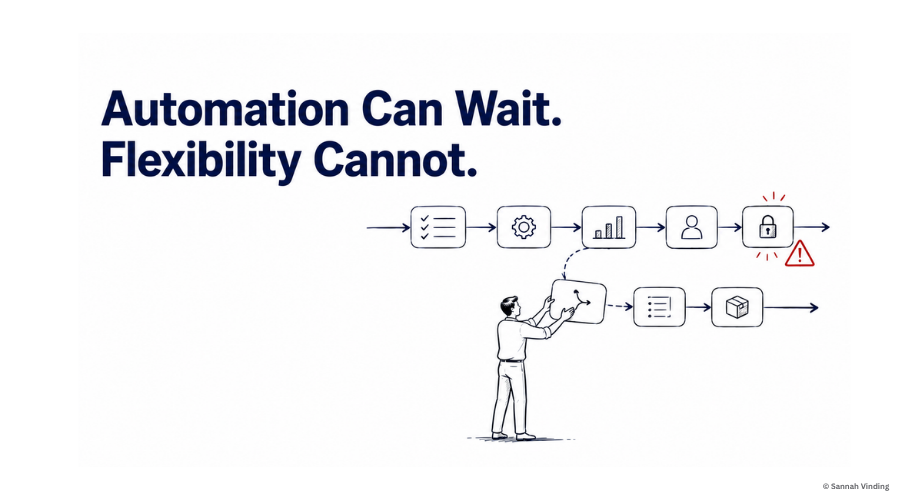
Automation Can Wait. Flexibility Cannot.
Deloitte’s 2025 Smart Manufacturing and Operations Survey found that 92% of manufacturers believe smart manufacturing will be the main driver of competitiveness over the next three years.
That is not surprising. Leaders in manufacturing, distribution, electronics, and supply chain are under pressure to move faster, improve productivity, and make better use of data. Automation is part of that answer. But the harder leadership question is whether the work is stable enough to be locked into a system.
When the team is still learning, the process is still shifting, or the business needs room to adjust, flexibility is not a delay tactic. It is part of the operating design.
Efficiency Is Not the Same as Readiness
A conveyor, warehouse management rule, pick technology, or AI-supported decision tool can make work faster. It can also make the wrong assumption harder to unwind.
Deloitte’s survey shows why the pressure is real. Manufacturers reported average improvements of 10% to 20% in production output, 7% to 20% in employee productivity, and 10% to 15% in additional capacity from smart manufacturing initiatives. But the same report also found that 65% of respondents ranked operational risk as their first or second concern related to smart manufacturing initiatives.
That tension matters. Technology can improve execution. It can also expose weak process understanding, poor data, or unclear ownership.
In Episode 145 of the Leadership in Manufacturing Podcast, Aaron Hein of Sager Electronics described a choice many operations leaders will recognize. When building a new distribution operation, he chose a more flexible setup because the business, the team, and the operation still needed room to adapt.
That is leadership discipline.
Flexibility Protects Learning
Automation is often treated as the finish line. The better way to think about it is as a commitment.
Once a process is automated, the system starts reinforcing the assumptions built into it. If those assumptions are right, the organization gains speed and consistency. If they are wrong, the team may spend years working around a decision that was made too early.
MIT Sloan’s work on positive-sum automation makes a similar point: the goal is not simply to automate more work, but to design automation that improves productivity while also improving flexibility and the team’s ability to adapt as the business grows and changes.
That flexibility gap still matters. A 2025 ITIF report found that only 8.3% of U.S. manufacturing firms that could benefit most from robots have actually incorporated them. The issue is not only whether automation exists. It is whether companies can integrate it, adapt it, and support the people who need to use it as the work changes.
The strongest automation decisions protect learning. They give the team a clearer way to work while leaving room for judgment, exceptions, customer reality, supplier changes, product mix, and demand shifts.
“The system matters, but the leader still has to know when the team needs flexibility, context, and calm.”
That is the leadership work. Not slowing down the future, but making sure the future is built on what the team actually understands.
The Human System Has to Be Ready Too
Operations do not change on paper. They change through people.
Gartner found that only 32% of mid-to-senior level business leaders said the last change they led achieved healthy change adoption. The same research found that 79% of employees have low trust in change.
A technically good decision can still fail if the people expected to use it do not understand it, trust it, or have enough room to work through what changes in the day-to-day flow.
Aaron named this directly in the episode. His job was not only to choose the right operating model. It was to communicate through change, listen before executing, and avoid adding more noise to an already complex transition.
“I can’t add chaos to chaos. My leadership needs to be steady.”
That line is bigger than one facility move. It is a reminder that leaders can accidentally create instability while trying to create efficiency.
Before You Automate, Map What Must Stay Flexible
Automation is not the problem. Automating too early is.
Before locking work into a system, leaders need to ask a better set of questions:
- What part of this process is stable enough to standardize?
- What part is still changing month to month?
- Where does the team still rely on judgment, context, or exception handling?
- What would become harder to change if we automated this now?
- Who understands the work well enough to help design the system?
Gallup found that among employees experiencing significant disruption, those who strongly agreed that leaders communicate effectively were 4.3 times as likely to be engaged and 65% less likely to feel frequently burned out.
That matters because automation is not only a technical rollout. It is a leadership conversation.
The best leaders do not choose flexibility because they are avoiding progress. They choose it because they are paying attention.
They know the right system, built too early, can become the wrong system. Automation should support the work, not trap the team inside an assumption.
Listen to the full conversation with Aaron Hein on the Leadership in Manufacturing Podcast.
You can unsubscribe at any time.*
Sannah Vinding

Sannah Vinding
Engineer | GTM, Growth & Product Marketing Leader, Podcast Host
Sannah Vinding is an engineer and go-to-market leader known for bridging technical depth with business clarity across electronics and manufacturing.
Her work sits at the intersection of engineering, product, and commercial teams, translating complex technology, data, and customer insight into clear positioning, strong go-to-market execution, and measurable business impact.
She created Leadership in Manufacturing as an applied leadership platform to explore how leaders actually think, communicate, and make decisions when complexity is high and expectations are rising.
Through candid conversations with executives across manufacturing, distribution, and supply chain, Sannah brings together voices from across the electronics value chain to share lessons that help leaders grow with clarity and confidence.
Available on Your Favorite Podcast Platforms!




Related Episodes
Leadership in Manufacturing Named a Top Five Podcast for Manufacturers
Leadership in Manufacturing was named a top-five podcast for manufacturers by MillionPodcasts. This recognition reflects the growing need for practical leadership conversations inside electronics, manufacturing, distribution, supply chain, and technical teams.
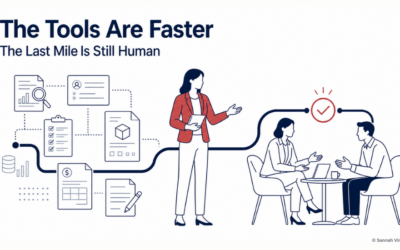
The Tools Are Faster. The Last Mile Is Still Human.
AI can help sales teams research, document, and prepare faster. But in electronics and manufacturing, the last mile of sales still depends on trust, judgment, and human customer conversations.