
Episode 137
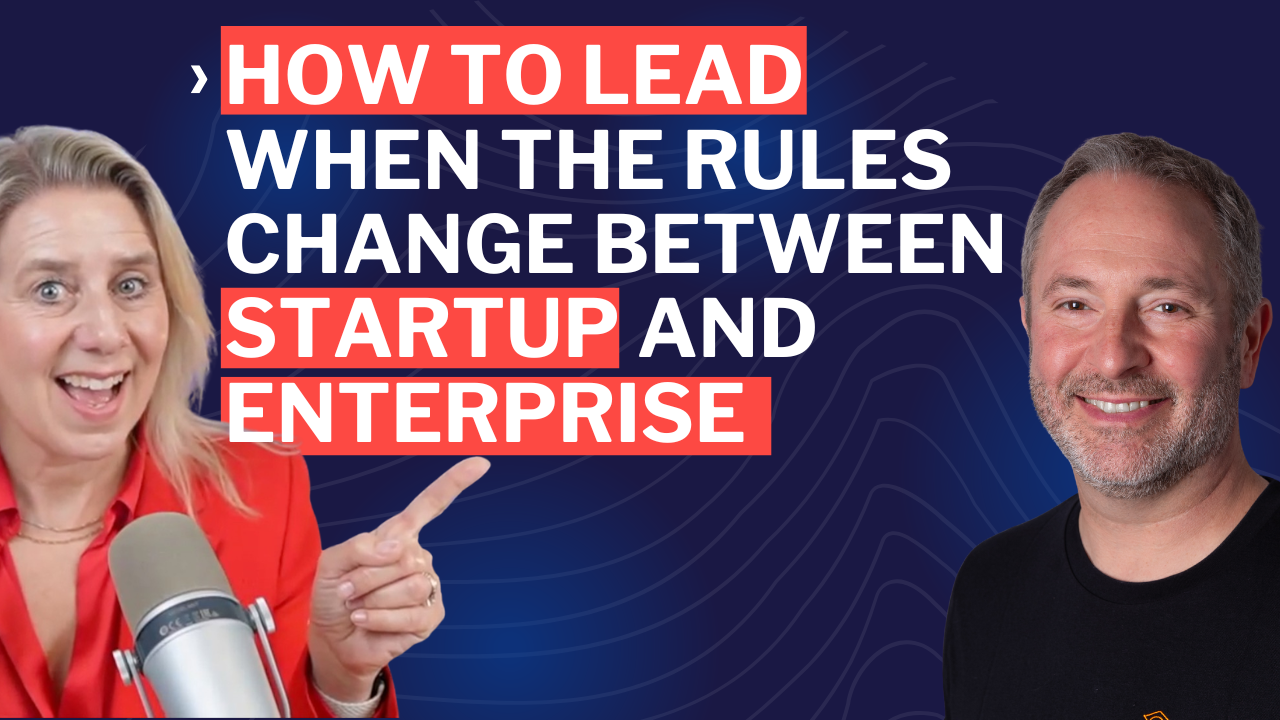
How to Lead When the Rules Change Between Startup and Enterprise
What Chris Lanier learned moving between Microsoft, startups, and Exein — and why autonomy without judgment is just risk




Episode summary
Chris Lanier is the Managing Director, Americas at Exein, a cybersecurity company focused on securing embedded and IoT devices at the edge. Before Exein, he spent more than 20 years at Microsoft holding multiple director-level positions leading Americas and worldwide sales organizations across IoT, cloud, automotive, and embedded platforms. He has navigated the full spectrum, from early-stage startups to one of the world’s largest technology companies, and carries lessons from each.
This conversation explores what actually changes when you move between large and small organizations. The constraints that slow you down in a large company often exist for a reason. The autonomy you gain in a startup amplifies your best decisions, and your worst ones. The leaders who navigate these transitions well are the ones who understand what each environment demands, rather than defaulting to what worked before.
Chris shares what he has learned about giving trust before it’s earned, hiring for attitude and aptitude rather than deep experience, leading global teams across cultures without losing alignment, and why the best leaders combine vision and confidence with genuine humility. He also breaks down what cybersecurity leaders in manufacturing and IoT need to understand about distributed device risk, including why a casino fish tank thermometer became the entry point for a major data breach.
This episode is for leaders navigating growth, scale, or transition who want to lead with clarity and trust regardless of the environment they’re in.
You Will Learn
-
-
- How to give trust at the start of a relationship, and when to recalibrate
- Why autonomy in a small company requires more judgment, not less oversight
- How to lead global teams across cultures without imposing a single playbook
- Why in-person time with distributed teams has compounding returns over months
- How to hire for attitude and aptitude when deep experience is hard to find
- What IoT and manufacturing leaders need to understand about distributed device security
- How to lead with vision and confidence without losing humility
-
Listen now and subscribe to Leadership in Manufacturing.
Key takeaways
Trust Is the Starting Point, Not the Reward
Chris does not make his team earn trust over time. He extends it from day one. His philosophy: assume positive intent, give freedom with inspection, and only recalibrate if someone breaks it. This approach works especially well when hiring senior people who have already done the job before. It signals respect for their experience and creates the psychological safety that lets them perform quickly.
“I like to assume positive intent. So you get my trust out of the gates, you have to mess it up for me not to trust you.”
Small Companies Give You Freedom, and Amplify Your Mistakes
Moving from Microsoft to a startup taught Chris that the absence of constraints is not the same as freedom to act carelessly. In a large organization, the system catches errors. In a small one, you are the system. The leaders who thrive in fast-moving, resource-constrained environments are the ones who bring their own discipline, even when no one is watching.
“Some of the constraints are meaningful. They’re there for a reason. You have to wield your power carefully.”
Great Leaders Hire People Who Push Their Thinking
Chris draws on the idea of hiring people smarter than yourself and broadens it. He looks for people who can think creatively, bring perspectives he does not have, and who approach business value with the same rigor as technical excellence. The goal is a team that collectively sees more clearly than any one of them could alone.
“Mixing technical leadership and technical competence with a really strong, smart eye for business and value. Long-term value generation. If you can combine those two, you really get magic.”
Vision and Confidence Work Best Alongside Humility
Chris’s definition of a great leader: someone who can point to where the organization is going, articulate how to get there, and do all of it without being inflexible when feedback matters. One of his most admired leaders took critical feedback during a team review, improved on it, and became measurably better for it. That combination, conviction plus openness, is rare.
.
“Someone who has vision and can take us to another place, and can do that without being an asshole. Someone who could do it with some humility.”
Cybersecurity Risk Does Not Scale with Device Size
The smallest connected device can be the highest-risk entry point. Chris describes a real incident: a casino’s high-roller database was compromised through a faulty thermometer in a fish tank. It was connected to the network, it was not secured, and a bad actor used it as an entry point. For manufacturers and IoT teams deploying devices at scale, the lesson is clear.
“There’s just no device too small that doesn’t need protecting.”
Leadership Is About the Choices You Make, Not the Environment You’re In
Today’s conversation was a strong reminder that leadership is not determined by the org chart or the company size. It is determined by the choices a leader makes inside whatever environment they find themselves in.
“Leadership is not about the environment you’re in. It’s about the choice you make inside it.”
Why this matters
Leaders in manufacturing and electronics rarely get to stay in one type of environment for their entire careers. Companies grow. Acquisitions happen. Startups scale. Divisions get restructured. Each transition brings a different set of rules: different expectations about autonomy, different tolerance for risk, different definitions of what moving fast actually means.
What Chris describes is something many leaders feel but struggle to articulate: the skills that made you effective in a large organization do not always transfer cleanly when the guardrails disappear. And the instincts you build at a startup do not automatically scale when resources arrive. Transparency looks different at each stage. Trust looks different. The absence of structure, which can feel like freedom, requires more judgment, not less. The leaders who navigate this well are the ones who understand what the environment demands, rather than assuming that what worked before will work again.
In technical industries, IoT, cybersecurity, embedded systems, electronics manufacturing, this challenge is especially acute. The pace of change is faster, the stakes of a wrong decision are higher, and the distance between teams (often spanning multiple countries and cultures) makes alignment harder. The leaders who do it well are the ones who have done the work to understand what trust really looks like in practice, across geographies, org sizes, and organizational life stages.
“Some leaders build alignment by controlling every detail, and others build alignment by trusting first. In technical fast-moving environments, trust is not a nice to have. It directly impacts how teams execute, communicate, and work across functions and regions.”
Episode highlights
Why Autonomy in Small Companies Requires More Discipline, Not Less
-
- Chris spent years at Microsoft, where structure, process, and oversight were built into the system. When he moved to smaller companies, he discovered that the absence of those guardrails was not automatically a feature. It was a responsibility. The freedom to move fast only works well when the person moving fast has the judgment to know when to slow down. Leaders who come from large organizations and move into smaller ones often underestimate this. The freedom feels like a relief until the first significant mistake.
Why In-Person Connection Is a Force Multiplier for Remote Teams
-
- Chris shared a specific story: a 2.5-hour car ride with a colleague in Italy, talking about film, art, music, and business, changed the quality of every video call that came after. It was not a team-building exercise. It was just time. But that time compounds. Leaders who invest in bringing global teams together in person are investing in the quality of every remote interaction that follows, for months.
Why Hiring for Attitude and Aptitude Outperforms Hiring for Experience
-
- One of Chris’s early mentors gave him a hiring principle he has carried ever since: look for attitude and aptitude first, not deep experience. A motivated, creative thinker with the right instincts will often outperform a highly experienced hire who lacks the drive or the mindset. Chris applies this filter across geographies and org sizes, and it consistently produces teams that think more clearly and move more effectively.
Why Cybersecurity in IoT and Manufacturing Is Fundamentally Different
-
- Enterprise IT security has made real progress. But the moment you scatter data and compute across thousands of edge devices, sensors, thermostats, controllers, embedded systems, centralized security stops being sufficient. Chris explains why securing the device layer requires a completely different model, and why the regulatory pressure from frameworks like the EU Cyber Resilience Act reflects a growing understanding of just how exposed most organizations actually are.
Why Passion and Work Should Overlap as Much as Possible
-
- Chris’s closing reflection was personal: he wishes he had made the shift toward work he loved earlier in his career. Not because hard work is avoidable (he embraces hard work) but because the hardest work feels entirely different when it is in service of something you actually care about. Leaders who understand this about themselves build more sustainable careers. And leaders who help their teams find that alignment build more motivated organizations.
Practical Tip
Give Trust at the Start, Inspect with Intention
When you bring a senior hire onto your team, begin the relationship with full trust, not a probationary period. Chris’s approach is to extend trust from day one and use regular, low-friction check-ins to stay informed, not to micromanage.
In practice, this means:
- Have an honest early conversation about what success looks like in the first 90 days
- Give the person the freedom to work in their own way
- Schedule regular check-ins not to control, but to stay connected and visible
- Only recalibrate trust if a specific behavior warrants it, not because you’re uncertain
This approach signals that you respect the person’s experience. It also creates the kind of psychological safety that lets senior people do their best work quickly, which is exactly what you’re paying for.
About the guest

Chris Lanier
Managing Director, Americas at Exein
Chris Lanier is a senior sales and operations leader with deep experience building and scaling global go‑to‑market organizations across enterprise software, IoT, embedded systems, and cybersecurity. He currently serves as Managing Director, Americas at Exein, where he leads the commercial organization, drives regional growth, and builds strong customer and partner relationships across North and South America.
Chris has a proven track record of creating high‑performing, globally distributed teams that deliver measurable business results. His career spans executive leadership roles at Exein and Wind River, as well as more than a decade at Microsoft, where he held multiple director‑level positions leading Americas and worldwide sales organizations, strategic partnerships, and solution sales across IoT, cloud, automotive, and embedded platforms.
Known for his people‑first leadership style, Chris focuses on clarity, execution, and trust while navigating complex, matrixed environments and diverse stakeholder groups. He is passionate about mentoring leaders, developing talent, and building cultures that consistently deliver impact for customers, partners, and employees alike.
Who this episode is for
This episode is built for:
-
-
- Engineering leaders and operations managers navigating rapid organizational growth or transition
- Technical sales leaders and FAEs managing global or cross-regional teams
- Product managers and go-to-market leaders in IoT, embedded systems, or cybersecurity
- Anyone moving between a large enterprise and a smaller, faster-moving organization
- Manufacturing and electronics leaders responsible for distributed product or field teams
- Anyone who leads, or wants to lead, with trust as a foundation rather than a reward
-
What you will be able to do after listening
After listening to Episode 137, you will be able to:
-
-
- Understand how to calibrate your leadership approach when org size or structure changes
- Use a trust-first framework when onboarding senior hires
- Recognize the specific risks that come with greater autonomy in smaller organizations
- Build stronger alignment across cross-cultural and globally distributed teams
- Identify the device-level cybersecurity risks most relevant to IoT and manufacturing environments
- Apply the attitude-and-aptitude hiring filter to your next open role
- Evaluate whether your current leadership style fits the environment you are actually in
-
You can unsubscribe at any time.*
Related Episodes
How Distribution Leaders Build Trust as AI Speeds Up Work – Episode 151
Riad Nizam of Master Electronics shares how distribution leaders build trust, culture, communication, and judgment as AI speeds up work.
Why Good Managers Build Trust Before They Need It – Episode 150
Nate Witsaman of DigiKey joins Sannah Vinding to discuss curiosity, trust, feedback, remote leadership, and developing managers.