You Trained Them. They Didn’t Learn.
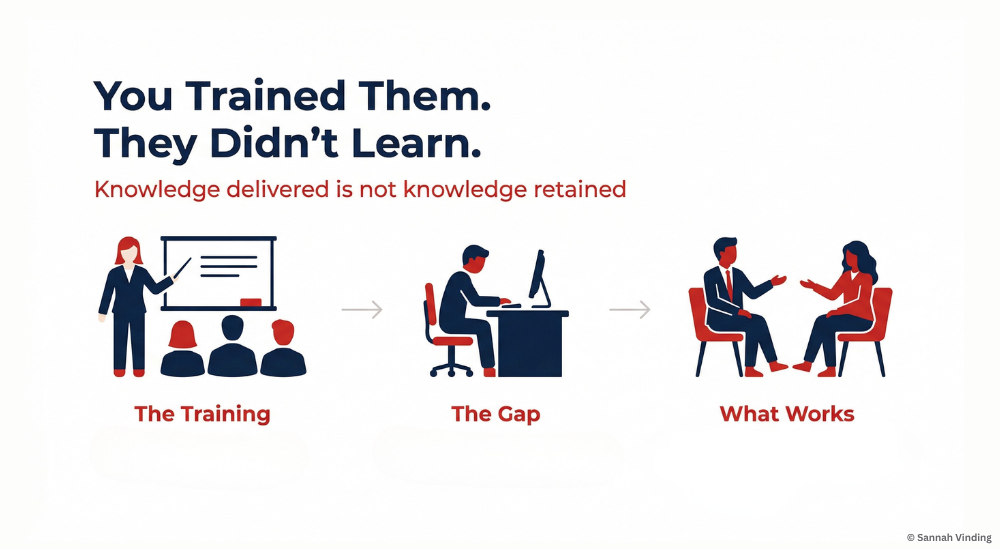
U.S. companies spent $102.8 billion on corporate training in 2025. Employees forget up to 70% of new information within 24 hours of receiving it.
That is not a content problem. It is not a budget problem. It is a gap that most organizations in manufacturing and distribution have never clearly named, and it sits at the center of every technical training effectiveness conversation worth having.
Training fails when the environment does not create enough safety for people to genuinely not know something. The information lands, the session ends, and everyone returns to the field. But the behavior does not change because comprehension never actually happened. The material was delivered. The learning was not.
The $300 Seat Nobody Audits
A full-day technical training session at a distributor or manufacturer typically runs about $300 per person when you account for the seat cost, travel, and time out of the field. A 40-person class is $12,000 before hotels and meals. Most organizations approve that number without much friction.
What almost no one measures is what changed on the other side of it. Did the counter sales team handle technical questions differently the following week? Did the service techs troubleshoot faster? Did the field reps actually convert what they heard into different behavior?
The answer, more often than not, is not much. Research on training retention shows that employees retain only about 25% of training content after two weeks without reinforcement. In manufacturing and distribution, where technical depth matters and field mistakes are expensive, that retention gap is not an acceptable outcome. It is a structural problem.
The content is usually fine. The material covers what it needs to cover. Technically excellent trainers are brought in. But technical excellence and the ability to actually teach are two different skills, and most organizations have treated them as interchangeable for too long.
When the Expert Walks In
There is a specific dynamic inside technical training that rarely gets named. The people who know a product most deeply are almost always the ones asked to train it. Subject matter expertise and teaching ability are treated as equivalent. They are not.
The expert in the room has spent years building fluency that is now automatic. What once required real effort now requires none. That fluency creates a specific blind spot: the inability to see what someone new genuinely does not yet understand. When a trainer moves too fast, skips a foundation that feels obvious to them, or corrects someone in front of the group, the room closes. People stop asking real questions. They start performing comprehension instead of achieving it.
The data reflects this. Only 25% of employees fully engage with training content, with the average corporate completion rate sitting at 45%. In technical environments where the gap between knowing and applying is already significant, disengagement during the session is the last problem you need.
This is not a learner problem. The same information delivered with a different tone produces a completely different outcome. “What are your numbers?” and “Let’s work through this together” are not stylistic variations. They are different instructions to the nervous system of the person in the room.
“If they’re failing, it comes back to you. You’re not teaching the right way.”
What the Trainers Who Change Behavior Do First
The leaders and trainers who consistently produce behavior change share one orientation: they think about the room before they think about the content. Before the first slide, they establish that it is safe to be wrong, safe to not know, and safe to ask what might sound like a basic question.
That is not soft leadership. In a technical environment, it is precision work. A room that feels unsafe produces polished performance. A room that feels safe produces actual learning.
“I never call anybody out. I never act like I’m smarter than them. I never disagree. If anything, I’ll say, I like the way you’re thinking. And then I build off of that. I almost make them feel like that’s the right answer. But I correct a little bit without calling them out on it.”
The implication for manufacturing and distribution leaders is direct: your trainers need as much development in delivery as they do in technical knowledge. Investing in content without investing in how it lands is the fastest way to spend $12,000 and change nothing.
Listen to the full conversation with Don Gillis on the Leadership in Manufacturing Podcast.
You can unsubscribe at any time.*
Sannah Vinding

Sannah Vinding
Engineer | GTM, Growth & Product Marketing Leader, Podcast Host
Sannah Vinding is an engineer and go-to-market leader known for bridging technical depth with business clarity across electronics and manufacturing.
Her work sits at the intersection of engineering, product, and commercial teams, translating complex technology, data, and customer insight into clear positioning, strong go-to-market execution, and measurable business impact.
She created Leadership in Manufacturing as an applied leadership platform to explore how leaders actually think, communicate, and make decisions when complexity is high and expectations are rising.
Through candid conversations with executives across manufacturing, distribution, and supply chain, Sannah brings together voices from across the electronics value chain to share lessons that help leaders grow with clarity and confidence.
Available on Your Favorite Podcast Platforms!




Related Episodes
Why This Shift Is So Hard for Leaders
Leadership changes when organizations scale. Learn how to lead effectively between startup speed and enterprise structure in the electronics manufacturing industry.

Stop Walking In With a Line Card. Start Walking In With a Plan
AI won’t build trust for you. But it can help you earn it. Episode 136 breaks down how smarter prep drives credibility in electronics sales