
AI Sounds Right. That’s the Problem.
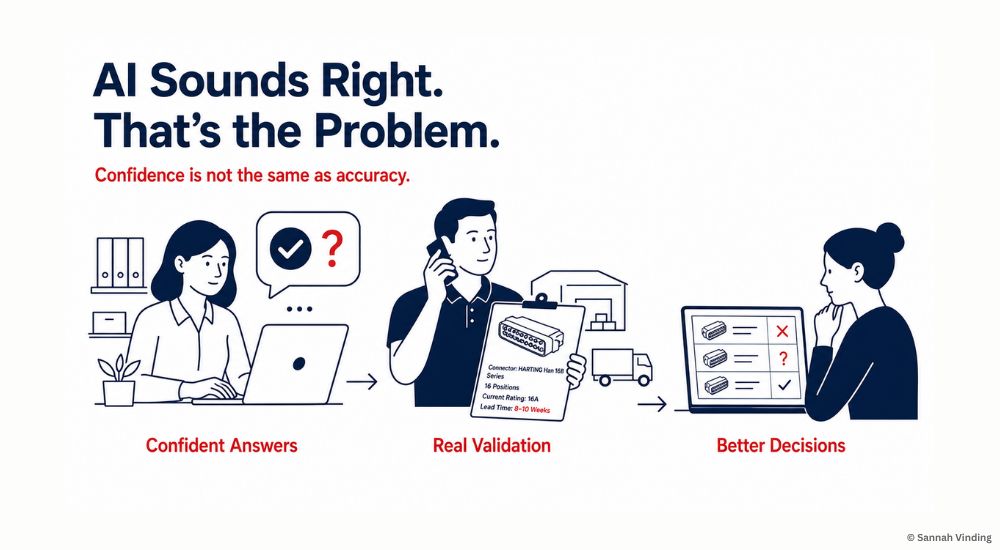
94% of B2B buyers used generative AI in their last purchase process. 20% of them said the AI made them less confident in their decision, not more.
Buyers are showing up to sales conversations with answers already in hand. The answers are clean, fast, and confidently delivered. They are also, often, wrong.
Sales leaders in electronics, manufacturing, and supply chain are watching this play out in real time. The buyer arrives more prepared than ever, and less sure than ever. The rep on the other end is the first place a confidently wrong answer gets caught. The job has not gotten easier. It has gotten different.
AI generates answers with the same confidence whether the underlying information is accurate or not. In B2B technical sales, this creates a new gap. Buyers walk into conversations carrying confidently wrong information, and the rep’s job has shifted from delivering information to validating what AI returned and helping the buyer see what was missed.
Confidence Is Not the Same as Accuracy
The Stanford AI Index found hallucination rates across leading large language models ranging from 22% to 94%, depending on the model and the task. On domain-specific queries, the kind a buyer asks before evaluating a component, those rates climb to between 58% and 88%.
That gap is invisible to the buyer. The model returns its answer in the same tone whether it is pulling from a verified datasheet or generating something plausible. There is no asterisk. There is no hesitation.
In electronics and manufacturing, that confidence has practical consequences. A buyer searching for a cross reference, a substitution, or a lead time gets a clean answer in seconds. The answer might be in the right neighborhood. It might also be a discontinued part, a wrong package, or a price quoted from outdated stock.
The rep on the other end is no longer the first source of information. They are the first place a wrong answer gets caught. That work was always part of B2B selling. It used to be a small percentage of the call. It is now most of it.
Why Buyers Are Less Confident, Not More
For all the productivity claims, generative AI has not made B2B buyers feel more sure of their decisions. The same buyer experience report found that 62% said they needed sellers to clarify what the AI had told them, and 58% engaged a vendor earlier than usual specifically to get AI questions answered.
That is a remarkable signal. The technology was supposed to compress the buying cycle. Instead it has added a verification step.
The friction is structural. AI does not flag the boundary between what it knows and what it is generating. Buyers, especially younger buyers without a deep network of distributors and reps, often cannot tell the difference. They show up to the conversation half-confident. They want a person to help them decide whether the half they trust is the right half.
That work was always part of selling. AI has just made it the dominant part.
“Buyers are showing up with answers before the conversation starts. The sales rep who closes the last mile is the one who knows when to push back on what AI returned.”
The Skill Sales Leaders Should Be Hiring For
The reps who win in this environment are not the ones who know more than AI. They are the ones who know when AI is wrong. That is a different muscle. It is built by exposure to suppliers, design conversations, lead time history, and the specific failure modes of components in the field.
Gartner projects that by 2030, 75% of B2B buyers will prefer sales experiences that prioritize human interaction over AI. The buyers are already telling us what they need. The hiring profile, the ramp programs, and the enablement curriculum should be built around the rep’s ability to validate AI output, not match it.
“AI is a great tool. But it answers so confidently. Whether that answer is right or not is something different.”
The next decade of B2B selling will not be won by reps who use AI faster. It will be won by reps who know when to push back on it. The buyers are already showing up with answers. The question for every sales leader is whether your team has the experience, the network, and the judgment to tell them which ones to trust.
You can unsubscribe at any time.*
Sannah Vinding

Sannah Vinding
Engineer | GTM, Growth & Product Marketing Leader, Podcast Host
Sannah Vinding is an engineer and go-to-market leader known for bridging technical depth with business clarity across electronics and manufacturing.
Her work sits at the intersection of engineering, product, and commercial teams, translating complex technology, data, and customer insight into clear positioning, strong go-to-market execution, and measurable business impact.
She created Leadership in Manufacturing as an applied leadership platform to explore how leaders actually think, communicate, and make decisions when complexity is high and expectations are rising.
Through candid conversations with executives across manufacturing, distribution, and supply chain, Sannah brings together voices from across the electronics value chain to share lessons that help leaders grow with clarity and confidence.
Available on Your Favorite Podcast Platforms!




Related Episodes
AI Can Speed Up Sales. It Cannot Create Credibility.
AI can help technical sales teams move faster, but credibility still depends on accuracy, context, judgment, and the person who can stand behind the answer.
Leadership in Manufacturing Named a Top Five Podcast for Manufacturers
Leadership in Manufacturing was named a top-five podcast for manufacturers by MillionPodcasts. This recognition reflects the growing need for practical leadership conversations inside electronics, manufacturing, distribution, supply chain, and technical teams.