
Episode 134
How Leaders Start Using AI Without Overwhelming Their Teams
People-First AI Adoption for Technical Teams




Episode summary
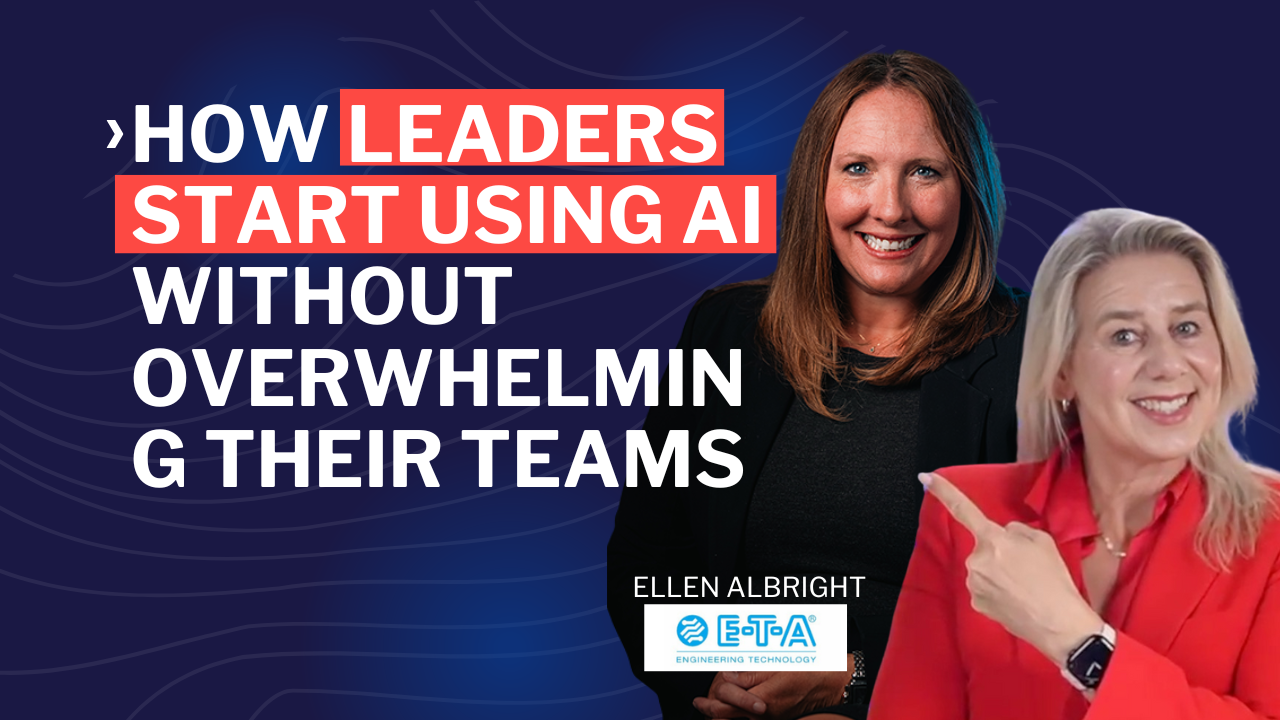
In Episode 134 of the Leadership in Manufacturing Podcast, host Sannah Vinding returns with Ellen Albright, Marketing and Communications Director at E-T-A Engineering Technology, for a focused bonus conversation on starting AI the right way.
This short episode distills practical advice for leaders who are early in their AI journey or feeling overwhelmed by tools, trends, and expectations. Ellen and Sannah discuss why successful AI adoption starts with business objectives, not technology, and how leaders can avoid common pitfalls by choosing a small number of tools, setting clear guardrails, and building habits over time.
Rather than treating AI as a quick fix, the conversation reinforces that AI adoption is a leadership decision rooted in alignment, change management, and clarity of purpose. Leaders will hear why asking better questions, refining prompts, and sharing learnings across teams matter more than chasing the latest feature.
This bonus episode is for leaders in electronics, manufacturing, and supply chain who want to move from curiosity to confident, people-first AI adoption without overwhelming their teams.
You Will Learn
-
Why leaders should align AI initiatives with business goals from the start
-
How to avoid tool overload by starting small and building habits
-
Why AI rarely delivers value on the first answer and how to work with it effectively
-
How asking better questions leads to better outcomes with AI
-
Why people, trust, and clarity still matter more than technology
Listen now and subscribe to Leadership in Manufacturing.
Key takeaways
Start With Business Goals, Not Tools
AI adoption works best when leaders begin with clear objectives instead of chasing the latest technology. Picking one or two tools that support real daily work prevents overwhelm and keeps teams focused.
“Don’t just use AI because it’s cool. Use it because it makes your role or your business better.”
Small, Intentional Steps Beat Big Rollouts
Trying to adopt too many AI tools at once creates confusion and resistance. Leaders who start small, experiment, and build habits over time create stronger adoption and less friction.
“Pick one or two tools and really start experimenting instead of trying to do everything.”
Better Questions Lead to Better AI Results
AI rarely delivers value on the first response. Leaders and teams must learn to ask clearer questions, refine prompts, and treat AI as a collaborative process rather than a one-click solution.
“It’s never the first answer where you’re done. You have to ask better questions and refine.”
Why this matters
As AI adoption accelerates across electronics manufacturing, distribution, and supply chain, many teams feel pressure to move fast. The real risk is not moving too slowly. It is adopting AI without clarity, alignment, or leadership ownership.
This bonus episode reinforces a critical leadership lesson. AI delivers value when it is tied to business objectives, introduced gradually, and supported by clear expectations. When leaders focus on purpose before tools, teams stay confident, engaged, and in control of the work.
“AI can accelerate the work, but leaders are still responsible for focus, clarity, and trust.”
Episode highlights
Why AI Should Be Aligned to Business Objectives From Day One
-
- This episode explains why AI initiatives fail when they are driven by trends instead of outcomes. Leaders learn how to anchor AI adoption to real goals.
How to Avoid Tool Overload During AI Adoption
-
- Trying too many tools at once overwhelms teams. This conversation highlights why starting with one or two use cases creates momentum instead of resistance.
Why Asking Better Questions Improves AI Results
-
- AI improves when leaders and teams learn to refine prompts, ask clarifying questions, and treat outputs as drafts, not decisions.
How Habit Building Makes AI Adoption Stick
-
- Successful AI adoption happens when teams build repeatable habits, document what works, and share learnings across the organization.
What People-First AI Leadership Looks Like in Practice
- This bonus episode reinforces that AI should support work, not replace thinking. Leaders remain accountable for judgment, trust, and outcomes.
Practical Tip
Choose One AI Habit to Build This Month
Instead of rolling out multiple tools, pick one repeatable AI habit, such as:
-
- Using AI to summarize meetings
- Drafting first-pass documentation
- Organizing internal notes or FAQs
Then clearly define:
-
- When the tool should be used
- What it can and cannot do
- How outputs should be reviewed
Small habits compound faster than big launches.
Clarity builds adoption.
Focus builds trust.
About the guest

Ellen Albright
Marketing & Communications Director E-T-A Engineering Technology
Ellen Albright is a marketing and communications leader with over 20 years of experience driving business growth through strategic, data‑driven marketing. She currently serves as Marketing & Communications Director at E‑T‑A Engineering Technology, a global manufacturer of circuit protection and control products, where she has spent more than two decades building and strengthening the company’s brand, demand generation, and customer engagement efforts.
In her role, Ellen leads integrated marketing programs across digital, automation, product launches, web, events, and distributor collaboration. She works closely with engineering, sales, and customer service teams to translate technical products into clear, compelling value for customers and partners. Her background includes deep expertise in digital strategy, marketing automation, online marketing, market planning, and performance measurement.
Known for her collaborative approach and practical mindset, Ellen is passionate about using insight, creativity, and measurable strategy to build strong brands, align teams, and deliver results
Who this episode is for
This episode is built for:
-
-
Leaders implementing AI in sales, engineering, or manufacturing teams
-
Executives responsible for technical knowledge, efficiency, and customer experience
-
Managers introducing AI tools without overwhelming their teams
-
Organizations balancing automation with human expertise and trust
-
Leaders focused on practical, people-first AI adoption in complex industries
-
What you will be able to do after listening
After listening to this episode, you will be able to:
-
- Identify where AI agents can realistically support sales and engineering teams
- Define clear boundaries between AI support and human judgment
- Introduce AI tools in ways that build trust instead of resistance
- Align AI initiatives with real business goals, not trends
- Improve access to technical knowledge without overwhelming subject matter experts
- Lead AI adoption as a change management effort, not just a technology rollout
Leadership in Manufacturing Newsletter:
Join the 4,100+ professionals in the electronics manufacturing industry who rely on our insights.
Developing Future Leaders!
* By subscribing, I consent to receive email updates.
Related Episodes
How Distribution Leaders Build Trust as AI Speeds Up Work – Episode 151
Riad Nizam of Master Electronics shares how distribution leaders build trust, culture, communication, and judgment as AI speeds up work.
Why Good Managers Build Trust Before They Need It – Episode 150
Nate Witsaman of DigiKey joins Sannah Vinding to discuss curiosity, trust, feedback, remote leadership, and developing managers.