Stop Walking In With a Line Card. Start Walking In With a Plan
How Modern Reps Are Using AI to Build Trust Before the Meeting Even Starts
You walk into a customer’s facility. The engineer barely looks up. You open your bag. You pull out your line card.
And the first thing he says is: “Do you know what we build?”
That moment, that uncomfortable, relationship-ending silence, is one Tom Walker, Co-Founder and VP of Spectron Components, never wants to experience again. And in Episode 136 of the Leadership in Manufacturing Podcast, he breaks down exactly how modern manufacturer’s reps are using AI to make sure it never happens.
But here is the thing: this conversation is not really about AI at all.
It is about trust. Preparation. Strategic thinking. And what it actually means to lead in a leaner, faster, higher-expectation world.
If you work at the intersection of engineering, product marketing, and go-to-market in the electronics industry, this one is for you.
The Rep Role Has Changed. And “Showing Up” Is No Longer Enough
Let’s be honest. The days of driving around with a Thomas Guide map and rolls of quarters for payphones are long gone. But a lot of the mindset from that era? It is still hanging around like an outdated component on a BOM that no one has reviewed in years.
Tom Walker has been in the electronic components rep business for nearly four decades. He has watched the industry shift in ways that would be unrecognizable to his earlier self. Access to engineers and purchasing teams is tighter. Engineering departments are smaller. Expectations are higher. And buyers have done half their research before a rep even walks in the door.
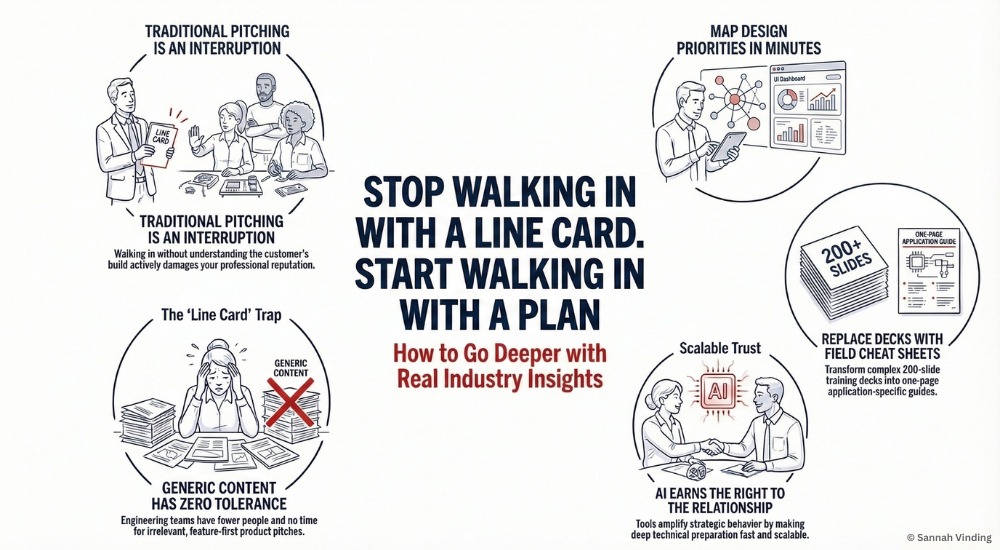
The old playbook of showing up, throwing down the line card, and asking if they use any LEDs is not just ineffective anymore. It actively damages credibility.
What replaces it? Preparation that is so precise and relevant that the engineer stops seeing you as an interruption and starts seeing you as a solution.
“You can’t just walk in and throw your line card down anymore. You have to understand what they’re building before you ever show up.”
AI Does Not Replace the Relationship. It Earns the Right to Have One.
Here is the key insight: AI is not the point. Earning the trust of an engineer in the first five minutes of a conversation is the point. AI is just the tool that makes the preparation fast enough to be scalable.
Consider what this looks like in practice. A principal needed a list of robotics companies in Southern California that could be a fit for their product line. The catalog went into ChatGPT, the prompt ran, and a targeted account list came back in under 30 minutes. The president called back, stunned: “How did you do this?”
That reaction is the ROI. Not the tool. The trust earned. The credibility built. The relationship deepened.
And it does not stop at account lists. One approach worth building is what Spectron calls a “multi-line hunter”: a structured AI workflow that maps every line in the portfolio against a target customer, ranks them by fit probability, and tells a new salesperson exactly where to start. Instead of walking in hoping for an order, the rep walks in with a clear hypothesis: here is what you build, here is where you may be exposed in your supply chain, and here is where I can help.
The Old-School Twist That Wins
After AI identifies targets, Tom’s team prints highly curated product guides.
These are not generic brochures. They are technical, visual, and relevant. Usually 8 to 12 pages. Sometimes more focused, like 4-page mini guides for a specific principal or market segment.
Tom mentioned they can get these printed and shipped for about $3 per piece.
That matters because nobody does this anymore.
Engineers are drowning in email. They are not drowning in useful, well-designed physical technical content.
So when the follow-up call happens days later, the rep is no longer a stranger. The name is familiar. The line card is familiar. The barrier is lower.
“AI lets us react faster and appear larger than we are, not in a deceptive way, but in a smarter way.”
For B2B Marketing Leaders in Electronics: This Is Where You Come In
This framework is not just relevant to manufacturers’ reps. It maps directly onto the challenges facing B2B marketing leaders in the electronics and semiconductor space, where your audience is engineers, your products are complex, and trust is earned through technical credibility, not clever copy.
Here are six concrete recommendations you can apply in your organization right now.
1. Use AI to Build “Account Intelligence Briefs” Before Customer-Facing Moments
The multi-line hunter concept translates directly into marketing and sales enablement. Before a field application engineer (FAE), regional sales manager, or channel partner walks into a key account, they should have a one-page account intelligence brief that answers:
- What does this customer build, and what are their design priorities right now?
- Where might they have supply chain exposure (long-lead components, single-source risk, EOL transitions)?
- Which of your product lines have the highest probability of relevance to their current design phase?
- Who are the key engineers and buyers, and what problems are on their roadmap?
Build a repeatable prompt workflow in ChatGPT, Claude, or your preferred LLM that generates this brief in minutes using publicly available data: company website, press releases, job postings (they reveal design priorities), LinkedIn, distributor sales data, and trade show attendance lists.
The output is a rep or FAE who walks in laser-focused, not guessing. That is how you earn the first five minutes.
2. Stop Selling Products. Start Mapping Solutions Across Your Line Card.
The most important mindset shift in this conversation is the move from reactive selling to strategic thinking. Tom Walker put it plainly: his salespeople are thinking “get the order, get an RFQ.” He is thinking about how many of his lines he can get into a single customer.
To act on that, he built what he calls a multi-line hunter. He types in a customer name, and the tool returns a table mapping every line in his portfolio against that account, ranked by fit probability, high, medium, low, don’t waste your time, along with what to talk about for each one.
The result is a salesperson who walks in thinking about the full relationship, not just the next order. And as Tom noted, the more lines you can sell into a customer, the tighter the relationship, the more value you deliver, and the harder you are to replace.
Ask yourself:
- Which of your lines has the highest fit probability for this specific account, and why?
- What should your rep lead with, and what comes next once the door is open?
- How can you give every salesperson on your team a clear starting point instead of a line card and a guess?
AI can build that table for you. Feed in your portfolio and what you know about the customer, and let the model do the ranking. The output is a rep who walks in with a strategy, not a hope.
3. Make Technical Preparation the Standard, Not the Exception
Engineering teams today have fewer people doing more work. That means when a rep, FAE, or marketing touchpoint does get access, the tolerance for wasted time is near zero.
This has a direct implication for content marketing in the electronics industry: generic product content is no longer enough.
What engineers trust, above all else, is relevance. They want to know you understand what they are building before you start talking about what you sell.
Apply this to your content strategy:
- Shift from feature-first datasheets to application-first landing pages that open with the design problem before introducing the component.
- Create “pre-meeting prep” content packages for your channel partners and FAEs: one-pagers, application notes, and competitive comparison tools they can review the night before a customer visit.
- Use AI to generate a first draft of technical application content at scale, then have your engineers validate and sharpen it. The model works best as a first draft engine refined with human judgment, not as a final-output machine.
The engineers in your customer base will notice the difference between a partner who did their homework and one who is still asking “do you use any LEDs?”
4. Rebuild Your Distributor Enablement Strategy Around Cheat Sheets, Not Decks
One of the most practically useful moves from this episode: take the 200-slide “PowerPoint of death” from a principal, run it through an AI summarization workflow, and send distributor salespeople a single-page cheat sheet after training instead.
The response from distribution sales managers: “Nobody has done this.”
Think about what that says about the state of distributor enablement in electronics. After years of complex product training, the people selling your components on the front line often cannot remember three things about your product two days after the training ends.
Here is how to apply this immediately:
- Take your existing product training decks, webinar recordings, or application guides and run them through an AI summarization workflow. Prompt it to produce a one-page “field cheat sheet” in plain language: what the product does, where it fits, what problems it solves, and the three questions a distributor salesperson should ask to qualify an opportunity.
- Build these cheat sheets into your channel portal or distributor onboarding flow.
- Send them as a follow-up to every product training session, as a value-add, not an afterthought.
This is not complicated. It is the kind of thoughtful, practical enablement that makes your product line easier to sell than your competitor’s and compounds over time into loyalty and preference.
5. Protect Company Culture While Adopting New Tools, Before the Tension Becomes a Problem
Most organizations dance around a truth that this episode addresses directly: technology adoption without cultural intentionality creates fragmentation.
At Spectron, they use Monday team calls, open communication norms, and a deliberate “safety culture” where every team member can raise concerns, push back on new lines, and contribute to strategy. They run a roundtable when evaluating new principals specifically so that co-owners talk less and the team talks more.
For B2B marketing leaders in electronics organizations, this has an important parallel. AI adoption is accelerating across marketing, sales, and product functions. The risk is not that people will adopt it too slowly. The risk is that:
- Some team members will use it well while others lag, creating invisible capability gaps.
- People will not know what outputs to trust, how to validate AI-generated content, or when human judgment should override the model.
- Leadership will assume adoption is happening without ever creating a safe space to surface confusion, mistakes, or concerns.
Create that space intentionally. Run a monthly “AI lessons learned” session. Make it safe to share both breakthroughs and failures — both happen regularly when teams are genuinely experimenting. Define your team’s standards for when AI output requires human validation before it reaches a customer.
Culture is not a soft issue. It is the container that determines whether new tools create value or create chaos.
6. Build for Long-Term Credibility, Not Just Short-Term Activity
The most resonant moment in this episode comes from a simple question: what advice would you give yourself 20 years ago? The answer had nothing to do with tactics or tools. It was about perspective.
Think broader. Go with the flow more. Don’t be so micro-focused. Enjoy the relationships.
For marketing leaders in a high-pressure, quota-driven environment, this is hard to hear, and harder to act on. But the ROI is real.
Engineers remember the rep who knew what they were building. Buyers remember the distribution partner who sent them a useful one-pager when everyone else sent them a PDF they never opened. Principals remember the team that called back with a targeted account list in 30 minutes.
These moments compound. Not in a quarter. Over a decade.
Your marketing strategy should reflect this. What content are you creating today that a design engineer will bookmark and return to in six months? What technical guides are you publishing that will still be accurate and valuable when a new engineer joins that customer’s team next year? What relationships is your marketing infrastructure (your podcast, your newsletter, your application notes) quietly building that will pay off in design wins two design cycles from now?
Long-term thinking is not opposed to urgency. It changes how you execute on today’s priorities.
The Mindset Shift That Ties It All Together
Everything in this episode, the AI workflows, the multi-line strategy, the cultural practices, the advice to a younger self, connects back to one fundamental shift:
From reactive to strategic.
Reactive reps walk in hoping for an opportunity. Strategic reps walk in having already identified where they can help.
Reactive marketing creates content about products. Strategic marketing creates content that earns credibility with engineers before they ever pick up the phone.
Reactive leaders adopt tools because everyone else is. Strategic leaders adopt tools with a clear understanding of what behavior they are trying to amplify and what culture is required to make that amplification work.
“Tools amplify behavior. They don’t replace responsibility.”
Your Next Move
The challenge for everyone listening (and reading) is deceptively simple: Pick one key customer. Step back. Ask where you could be positioned more strategically. Use the tools to think broader, not just move faster.
That is the rep mindset. And it is exactly the mindset that the best B2B marketing leaders in electronics are bringing to their organizations right now.
If this resonated with you, listen to Episode 136 of the Leadership in Manufacturing Podcast and go back to Part 1 if you have not already. Then share it with someone in your organization who needs to hear it.
Because the conversation about AI in manufacturing is just getting started. And the leaders who build trust while adopting new tools will be the ones still in the room when it matters most.
You can unsubscribe at any time.*
Sannah Vinding
Sannah Vinding
Engineer | GTM, Growth & Product Marketing Leader, Podcast Host
Sannah Vinding is an engineer and go-to-market leader known for bridging technical depth with business clarity across electronics and manufacturing.
Her work sits at the intersection of engineering, product, and commercial teams, translating complex technology, data, and customer insight into clear positioning, strong go-to-market execution, and measurable business impact.
She created Leadership in Manufacturing as an applied leadership platform to explore how leaders actually think, communicate, and make decisions when complexity is high and expectations are rising.
Through candid conversations with executives across manufacturing, distribution, and supply chain, Sannah brings together voices from across the electronics value chain to share lessons that help leaders grow with clarity and confidence.
Available on Your Favorite Podcast Platforms!




Related Episodes
The Rep With a Fax Machine Is Losing
How manufacturing reps are using AI, smarter targeting, and disciplined workflows to win access, identify the right engineers, and support principals more effectively. Episode 135 with Tom Walker on modernizing the rep role.
When Datasheets Slow Sales
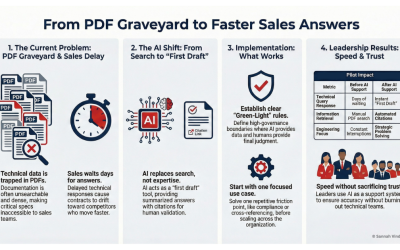
How manufacturing leaders use AI to turn datasheets into faster, trusted sales answers without replacing engineers or risking accuracy.