
Episode 94
Advice for Industry Leaders: Career Lessons from Manufacturing Leaders
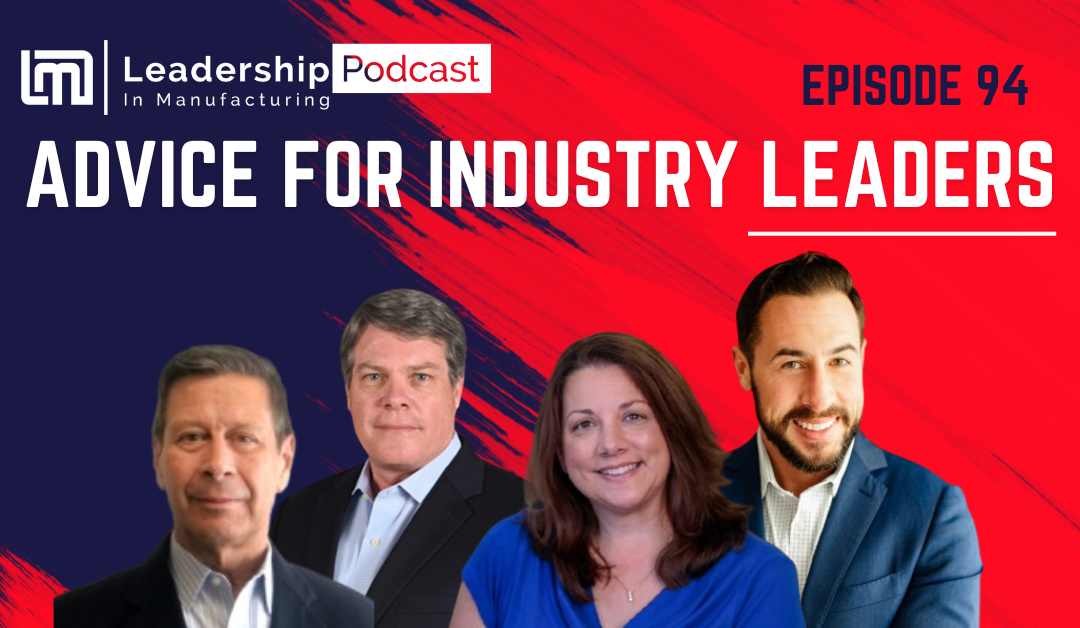
In this special recap episode of the Leadership in Manufacturing Podcast, Sannah Vinding brings together career advice from four leaders across electronics, distribution, and manufacturing: Don Akery, Holly Good, Michael Knight, and Eric Slatten.
The episode focuses on the kind of advice leaders often understand more deeply with experience: slow down before you sell, trust your timing, invest in your network, have more confidence, and listen to understand.
For leaders in electronics, manufacturing, distribution, and supply chain, this episode is a practical reminder that career growth is not only about the next role. It is shaped by relationships, judgment, confidence, timing, and the choices you make long before the opportunity arrives.
“Virtually all of the great things that have happened to me in my life and career have resulted from an investment in networking I made prior to them happening.”
Who this episode is for
This episode is for:
- Leaders building long-term careers in electronics, manufacturing, or distribution
- Sales and business leaders who want to build stronger customer relationships
- Emerging leaders learning how to trust their judgment
- Professionals navigating career timing, growth, and opportunity
- Managers mentoring the next generation of industry talent
- Anyone who wants practical career advice from experienced industry leaders
What you will learn
In this episode, you will learn:
- Why slowing down can build stronger customer relationships
- How trusting your gut can help you make better career decisions
- Why networking before you need it matters
- How confidence changes the way you show up with customers, leaders, and peers
- Why listening to understand is different from listening to respond
- How experienced leaders think about timing, regret, and long-term growth




Key takeaways

Slow Down and Build Relationships:
Don Akery encourages us to slow down and truly understand our customers before rushing to make a sale. Building genuine relationships can pave the way for long-term success.

Trust Your Gut:
Holly Good tells us to stay the course. Trust your instincts, and remember that the right opportunities will present themselves when the timing is right.
Invest in Networking:
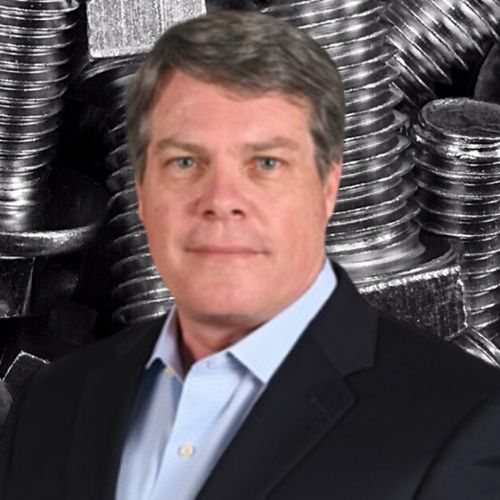
Michael Knight underscores the power of networking. Building a robust network can open doors to new opportunities and support your career growth.

Have Confidence:
Eric Slatten advises us to be confident in our abilities and not to be overly concerned with titles. Everyone is approachable, and confidence can help bridge those gaps.
“Reflecting on the journey, it is acknowledged the importance of valuing time and making balanced decisions. Time is the most precious asset; use it wisely.”
Leading with Confidence and Purpose in Industry
Show Notes:
In this episode of the Leadership In Manufacturing Podcast, host Sannah Vinding engages with industry leaders Eric Slatten, Don Akery, Holly Good, and Michael Knight, offering a treasure trove of advice from their expansive career journeys.
The conversation kicks off with Don Akery, who advises slowing down to truly understand your current situation. Don emphasizes the importance of building relationships before diving into sales, comparing it to pacing yourself on a first date. This thoughtful approach fosters trust and aligns with Sannah’s perspective on providing value first.
Holly Good chimes in with her counsel to “stay the course.” She highlights the significance of gut instincts and timing, sharing her own career trajectory with Cornell Jubilee, which evolved organically as her personal circumstances changed. Holly’s journey underscores the value of persistence and aligning opportunities with the right moments in life.
Michael Knight reflects on the importance of staying curious and giving back to communities, a realization that came to him later in his career. He acknowledges that while hindsight offers clarity, the choices made at any given time shape who we are today. His advice to new industry entrants is to commit, work diligently, choose mentors wisely, and actively network—emphasizing the immense impact of a robust professional network.
Eric Slatten advises younger professionals to have more confidence and not be intimidated by titles. He shares his own experience of evolving from hesitation to confidently engaging with anyone, understanding that mistakes are part of the learning process. His key takeaway: confidence and humility go hand in hand.
The episode wraps up with a unified message: Leadership in manufacturing thrives on continuous learning, building genuine relationships, and staying true to oneself.
For more insights and to connect with industry leaders, visit leadershipandmanufacturing.com and follow us on LinkedIn, YouTube, and Instagram. Remember: stay curious and keep learning.
Check out the full episode for more detailed advice from these industry veterans!
Guests:
Don Akery
Don Akery
Chief Executive Officer at Waldom Electronics
Don Akery is a visionary leader and dedicated principal with extensive experience in the distribution of electronic components. Currently serving as the Chief Executive Officer at Waldom Electronics, he has achieved revenue, profit, and business objectives while adhering to compliance requirements and developing corrective action plans.
Don has a proven track record in P&L enhancement, sales growth, sales management, business development, employee recruiting, and talent development. He holds a degree in Applied Behavioral Sciences and is actively involved in organizations such as Women in Electronics and the National Association of Wholesaler-Distributors. Throughout his career, Don has been recognized for his outstanding work ethic, determination, and strong leadership skills.
Holly Good
Holly Good
Director, Global Distribution Sales, Knowles Precision Devices
Holly Good is the Director of Global Distribution Sales at Knowles Precision Devices with over eight years of experience in managing and supporting channel partner relationships.
She excels in organizational leadership, distribution channel management, new business development, and product training.
Holly is also a Founding Advisory Board Member at Women in Electronics, where she is dedicated to the professional and personal leadership development of women in the electronics industry.
Holly has received the WE Recognizes Award in 2020 for her outstanding achievement in empowering, developing, advocating, and celebrating women in the industry.
Michael Knight
Michael Knight
President & CEO Endries International Inc
Michael Knight is the President and CEO of Endries International Inc., a provider of OEM fastener solutions. With over 25 years of experience in the electronic components distribution and manufacturing industry, Michael Knight is an accomplished professional in the field.
Prior to his role at Endries International, Michael Knight spent 18 years at TTI, where he held various management positions. This experience allowed him to gain valuable expertise and insights into the industry.
With his wealth of experience and strong leadership abilities, Michael Knight continues to make significant contributions to the electronic components industry.
Eric Slatten
Eric Slatten
President & CEO, ECS Inc. International
Eric Slatten is a dynamic leader serving as the President & CEO at ECS Inc. International, where he manages key accounts and drives strategic initiatives.
With over 16 years of experience in the industry, Eric is known for his expertise in overseeing contract negotiations and acquisitions, contributing significantly to the company’s growth.
Listen Now
Full Episode Transcript
The transcript below has been lightly edited for readability. It may contain minor errors, but it is included to make the episode easier to search, reference, and revisit.
Full Episode Transcript
The transcript below has been lightly edited for readability. It may contain minor errors, but it is included to make the episode easier to search, reference, and revisit.
Sannah Vinding [00:00:00]:
Good. I want the big advice here.
If you look back, maybe 10 years, what kind of advice would you give yourself if you had to go back in time?
Eric Slatten [00:00:08]:
Have more confidence in yourself. For me, speaking to myself, it would be: have more confidence.
Michael Knight [00:00:14]:
Giving back more. Investing more in the communities that I am engaged with, and investing more in friends and associates. If I were going to do anything differently, I would have made more time for that earlier because it really is rewarding.
Holly Good [00:00:30]:
If it feels right in your gut, it is right for you.
Don Akery [00:00:33]:
I use the analogy: if you were to go out on a date with someone for the first time, and you go up to the door, they open the door, and you try to kiss them, that is not going to be a good day. And that relationship is probably not going to be that good.
I would say slow down and understand what you are going through today.
Sannah Vinding [00:00:54]:
Welcome to the Leadership in Manufacturing Podcast, your go-to resource for mastering leadership excellence in the dynamic world of electronics. I am your host, Sannah Vinding, and I am so excited you are here.
I am here to bring you insightful interviews with industry leaders from distribution, manufacturing, and manufacturers’ reps.
Before we start, I have a small request. If you are enjoying our podcast on platforms like Apple Podcasts or Spotify, please hit the follow button. Your support helps us bring in even more amazing guests to share valuable knowledge.
Thank you for listening in. If you want to learn more, check out our website at leadershipinmanufacturing.com.
Sannah Vinding [00:01:30]:
If you could give yourself advice from 10 or 20 years ago, depending on how far back you want to look, what kind of advice would you give yourself?
Don Akery [00:01:38]:
I would say slow down and understand what you are going through today.
Early in my career, I think I was going through the motions and trying to go faster and faster. But sometimes you have to slow down.
I use an analogy with my sales team, and this is something I use internally quite a bit. I see salespeople go in and try to sell too fast.
I am out on LinkedIn, and you are too, so I know you get solicited the way I do. So many people come in and immediately start telling me about the benefits and features of some service, tool, or software that can change my business.
I use the analogy: if you were to go out on a date with someone for the first time, and you go up to the door, they open the door, and you try to kiss them, that is not going to be a good day. That relationship is probably not going to be that good.
Why not slow down a little bit and learn today? Find out something about the person, just like if you were on a date. You want to get to know the person. You want to know if you have common values.
It is no different with a customer relationship.
So I think slowing down a little bit, getting to know the customer, and not trying to rush to kiss them or sell them something the first time you meet them is important. I learned it over the years, but it took me quite a few years to get there.
Sannah Vinding [00:03:15]:
I can agree with that. When someone is right there in your face, it is just: let’s connect first.
It is the same if you go to a conference. It is not like you walk up and say, “Here is my business card. Sign here, and you will have the purchase order tomorrow.”
You want to provide value first and build that relationship. I like what you are saying. Slow down.
Don Akery [00:03:39]:
Slow down a little bit. Pay attention to what you are doing. Get to know the customer. Get to know your people. Get to know your competitors.
You will be better at whatever you do. If you learn that early in your career, you will be super successful.
Sannah Vinding [00:03:55]:
I also think about recommendations. If you start building that relationship, then you may find out that this customer actually does not need what you are providing as a solution.
But if you introduce somebody else and say, “That is a better fit,” that brings so much more trust within your network.
Don Akery [00:04:20]:
Absolutely. Nothing takes me worse than somebody contacting me with this great thing, and I say, “Well, you do know I am not in that industry, right?”
And they say, “No, I did not know that.”
Well, you probably should have known that before you tried to sell me that.
Sannah Vinding [00:04:35]:
That means there is too much automation going on, too much AI. They did not look at the data first.
Don Akery [00:04:42]:
That is it. Absolutely.
Sannah Vinding [00:04:43]:
Let’s talk about advice. If you were looking back at yourself 10 years ago, what kind of advice would you give yourself?
Holly Good [00:04:53]:
I think I would say, stay the course.
If it feels right in your gut, it is right for you. There are different times in your life where different things are right for you. You might have certain aspirations in your head, but the timing in your life might not be right.
For me, it is: stay the course. When the opportunity is right, it works its way out.
When I started at Cornell Dubilier, I started in product marketing. That was right for me at that time. It was my first job at a manufacturer. My background had been in distribution, and I had worked for a rep. When I came to work at a manufacturer, I started in product marketing.
Then it was also timing. Sometimes it works out that way.
By staying within Cornell, I was able to do different jobs and ultimately landed in managing the distribution channel there. It was all about timing. I stayed the course. When that opportunity came up, it was a good time for me.
My son was older. I was able to travel. When he was younger, that was not a choice I wanted to make at that time.
So for me, it was just stay the course, because things will work out if you know what you want. You stay true to yourself and stay the course.
Sannah Vinding [00:06:43]:
It is a journey, and it helps you in the position you have now because you have been in different chairs within the industry. That helps you have a good reflection of what is needed and what is not needed.
Michael, if you could give yourself advice when you look back 10 years, what kind of advice would you give yourself?
Michael Knight [00:07:06]:
It would actually be to keep doing what I was doing.
I have zero regrets about my career and how I have lived my life. It sounds weird, but I would keep doing it. Put my head down. Stay curious.
Maybe one of the things that has happened as I have gotten older is I have gotten more sensitive to giving back more, investing more in the communities I am engaged with, and investing more in friends and associates.
If I were going to do anything differently, I would have made more time for that earlier because it really is rewarding.
But other than that, I am very, very fortunate.
Sannah Vinding [00:08:16]:
When I look back, there are always different things you reflect on. I think now I should have valued my time a little bit differently.
It is a mix of work life and personal life. There are certain things where I think, “Yes, I maybe should have done things a little bit differently.”
But again, you can only do what you do. You can only do what you know at that time, or what you feel or believe. But I value my time differently now.
Michael Knight [00:08:53]:
That ties back to what we were talking about earlier.
It is easier to look backward and say, “If I had made a different choice here…” But a different choice would lead to different outcomes.
If you have had an outcome that you regret, then it is easy to say, “I wish I had made a different choice.” But if you had an outcome that is not bad, you may wonder, “If I made a different choice, could it have been better?”
Could I have been the next drummer in the greatest rock and roll band on earth, which is Cheap Trick? I dreamed a little bit when I was a kid. If I had made a different choice, could that have happened? Would that have been amazing? Yes.
But would it have been more amazing than this? I do not know. You will never know.
We do not get to have time machines. You have to live with the collection of choices.
Sannah Vinding [00:09:55]:
And you make choices every day.
When you look back, those choices form who you are. It is what it is. But it is always interesting to reflect.
I want the big advice here. If you look back, maybe 10 years, what kind of advice would you give yourself if you had to go back in time?
Eric Slatten [00:10:20]:
Have more confidence in yourself.
For me, speaking to myself, it would be: have more confidence.
We are all still learning. As long as you are not arrogant about anything, if you walk in with confidence and the knowledge you know you have, be confident in that.
Do not be so concerned about talking to this title or that title. We are all people. Do not take it so seriously.
One thing I talk about here at ECS is that some people get upset or concerned that they are going to make a wrong decision. But you are never going to make a decision so terrible that it is going to ruin the company.
We all make bad decisions. We all make mistakes. We learn from them. That is it.
When I used to be in front of a customer or somebody with a big title, I would think differently. But as I have gotten older, I understand they are just people.
There is no one person who is so special that you cannot have a conversation with them, talk to them, introduce them to your product, and introduce them to yourself.
Have more confidence in your abilities. That would be my suggestion to myself 10 years ago.
Sannah Vinding [00:11:44]:
That is good advice. I want to add listening as well. That is also important.
Eric Slatten [00:11:55]:
Do not just listen to listen. Listen to learn. Listen to understand.
Sannah Vinding [00:11:59]:
If somebody is new and wants to get into the industry, what kind of advice would you give that colleague?
Michael Knight [00:12:08]:
This is old school, but it is: pick something and stick with it. Give it a chance.
Show up early. Do your best to outwork everybody around you.
Pick a mentor. Attach yourself to somebody you think, “In a couple of years, five years, or 10 years, I would love to be where this person is. I would love to have the kind of attitudes and ethics this person has.”
Be very deliberate about it.
Regardless of your field of interest or what company you go to, network like crazy.
This is something I frankly do not see a great appreciation for in younger generations. I see young people in the workforce, and this is a generalization, but they tend to compartmentalize. They have their work life, and then there is a cutoff point where it becomes their personal life.
What ends up happening is that at the end of the workday, if there is an event, a mixer, or someplace to go where you can network in your industry, attendance has gotten quite small.
I think that is a mistake.
It is never too early in your life to start networking. Virtually all of the great things that have happened to me in my life and career have resulted from an investment in networking I made before they happened.
Sannah Vinding [00:13:53]:
That is good advice. I like that.
When I look at my career, I was not good at that in the beginning, but I am getting better. So that is good to keep in mind.
Michael Knight [00:14:05]:
It is something worth being deliberate about.
Sannah Vinding [00:14:10]:
If you like the Leadership in Manufacturing Podcast, do not forget to subscribe, rate, and share the show wherever you get your podcasts.
Our podcast is for industry decision makers like yourself, providing a personalized experience to elevate your leadership journey.
Be sure to tune in. You will have access to a wealth of practical advice and innovative strategies to boost and refine your leadership style.
Check it out at leadershipinmanufacturing.com.
Remember, stay curious. Keep learning. See you next time.
Related Episodes
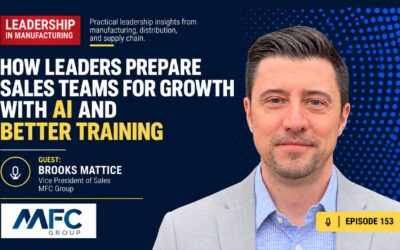
How Leaders Prepare Sales Teams for Growth With AI and Better Training – Episode 153
Brooks Mattice of MFC Group explains how leaders prepare sales teams for growth through training, onboarding, feedback, and AI-supported tools.
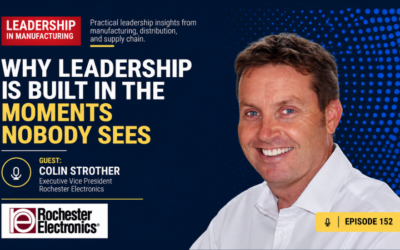
Why Leadership Is Built in the Moments Nobody Sees- Episode 152
Colin Strother, Executive Vice President at Rochester Electronics, joins Sannah Vinding to discuss trust, authenticity, customer commitment, and leading global teams across the electronics industry. They talk about why customers need both digital and personal service, how leaders develop confidence and composure, and what small actions reveal about leadership.