Episode 145
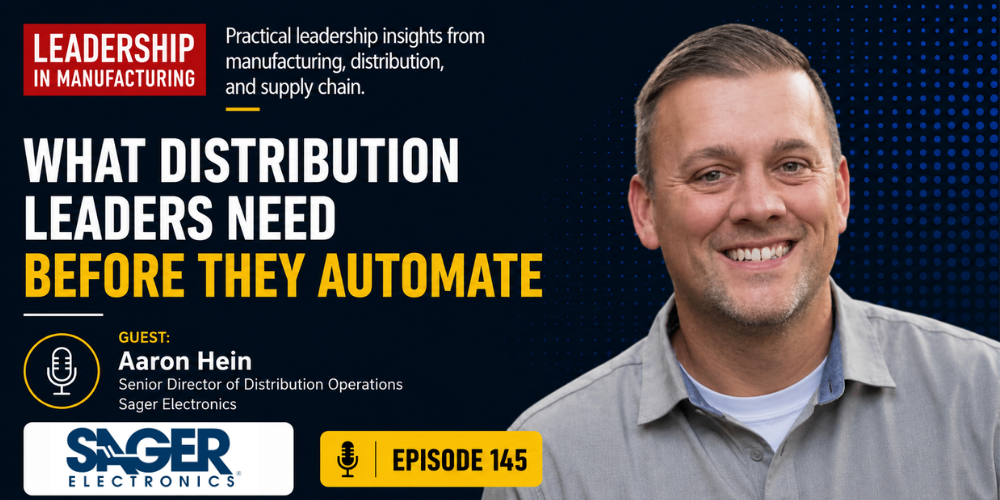
What Distribution Leaders Need Before They Automate
Aaron Hein of Sager Electronics on flexibility, trust, and leading operational change without adding chaos
Episode summary
The short version: Automation can improve operations, but only when leaders understand the work, the team, and the flexibility the business still needs.
In this episode, Aaron Hein explains why he chose a more flexible operational setup at Sager Electronics, how he leads through a major distribution transition, and why trust still determines whether change actually works.
Aaron Hein is the Senior Director of Distribution Operations at Sager Electronics, where he leads operations, logistics, and quality efforts. He brings more than 15 years of experience across distribution, supply chain, continuous improvement, and industrial engineering, including more than a decade at TTI, Inc.
In this conversation, Aaron talks about a decision that many operations leaders are facing right now: when to automate, when to stay flexible, and how to avoid locking the team into a system before the work is fully understood. At Sager, he is helping lead a major operational transition while building a new team, learning the rhythm of the operation, and making sure the system can adapt as the business changes.
The useful part is that Aaron does not treat this as a technology conversation only. He talks about listening before executing, communicating with intention across distance, staying steady when the plan changes, and building enough trust that people can follow a new direction without feeling pushed into it.
This episode is especially relevant for distribution leaders, operations leaders, supply chain teams, and technical leaders who are under pressure to move faster while still protecting quality, trust, and execution.
Questions This Episode Helps Answer
- What should distribution leaders understand before they automate?
- How do you decide when flexibility matters more than a fixed system?
- How can operations leaders build trust during a major site transition?
- What does steady leadership look like when the plan keeps changing?
- Where does AI fit in warehouse and distribution operations today?
- Why does the human side of operations still matter when technology improves?
- How can leaders communicate change without creating more uncertainty?
- What should rising leaders learn before pushing for the next role?
What You’ll Learn
- Why automation should follow operational clarity, not replace it
- How Aaron thinks about flexibility when building a new distribution operation
- Why listening matters before a leader starts executing change
- How to communicate when you do not have every answer yet
- Where AI can help operations today, and where people still need to lead
- Why steady leadership matters during a high-stakes transition
- How leaders can give people room to make mistakes and learn from them
- What younger leaders should know about patience, timing, and opportunity




Key takeaways
Do not automate before you understand what the operation needs
Aaron explained that many people expect a new building to come with more conveyors, new pick technology, and heavier automation. His approach was different. Because Sager was moving work across the country and building a new team, he wanted an operation that could adapt as the team learned the business.
A rigid system can create problems if the business changes two or three years later. Flexibility gives leaders room to respond before the operation is locked into decisions made too early.
“This allowed us to adapt to changes that are happening down the road.”
Change moves faster when trust is already in place
Aaron talked about stepping into the Sager role and realizing that the execution skills that made him successful were not enough on their own. Before he could move projects forward, he had to listen, understand people, and build trust.
That is a practical reminder for leaders in technical environments. A good plan still needs people to believe the person asking them to follow it.
“I needed to listen. And that’s not always the best thing for me, but it’s something I need to practice.”
Leaders cannot disappear when information is incomplete
During the facility transition, Aaron had to communicate across distance with employees who were affected by the move. He said he had to become more intentional because he could not rely on walking the floor and having spontaneous conversations.
The lesson is simple, but not easy. People still need to hear from leadership, even when the update is incomplete.
“I need to communicate in these intervals, even if I don’t have good information or complete information, because they need to hear from me.”
AI can help with decisions, but it cannot read the room
Aaron sees AI as useful when the data is clean and the problem is structured. Slotting inventory, reviewing movement patterns, and supporting decisions are places where AI can help.
But the floor still has people on it. AI cannot know that someone is having a difficult morning, sense tension in a meeting, or understand the human context behind a performance conversation. That work still belongs to leaders.
“There’s still such a human piece of what we do every day.”
Steady leadership matters when everything else is changing
One of the strongest moments in the episode came when Aaron described the surprise of leading through change. He knew how to get from point A to point B, but the variables kept changing.
His job was not to add more motion to the room. It was to be steady enough that the team could keep moving.
“I can’t add chaos to chaos. My leadership needs to be steady.”
The Leadership Question
The real tension in this conversation is that operations leaders are under pressure to modernize, speed up, and automate, while the work itself is still changing underneath them. A system that looks efficient on paper can become a constraint if it is built before the team understands what the operation really needs.
For leaders in distribution, supply chain, logistics, manufacturing, and technical teams, that creates a practical decision. Do you optimize for speed right now, or do you protect enough flexibility for the team to learn, adjust, and build the right process?
The leadership question is: Are you choosing the system that looks efficient today, or the one your team can actually grow into?
If leaders miss this, they risk building rigidity into the operation too early. If they get it right, they create a system that supports the team, protects execution, and gives the business room to adapt.
“The system matters, but the leader still has to know when the team needs flexibility, context, and calm.”
Key Moments From the Conversation
Why each box in distribution carries a bigger story
-
- Aaron starts by explaining what he loves about electronics distribution. A box in a warehouse may look ordinary, but the component inside may end up in an aircraft, a drone, or another critical application. That bigger picture helps teams connect daily work to real-world outcomes.
Listening before executing in a new role
-
- Aaron came into the Sager role with a strong background in execution, cost savings, productivity, and quality improvement. But he quickly recognized that the new role required a different first move. He needed to listen, build relationships, and earn trust before pushing change.
Leading a facility transition with empathy
-
- The move from one facility to another was not just a business decision. It affected people, families, routines, and the identity of a long-standing team. Aaron talks about being honest about the business decision while still showing empathy for the people impacted by it.
Choosing flexibility over automation
-
- When building the new operation, Aaron chose a more manual and flexible setup instead of locking the team into a rigid automation structure too early. The decision was based on the reality of a new team, new processes, and a changing business environment.
Where AI fits in operations today
-
- Aaron sees real value in AI for decision support when the data is good. But he is clear that AI cannot replace the human work of leading a team, reading the room, understanding context, and helping people perform through real-life challenges.
Episode Chapters
- – [~00:00] Introduction to Aaron Hein and Sager Electronics
- – [~00:27] Why electronics distribution connects to the bigger picture
- – [~02:09] What Aaron realized when he stepped into the Sager role
- – [~03:24] Why listening mattered before execution
- – [~05:29] Leading through a facility transition with empathy
- – [~07:00] Communicating with intention across distance
- – [~08:29] Why Aaron chose flexibility over automation
- – [~09:52] Staying steady when plans change
- – [~12:05] Where AI fits in operations today
- – [~15:49] Learning through experience and other people
- – [~16:51] Mistakes, leadership, and giving people room to learn
- – [~21:44] The leadership skills that matter most
- – [~23:59] Advice for younger talent entering the industry
- – [~27:51] What Aaron would tell himself 10 years ago
Practical Tip
Before you automate, map what still needs to stay flexible
Automation is not the problem. The problem is automating before the operation, the team, and the decision points are clear enough to support it.
This week, ask:
- What part of the work is stable enough to systematize?
- What part of the work is still changing month to month?
- Where does the team still rely on judgment, context, or exception handling?
- What would become harder to change if we automated this too early?
- Who needs to be part of the conversation before we lock in the process?
The goal is not to slow progress. It is to make sure the system supports the work instead of trapping the team inside an assumption.
About the guest

Aaron Hein
Senior Director of Distribution Operations at Sager Electronics
Aaron Hein is Senior Director of Distribution Operations at Sager Electronics, where he leads operations, logistics, and quality efforts. He brings more than 15 years of experience in distribution, supply chain, continuous improvement, and industrial engineering across the electronics and manufacturing sectors.
Before joining Sager Electronics, Aaron spent more than 10 years at TTI, Inc., serving as Director of Operations and Director of Continuous Improvement. His background also includes supply chain and industrial engineering roles at Air Vent, Inc. and TTI, where he built deep experience in process optimization, materials flow, operational performance, and quality systems.
Aaron holds an MBA from The University of Texas at Arlington College of Business and a BS in Industrial Engineering from East Texas A&M University. His career reflects a strong focus on improving operational efficiency, strengthening logistics execution, and supporting scalable distribution performance.
Who this episode is for
This episode is built for:
-
-
-
Distribution leaders making decisions about automation and operational design
-
Operations and logistics leaders building or moving facilities
-
Supply chain teams balancing speed, quality, and flexibility
-
Manufacturing and electronics leaders managing change across technical teams
-
Rising leaders learning how trust, patience, and communication shape execution
-
Leaders working with AI, data, and systems while still managing people every day
-
-
What you will be able to do after listening
Leaders who listen to this conversation walk away ready to:
-
-
-
Reframe automation as an operating decision, not only a technology decision
-
Identify where flexibility still matters in a new or changing operation
-
Ask better questions before locking in a system design
-
Communicate change with more consistency, even when answers are incomplete
-
Recognize where AI can support decision-making and where leaders still need to lead
-
Build more trust before asking a team to follow a new direction
-
Lead with more steadiness when plans shift
-
-
You can unsubscribe at any time.*

Sager Electronics is a leading North American distributor of Interconnect, Power, and Electromechanical products, and a trusted provider of custom solutions. With more than 135 years of innovation and service, Sager connects technology and people through its Distributing Confidence business model, combining operational excellence, engineering expertise, and a nationwide network of distribution and service centers.
Learn more about how Sager Electronics delivers quality components and solutions at sager.com
This episode of the Leadership in Manufacturing Podcast is sponsored by Sager Electronics.
Related Episodes
Why Leadership Is Built in the Moments Nobody Sees- Episode 152
Colin Strother, Executive Vice President at Rochester Electronics, joins Sannah Vinding to discuss trust, authenticity, customer commitment, and leading global teams across the electronics industry. They talk about why customers need both digital and personal service, how leaders develop confidence and composure, and what small actions reveal about leadership.
How Distribution Leaders Build Trust as AI Speeds Up Work – Episode 151
Riad Nizam of Master Electronics shares how distribution leaders build trust, culture, communication, and judgment as AI speeds up work.