
The Rules Change. Most Leaders Don’t
82% of startup failures trace back to leadership or management issues, not market problems.
That number holds a familiar sting for anyone who has moved from a startup to an enterprise role. The difference is, in enterprise, failure doesn’t look like closure. It looks like stagnation, frustration, and being slowly sidelined in a role you thought you were hired to excel in.
The skills that made you effective at a startup don’t just stop working in enterprise. They actively work against you. And most leaders figure that out too late.
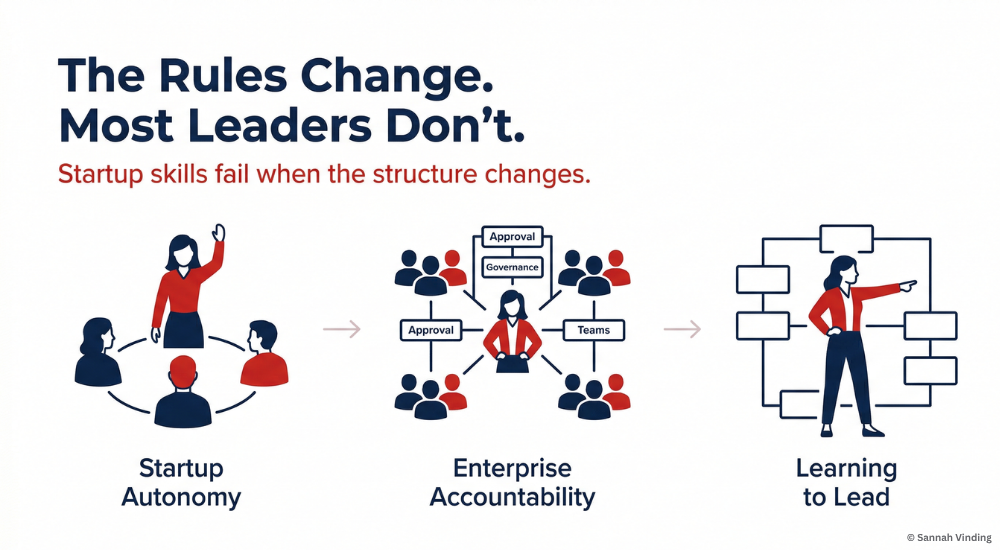
The core difference between startup and enterprise leadership is not ambition or intelligence. Startup leaders are rewarded for fast, autonomous decisions. Enterprise leaders must balance those instincts with governance, cross-functional alignment, and accountability to a much larger system. The transition requires unlearning habits that were once competitive advantages.
What’s Actually Happening
In a startup, leadership means clearing the path fast. You decide. You move. You fail, learn, and adjust. Approval chains are short or nonexistent. The person who sees the problem usually fixes it. You are rewarded for speed, intuition, and willingness to operate on incomplete information.
Enterprise is a fundamentally different operating model. Approval workflows exist for a reason. Governance layers, compliance requirements, regional considerations, and legacy systems don’t bend to speed. What looks like bureaucracy from the outside is control architecture built to manage thousands of people and significant liability.
The transition happens gradually, and most leaders don’t see it coming. You’re promised autonomy when hired. The organization genuinely wants your startup scrappiness. Then you hit the first decision that requires seven approvals. You navigate the first meeting where half the room disagrees but says nothing directly. You realize “let’s just do it” breaks down when one change impacts four departments you don’t manage.
Startup constraints are mostly external: capital, market, team size. Enterprise constraints are internal: process, alignment, risk tolerance. In a startup, poor decisions affect 50 people. In an enterprise, they affect 500 or 5,000. The caution isn’t bureaucratic theater. It’s mathematics.
Knowing that intellectually and accepting it emotionally are two different things.
“The hardest adjustment isn’t the process. It’s accepting that moving slower through the right channels is actually faster than moving fast through the wrong ones.”
Why It’s Harder Than It Looks
The friction isn’t just operational. It’s cultural and psychological. Startup leaders have been rewarded for confidence that borders on recklessness. Enterprise leadership requires that same confidence paired with real humility. You need to believe in your direction while holding it loosely enough to incorporate feedback from people who understand parts of the system you don’t.
This tension is especially sharp in technical industries like manufacturing and electronics, where decisions ripple across supply chains, regulatory compliance, and distributed operations. A manufacturing leader at a startup might change a vendor or production method quickly. In an enterprise, that same decision touches procurement, quality assurance, regulatory teams, and potentially international partners. The approval process isn’t an obstacle. It’s due diligence.
The other layer: startup environments favor flat structure and decentralized decisions. Enterprise environments are hierarchical by necessity, but the best ones distribute authority while maintaining accountability. The leader coming from a startup often reads hierarchy as restriction. In reality, hierarchy in a well-run enterprise can accelerate decisions if you know how to move within it. That requires trust in the framework, not skepticism toward it.
Enterprises that distribute decision-making authority across levels, rather than consolidating it at the top, move faster and make better decisions than those that don’t. But that distribution only works when people trust the structure. Leaders who fought against structure in startups tend to fight it in enterprises too, which means they never learn to use it efficiently.
What It Takes to Actually Get It Right
The transition requires unlearning as much as learning. The leaders who make it consistently do three things.
First, they stay curious about constraints rather than resentful of them. In a recent conversation on the Leadership in Manufacturing Podcast, Chris Lanier described how he navigated this shift across both startup and enterprise environments. His perspective is direct:
“Some of the constraints are meaningful. They’re there for a reason. You have to wield your power carefully.”
Listen to the full conversation with Chris Lanier on the Leadership in Manufacturing Podcast.
Many constraints are real. Some are legacy. That distinction matters enormously. Leaders who succeed make it quickly and focus their energy on the right fights.
Second, they pair trust-first leadership with transparency about structural reality. You can still fully trust your team. You also explain the approval workflows they’ll need to navigate and help them understand why those workflows exist. That honesty is worth more than pretending the constraints aren’t there.
Third, and most important: they stop measuring leadership by their personal speed and start measuring it by their team’s alignment. In a startup, success often means how fast you move. In an enterprise, it means how aligned your team is when you make a decision. That shift in metric changes everything. Cross-functional alignment meetings stop feeling like wasted time and start being the actual work.
Autonomy in a startup feels like freedom. Authority in an enterprise requires accountability. That’s not a failure of enterprise culture. It’s the price of scale.
You can unsubscribe at any time.*
Sannah Vinding

Sannah Vinding
Engineer | GTM, Growth & Product Marketing Leader, Podcast Host
Sannah Vinding is an engineer and go-to-market leader known for bridging technical depth with business clarity across electronics and manufacturing.
Her work sits at the intersection of engineering, product, and commercial teams, translating complex technology, data, and customer insight into clear positioning, strong go-to-market execution, and measurable business impact.
She created Leadership in Manufacturing as an applied leadership platform to explore how leaders actually think, communicate, and make decisions when complexity is high and expectations are rising.
Through candid conversations with executives across manufacturing, distribution, and supply chain, Sannah brings together voices from across the electronics value chain to share lessons that help leaders grow with clarity and confidence.
Available on Your Favorite Podcast Platforms!




Related Episodes

AI Can Speed Up Sales. It Cannot Create Credibility.
AI can help technical sales teams move faster, but credibility still depends on accuracy, context, judgment, and the person who can stand behind the answer.
Leadership in Manufacturing Named a Top Five Podcast for Manufacturers
Leadership in Manufacturing was named a top-five podcast for manufacturers by MillionPodcasts. This recognition reflects the growing need for practical leadership conversations inside electronics, manufacturing, distribution, supply chain, and technical teams.