
When Datasheets Slow Sales
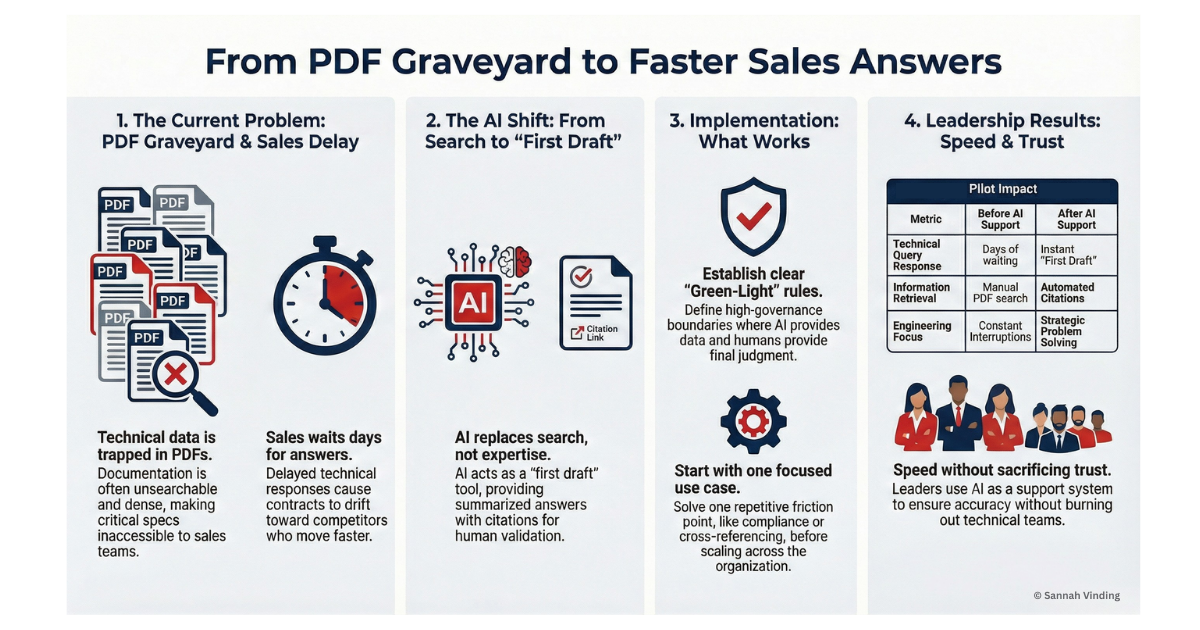
Stop Treating Your Datasheets Like Ancient Scrolls: How AI Turns Technical Noise Into Sales Velocity
There is a specific kind of silence that every leader in the electronics industry knows too well.
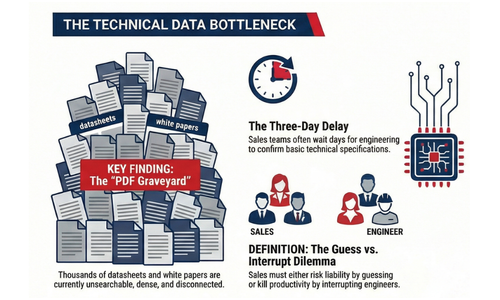
It is the sound of a Sales Manager waiting three days for an engineer to confirm if a specific breaker is rated for 60°C, while a million-dollar contract slowly drifts toward a competitor.
In manufacturing and distribution, speed is the currency, but accuracy is the law. You cannot afford to be wrong about technical specs, but you also cannot afford to be slow.
For years, the solution was simple but painful: Throw more people at the problem. But in Episode 133 of the Leadership in Manufacturing Podcast, Ellen Albright, Marketing & Communications Director at E-T-A Engineering Technology, flips the script. She reveals how leaders are building internal AI agents to turn static technical data into instant answers, without hallucinating the facts or replacing the experts.
If you are tired of your technical data being locked inside a “PDF graveyard,” this is your wake-up call.
The Problem: You Have the Data, But You Can’t Reach It
Most electronics companies are sitting on a goldmine of data: thousands of datasheets, decades of white papers, and endless legacy documentation. The problem? It is unsearchable, dense, and disconnected.
When a customer asks a complex question, your sales team usually has two bad options:
- Guess (and risk a liability nightmare).
- Interrupt a Senior Engineer (and kill their productivity).
Ellen Albright argues that this is not a technology problem; it is a leadership problem. The data exists, but the access is broken.
The Solution: AI is the “First Draft” of the Answer
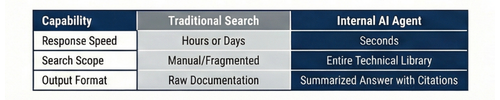
In her conversation with host Sannah Vinding, Ellen details how E-T-A Engineering Technology piloted an internal AI agent to solve this exact bottleneck. But here is the catch: They didn’t try to replace the engineer. They replaced the search.
The AI agent acts as a force multiplier. It scans the technical library in seconds and provides a summarized answer with citations.
“AI should help people get to the right information faster, not replace the need to think critically about the answer.”
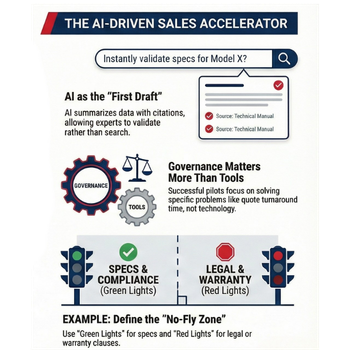
This distinction is critical. The AI provides the “first draft,” allowing the human expert to validate it and move on, rather than starting from zero.
Why Most AI Pilots Fail (And How Yours Won’t)
If you are a leader navigating growth and increased responsibility, you know that “new tools” often equal “new distractions.” Ellen highlights that the difference between a failed experiment and a competitive advantage comes down to one word: Governance.
Many leaders make the mistake of chasing the tool rather than the problem. They ask, “How do we use ChatGPT?” instead of “Why is our quote turnaround time lagging by 48 hours?”
Without clear guidelines, AI quickly turns into a toy. But when you define exactly what the AI is allowed to read and who is allowed to use it, it becomes a powerhouse.
3 Ways Leaders Can Apply This Tomorrow
Whether you are leading a global cross-functional team or stepping into your next executive role, you don’t need to be a software engineer to lead this change. Here are three practical recommendations based on Episode 133 that you can apply immediately to close the gap between technical data and sales execution.
1. Define the “No-Fly Zone” for Your AI
Don’t just hand over the keys. Successful adoption depends on teaching your team what questions AI cannot answer.
- The Recommendation: Create a clear “Green Light / Red Light” protocol.
- Green Light: “Summarize the temperature specs for Product X.”
- Red Light: “Draft a legally binding warranty clause for this client.”
- Why it works: It builds psychological safety. Your engineers won’t fear the tool if they know exactly where its authority ends and theirs begins.
2. Treat “Prompt Engineering” as a Standard Operating Procedure (SOP)
Ellen notes that “training people is as important as training AI”. If your team asks lazy questions, they will get dangerous answers.
- The Recommendation: Stop treating AI interaction as intuitive. It isn’t. Run a workshop for your Sales and Engineering teams on how to query your internal data. Teach them to ask for citations (e.g., “Show me which page of the datasheet this spec came from”).
- Why it works: It forces human validation. When the AI has to “show its work,” the risk of hallucination drops, and trust in the tool rises.
3. Start With One Boring Problem
Resist the urge to transform your entire supply chain overnight. Ellen suggests starting with one specific friction point.
- The Recommendation: Identify the single most repetitive question your engineering team receives from sales. Is it compliance certifications? Is it cross-referencing competitor parts? Build an agent to solve that specific thing.
- Why it works: Small wins build momentum. When your sales team realizes they can get an answer in 10 seconds instead of 10 hours, adoption becomes organic, not forced.
The Bottom Line: Technology Changes, Trust Remains
At the end of the day, AI is just the delivery mechanism. The real asset is your team’s judgment.
As Sannah Vinding summarizes:
“AI can help us move faster, but leadership is still responsible for clarity, trust, and accountability.”
Your goal as a leader in 2026 isn’t to automate your workforce; it’s to clear the path so they can do the work they were hired to do.
Ready to hear how E-T-A Engineering Technology actually built this? Dive into the full conversation to hear the tactical details on governance, implementation, and the surprising results of their pilot program.
👉 Listen to Episode 133: How Leaders Turn Technical Data Into Faster Sales Answers Using AI
You can unsubscribe at any time.*
Sannah Vinding

Sannah Vinding
Engineer | GTM, Growth & Product Marketing Leader, Podcast Host
Sannah Vinding is an engineer and go-to-market leader known for bridging technical depth with business clarity across electronics and manufacturing.
Her work sits at the intersection of engineering, product, and commercial teams, translating complex technology, data, and customer insight into clear positioning, strong go-to-market execution, and measurable business impact.
She created Leadership in Manufacturing as an applied leadership platform to explore how leaders actually think, communicate, and make decisions when complexity is high and expectations are rising.
Through candid conversations with executives across manufacturing, distribution, and supply chain, Sannah brings together voices from across the electronics value chain to share lessons that help leaders grow with clarity and confidence.
Available on Your Favorite Podcast Platforms!




Related Episodes
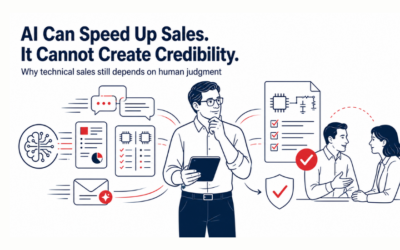
AI Can Speed Up Sales. It Cannot Create Credibility.
AI can help technical sales teams move faster, but credibility still depends on accuracy, context, judgment, and the person who can stand behind the answer.
Leadership in Manufacturing Named a Top Five Podcast for Manufacturers
Leadership in Manufacturing was named a top-five podcast for manufacturers by MillionPodcasts. This recognition reflects the growing need for practical leadership conversations inside electronics, manufacturing, distribution, supply chain, and technical teams.